


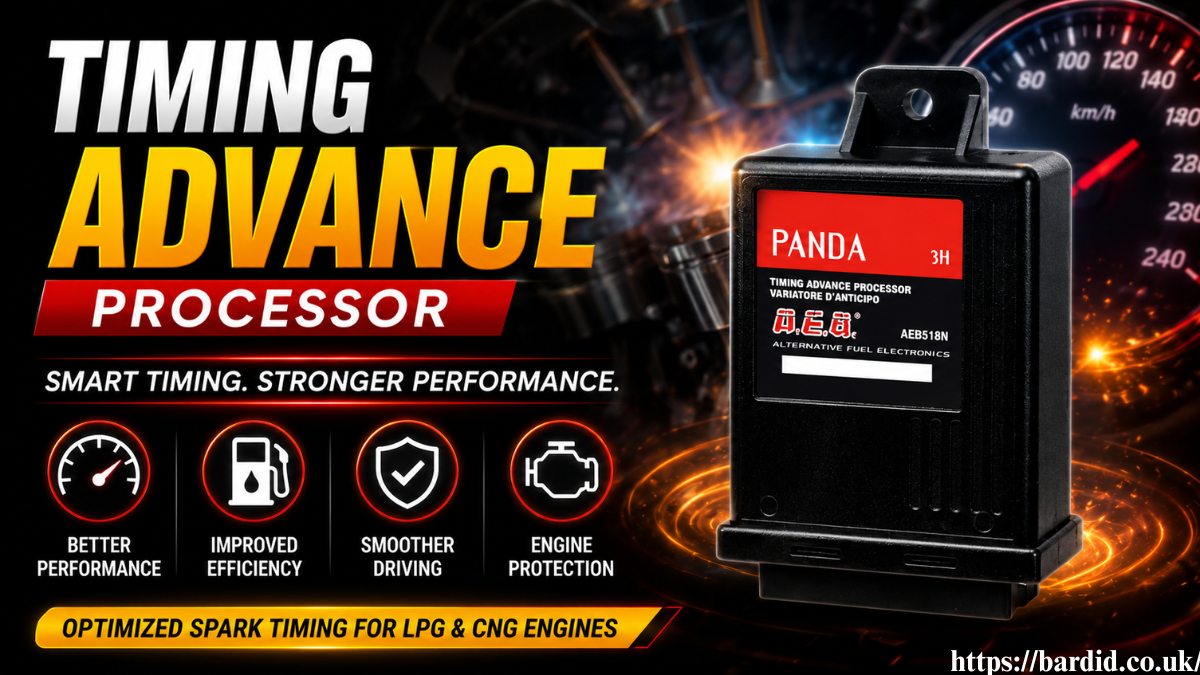
A Timing Advance Processor is an electronic control unit that adjusts ignition timing when a petrol engine runs on LPG or CNG. It helps the spark fire earlier, so the fuel-air mixture burns closer to the right point in the engine cycle.
For most bi-fuel vehicles, the right timing advance processor for LPG or CNG can improve throttle response, reduce backfiring, support better fuel efficiency, and make gas-mode driving feel closer to petrol-mode performance.
What Is a Timing Advance Processor in Simple Terms?
A Timing Advance Processor, also called a TAP timing advance processor, is a small electronic unit used in a bi-fuel vehicle to change spark advance when the engine runs on LPG or CNG. AEB defines timing advance processors as electronic control units that change the original spark advance of the engine when it runs on CNG or LPG.
In simple terms, petrol timing is not always ideal for gas fuel. LPG combustion and CNG combustion behave differently from petrol, so the spark may need to happen earlier. That is where an ignition timing advance processor helps.
Ignition timing means the exact moment the spark plug fires before the piston reaches the top of its compression stroke.
Why LPG and CNG Engines Need Better Spark Advance
LPG and CNG often need different combustion timing from petrol. When the spark timing is too late in gas mode, the engine can feel slow, weak, or rough. This is why many drivers notice LPG car performance issues or CNG car power loss after a petrol to LPG conversion or petrol to CNG conversion.
From what I’ve seen, the problem is often blamed on the LPG conversion kit, CNG conversion kit, injector quality, or reducer pressure. Those can matter, but gas mode ignition timing is often missed. If the petrol ECU keeps using timing behavior designed mainly for petrol, the fuel-air mixture may not burn at the best moment.
Clear fact: A timing advance processor for car tuning is not a power chip; it is a timing correction device for alternative fuel system performance.
How the Timing Advance Processor Works in Real Use
The basic timing advance processor working process is simple. The TAP reads or intercepts the ignition signal, crankshaft position sensor signal, or related engine signal. Then it adjusts the signal so the petrol ECU or ignition system fires earlier while the engine runs on LPG or CNG.
In real use, the processor usually activates from the gas valve signal. When the car switches back to petrol, the processor should stop advancing the timing and allow the petrol mode’s original timing to return. AEB also notes that timing advance processors can reset the original spark advance when running on petrol and include emergency cut-out support in case of problems. (AEB)
Timing Advance Processor Benefits for LPG and CNG Cars
The main timing advance processor benefits are better pickup, cleaner acceleration, improved engine torque, and reduced hesitation in gas mode. Some vehicles also show better fuel efficiency because the combustion event happens closer to the ideal point.
A timing advance processor for CNG can be especially useful because CNG engines may feel weaker after conversion if the timing is not adjusted. A timing advance processor for LPG can also help, especially in older distributor engines, aftermarket LPG system setups, and cars that feel lazy at low speed.
The best timing gain is not always the highest degree of advance; it is the safest degree that improves response without knocking.
Signs Your LPG or CNG Car May Need a Timing Advance Processor
A weak gas-mode engine usually gives clues. Common signs include poor throttle response, rough idle, backfiring, engine knocking, slow uphill pull, and weak acceleration after conversion. These problems do not always mean the timing advance processor installation is required, but they do mean ignition timing should be checked.
A common mistake is installing a TAP before confirming the basics. The mechanic should first check spark plugs, ignition coil health, wiring, gas pressure, injector behavior, petrol ECU faults, and engine condition. If those are fine and the car still feels weak on LPG or CNG, then a TAP may be the missing part.
Definition: Backfiring is a combustion problem where the mixture burns in the wrong place or at the wrong time.
Main Types of Timing Advance Processors by Ignition System
The right TAP depends on timing advance processor compatibility. Older cars may use a distributor and ignition coil. Some use electronic ignition with a module. Modern fuel injection engine setups often use a CKP sensor, a Hall effect sensor, an inductive sensor, a camshaft signal, an LPG ECU, a CNG ECU, and a diagnostic connector.
AEB lists models such as Cobra for inductive PMS sensor systems and Panda for Hall effect PMS sensor systems, with support for 3, 4, 5, 6, and 8-cylinder cars in certain configurations. (AEB)
| TAP Type | Best Fit | Important Check |
| Breaker point TAP | Older distributor engine | Distributor and ignition coil wiring |
| Electronic distributor TAP | Coil and module systems | Ignition module signal |
| Inductive CKP TAP | Inductive crankshaft position sensor | Signal waveform and polarity |
| Hall effect TAP | Digital Hall effect sensor | 5V or 12V signal type |
| Programmable timing advance processor | Modern LPG/CNG tuning | Software setup and road testing |
AEB vs STAG vs Universal Timing Advance Processor
AEB is strongly connected with the timing advance processor history and model variety. Its product range covers different ignition systems, including Cobra, Spider, Puma, Wolf N, Shark, and Panda families. STAG TAP-03 is more software-oriented and designed for LPG/CNG vehicles as an auxiliary device to improve fuel-air mixture ignition efficiency.
STAG TAP-03 also separates sensor use clearly. STAG TAP-03/1 is designed for inductive crankshaft position sensor engines, while STAG TAP-03/2 is designed for digital crankshaft position sensor engines. It also supports up to two electronic camshaft position sensors, depending on setup.
The best timing advance processor is the one that matches the ignition system, not simply the most popular brand.
Timing Advance Processor Installation and Workshop Workflow
A safe timing advance processor installation starts with identification, not wiring. The mechanic should confirm the ignition system, CKP sensor type, cylinder count, gas valve signal, TPS signal, grounding point, and whether a vehicle-specific harness is available.
The real workflow should include timing light testing, oscilloscope testing, emergency bypass testing, and a road-tested gas mode check. The timing advance processor wiring should be protected from heat, water, oil, and poor grounding. STAG installation guidance also highlights the importance of a proper power supply and a correct connection to the crankshaft position sensor circuit.
Identify the signal, install the TAP, set conservative advance, test in petrol mode, test in gas mode, then fine-tune under load.
Common Mistakes and Timing Advance Processor Troubleshooting
The most common timing advance processor troubleshooting issues come from wrong sensor matching, poor wiring, unstable power, incorrect TPS threshold, and too much spark advance. A no-start due to incorrect wiring is a real risk, especially on CKP-sensor engines.
A common mistake is ignoring idle advance disabled settings. Some engines do not like extra advance at idle or during deceleration. Another mistake is skipping the emergency connector for TAP bypass. If the processor fails or the settings are wrong, the emergency connector lets the vehicle return to normal operation for diagnosis.
Sensor compatibility means the TAP can correctly read and modify the vehicle’s original ignition or crankshaft signal.
Best Timing Advance Processor Setting for LPG and CNG
A timing advance processor setting may use values such as 6, 9, 12, or 15 degrees, depending on the model and engine. STAG documentation for TAP-03 wiring references selectable ignition advance values such as 6, 8, 10, and 12 degrees in switch-based setup.
The spark advance for CNG engine setups is often different from the spark advance for LPG engine setups. CNG may need more advanced technology in some vehicles, but that does not mean every CNG car should be pushed high. The safest method is advance setting adjusted gradually, then checked under real load.
What Competitors Miss About Timing Advance Processors
Many articles explain what a TAP is, but they miss the practical buying decision. The real issue is not only whether you need a timing advance processor price quote. The real issue is whether your car needs a Hall effect compatible unit, an inductive CKP unit, a programmable timing advance processor, or a simpler, older ignition model.
Another missed angle is content use across platforms. A blog should explain how the timing-advance processor works. A video should show before and after performance, timing light readings, and be checked with oscilloscope proof. Social content should focus on simple symptoms like weak pickup, backfire reduced after tuning, and CNG acceleration improvement.
Timing Advance Processor Trends in 2026
The 2026 trend is smarter calibration, not blind advance. More installers are moving toward programmable timing advance processor options, software setup, Bluetooth-supported diagnostics, and cleaner integration with LPG ECU and CNG ECU systems. STAG TAP-03 already reflects this direction with AC STAG software support and Bluetooth Next interface support.
Google Search and Google AI Overviews also reward clear entity relationships. That means a strong article should connect Timing Advance Processor, ignition timing, CKP sensor, Hall effect sensor, inductive sensor, petrol ECU, gas valve signal, TPS signal, engine knocking, and fuel efficiency in a natural way.
Is a Timing Advance Processor Worth It?
A Timing Advance Processor is worth it if your LPG or CNG car runs well on petrol but feels weak, late, rough, or inefficient in gas mode. It is especially useful for taxi CNG conversion, fleet LPG vehicles, older distributor engines, and modern engines where timing can be safely corrected with the right TAP.
It may not be worth it if the car already has strong gas-mode performance, the ECU handles ignition timing well, or the engine has unresolved mechanical faults. The TAP should solve a timing problem, not hide a bad conversion.
Final answer: A timing advance processor is worth buying when correct ignition timing improves real driving behavior, fuel use, and engine response after installation.
Conclusion
A Timing Advance Processor helps LPG and CNG engines run closer to their ideal ignition timing. It supports better LPG throttle response, CNG acceleration improvement, smoother combustion timing, and safer alternative fuel tuning when installed correctly.
The right choice depends on timing advance processor compatibility, not guesswork. Match the TAP to the crankshaft position sensor, ignition system, cylinder count, and gas setup. Then test it with a timing light, an oscilloscope, a road route, and an emergency bypass check.
For 2026, the smartest approach is simple: choose a proven AEB, STAG, Europegas, or compatible programmable TAP, install it through proper workshop installation, and tune it based on real engine response after installation.
You May Also Like PLG Supplies
FAQs
Can a Timing Advance Processor damage my engine?
Yes, a Timing Advance Processor can cause engine problems if it is installed incorrectly or set with too much spark advance. The hidden risk is not the device itself but poor tuning, wrong sensor matching, or ignoring engine knock under load.
Should I avoid a Timing Advance Processor if my LPG or CNG car already runs well?
Yes, you should avoid adding one if your car already has smooth gas-mode performance, good pickup, and stable fuel economy. A TAP should fix a real ignition timing gap, not be used as a random upgrade.
What happens if a Timing Advance Processor fails while driving?
If the processor fails, the engine may misfire, lose power, run rough, or switch poorly between petrol and gas. A good setup includes an emergency connector or bypass so the car can return to the original petrol ECU timing for safe diagnosis.
Does a Timing Advance Processor always improve mileage?
No, a Timing Advance Processor does not always improve mileage because fuel economy depends on timing, engine condition, gas quality, driving style, and conversion kit tuning. In some cars, the main benefit is better throttle response rather than lower fuel use.
Will a Timing Advance Processor affect my engine in the long term?
Yes, it can affect long-term engine health positively or negatively, depending on setup quality. Correct ignition timing may reduce incomplete combustion and backfiring, while excessive advance can increase knocking stress on pistons, valves, and bearings.
