
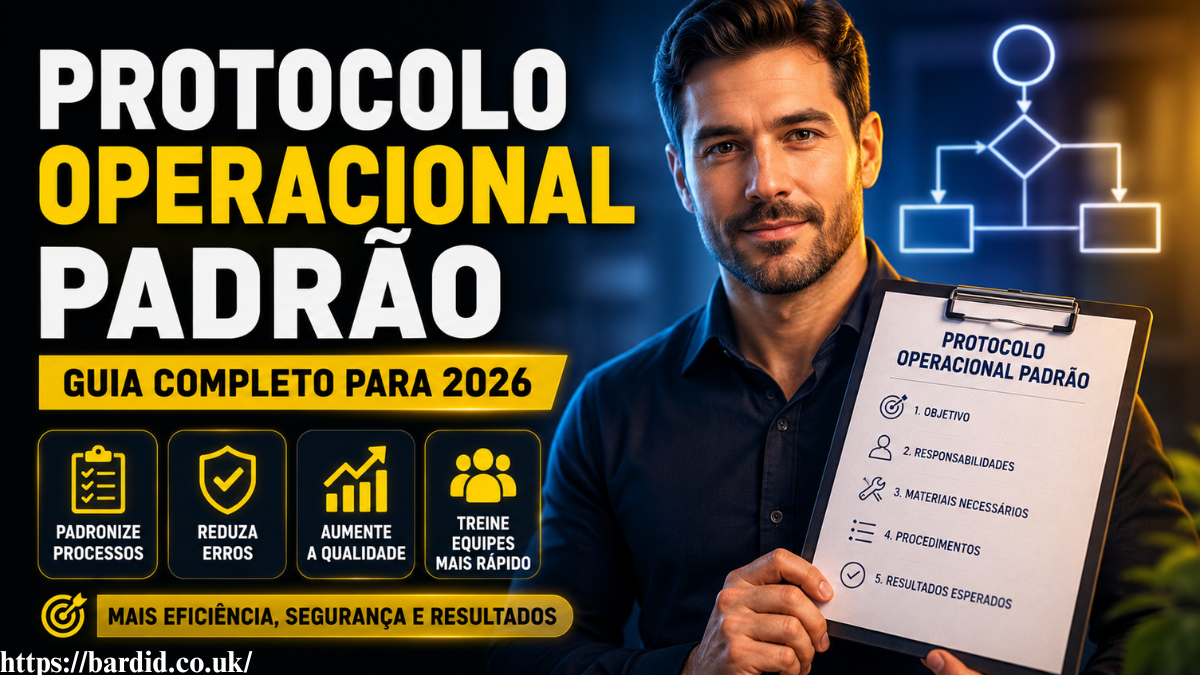
Protocolo operacional padrão is a step-by-step operational document that explains how a task should be completed correctly, safely, and consistently. It helps businesses reduce errors, train employees faster, improve quality control, and keep daily operations organized.
What is Protocolo operacional padrão in simple terms?
Protocolo operacional padrão means a formal operating guide used to standardize repeated tasks. It is closely related to a Standard Operating Procedure, also called SOP, and in Portuguese it is also known as Procedimento Operacional Padrão.
A POP tells employees what to do, who is responsible, which tools are required, what steps must be followed, and what result should be achieved. A clear operational procedure removes guesswork from daily operations.
A POP is a documented process designed to make routine work repeatable and measurable.
From what I’ve seen, businesses often create POPs after mistakes happen. A better approach is to document important workflows before errors affect customers, safety, compliance, or revenue.
Why POP matters for modern business workflows
A POP matters because teams need process consistency. When every employee follows a different method, the business faces delays, confusion, quality issues, and repeated corrections.
In real use, a POP is especially helpful for growing teams. A small company may manage work through verbal instructions at first, but as the team grows, informal communication becomes risky. Workflow documentation keeps everyone aligned.
Business process standardization helps companies maintain quality even when teams, tools, or employees change.
For example, a customer service process can include how to receive a complaint, check order details, respond to the customer, escalate the issue, and close the case. This keeps service quality consistent.
How a Standard Operating Procedure improves quality and safety
A Standard Operating Procedure improves quality control by defining the exact steps required for a task. It also supports safety standards because employees know which precautions, tools, and approvals are required.
In healthcare POP workflows, this may involve patient documentation, hygiene procedures, or medication handling. A manufacturing process, it may involve machine use, inspection, and safety checks. An administrative workflow, it may involve document control, approvals, and record keeping.
Quality assurance improves when every task has a clear standard, a responsible person, and a review method.
A common mistake is writing a POP that looks formal but does not match the real workflow. If employees cannot follow it during daily operations, the document becomes useless.
Main components every Protocolo operacional padrão should include
A strong Protocolo operacional padrão should include a title, purpose, scope, responsibilities, required materials, step-by-step instructions, quality checks, corrective actions, references, and revision history.
The purpose explains why the document exists. The scope explains where it applies. Responsibilities show who performs, checks, and approves the work. The step-by-step instructions explain the actual process.
Revision history is important because outdated procedures can create compliance and performance risks.
What competitors often miss is the corrective action section. Many articles explain how to write normal steps, but they do not explain what employees should do when something goes wrong. In 2026, this matters because workflows often depend on tools like Google Docs, Microsoft Word, Notion, Trello, Asana, Monday.com, and Process Street.
How to create a POP step by step
To create a POP, start with a task that is repeated often and affects quality, compliance, safety, or customer experience. Then observe how the task is currently done in the real workflow.
Next, speak with the employees who perform the task. They understand small problems, shortcuts, missing tools, and real workflow delays better than anyone else. After that, write the steps clearly, test the process, collect feedback, approve the document, and schedule a process review.
A tested process is stronger than a document written only from theory.
For example, a blog publishing POP may include keyword research through Google Search, content planning, writing, editing, image creation in Canva, SEO checks, WordPress upload, internal linking, meta description, final preview, and publishing approval.
POP vs checklist: What is the real difference?
| Area | POP | Checklist |
| Purpose | Explains the full operational procedure | Confirms tasks are completed |
| Detail | Includes steps, roles, tools, risks, and standards | Usually short and task-based |
| Best use | Training, compliance, audits, quality control | Daily reminders and quick checks |
| Responsibility | Defines who performs and approves work | Often does not define ownership |
| Corrective action | Should explain what to do if issues happen | Usually does not include issue handling |
A checklist can support a POP, but it does not replace it. The POP explains the process, while the operational checklist confirms whether the task was completed correctly.
Common mistakes when creating a Protocolo operacional padrão
A common mistake is copying a POP template from another business without adapting it. A copied document may look professional, but it may not fit your team, tools, customer service process, safety procedures, or regulatory compliance needs.
Another mistake is making the document too long. Employees avoid procedures that feel difficult to read. A good POP should be detailed enough to guide the task but simple enough to use during work.
A practical implementation succeeds when employees can follow the POP without constant supervision.
Other risks include unclear roles, missing review dates, no audit trail, outdated screenshots, poor staff adoption, and no performance tracking. In 2026, businesses should treat POP documents as living workflow tools, not one-time files.
How POP supports employee training and onboarding
A POP supports employee training because it gives new staff a clear guide to follow. Instead of relying only on verbal instructions, HR teams, managers, and operations managers can use POPs during onboarding.
This helps new employees understand workplace routine, internal procedures, tools, quality expectations, and approval steps. It also reduces repeated questions for senior staff.
Employee onboarding becomes faster when training is connected to documented workflows.
In real use, one POP can become multiple training assets. A company can turn a POP into a blog guide, a short training video, a social media carousel, and an internal checklist. This multi-platform angle helps businesses use the same knowledge across blog, video, and social content.
How workflow documentation supports audits and compliance
Workflow documentation supports audit readiness because it shows that the business has defined and controlled processes. Compliance officers, quality managers, and auditors use POPs to check whether procedures are being followed correctly.
In regulated environments, POPs may support ISO, Anvisa, Sebrae guidance, compliance management, documentation control, risk management, and continuous improvement.
An audit trail is easier to maintain when procedures are documented, reviewed, and updated regularly.
For example, pharmacy procedures may cover receiving products, checking storage conditions, cleaning procedures, and record control. Clinic management POPs may cover appointments, patient records, hygiene, and safety procedures.
How software and automation improve POP management
Software improves POP management by making documents easier to create, update, assign, and track. Google Docs and Microsoft Word are useful for simple documentation. Notion, Trello, Asana, Monday.com, and Process Street help connect POPs with workflow execution.
ChatGPT can help draft a first version, but human review is still important. Managers and employees must check whether the document reflects the actual workflow.
Digital POP systems reduce the risk of outdated procedures being used by employees.
In 2026, businesses can connect POPs with automation. For example, when a task is completed in Trello, the next approval can be assigned. When a form is submitted, a manager can receive a notification. This turns documentation into active process management.
Is Protocolo operacional padrão worth it for small businesses?
Yes, Protocolo operacional padrão is worth it for small businesses because it saves time, reduces mistakes, improves team training, and protects service quality.
Small businesses should not try to document everything at once. The smarter decision is to start with the most important workflows, such as customer complaints, invoice handling, employee onboarding, order processing, content publishing, cleaning procedures, and safety procedures.
A small business should create POPs first for tasks that affect money, customers, compliance, or risk.
This gives business owners and managers more control without making the company overly complicated.
Future trends: How POP will change in 2026
In 2026, POP documents are becoming more digital, visual, and connected to automation. Businesses are moving away from static files and toward live workflow documentation that can be updated quickly.
AI Overviews, AEO, E-E-A-T, and entity recognition also influence how educational POP content should be written online. Content should answer questions clearly, use natural entities, and explain relationships between concepts like quality management, process standardization, employee training, and compliance.
AEO-friendly content is structured so AI systems can extract clear answers quickly.
The future of POP is not only documentation. It is knowledge management, workflow intelligence, and continuous improvement.
Final thoughts on building a practical POP
A practical Protocolo operacional padrão helps people complete work correctly, consistently, and safely. It supports process standardization, quality control, employee training, compliance, audit readiness, and operational efficiency.
The goal is not to create a perfect document on the first attempt. The goal is to create a useful process that can be tested, improved, reviewed, and followed in a real workflow.
A POP becomes valuable when employees actually use it in daily operations.
For 2026, the best approach is to keep the language simple, connect the POP with real workflow, include corrective actions, use the right tools, and review the document regularly. This makes Protocolo operacional padrão a practical business asset, not just another file stored in a folder.
You May Also Like AC Milan vs SSC Bari Timeline
FAQs
Should I avoid using a Protocolo operacional padrão if my team is small?
No, small teams should not avoid it if the task affects quality, customers, money, or compliance. A simple POP can prevent work from depending on one person’s memory and make growth easier later.
What is the hidden risk of using an outdated POP?
An outdated POP can make employees follow steps that no longer match the real workflow. This can create compliance issues, repeated mistakes, tool confusion, and audit problems.
Is a POP the same as a checklist?
No, a POP is not the same as a checklist. A checklist confirms that tasks were completed, while a POP explains the full process, responsibilities, tools, risks, and corrective actions.
What happens if employees do not follow the POP?
If employees ignore the POP, the business loses consistency and cannot prove the process was controlled. The real failure is usually poor training, unclear ownership, or a document that does not match daily work.
Can a Protocolo operacional padrão become harmful over time?
Yes, it can become harmful if it is never reviewed or updated. A POP should change with new tools, team roles, regulations, customer expectations, and workflow improvements.
