


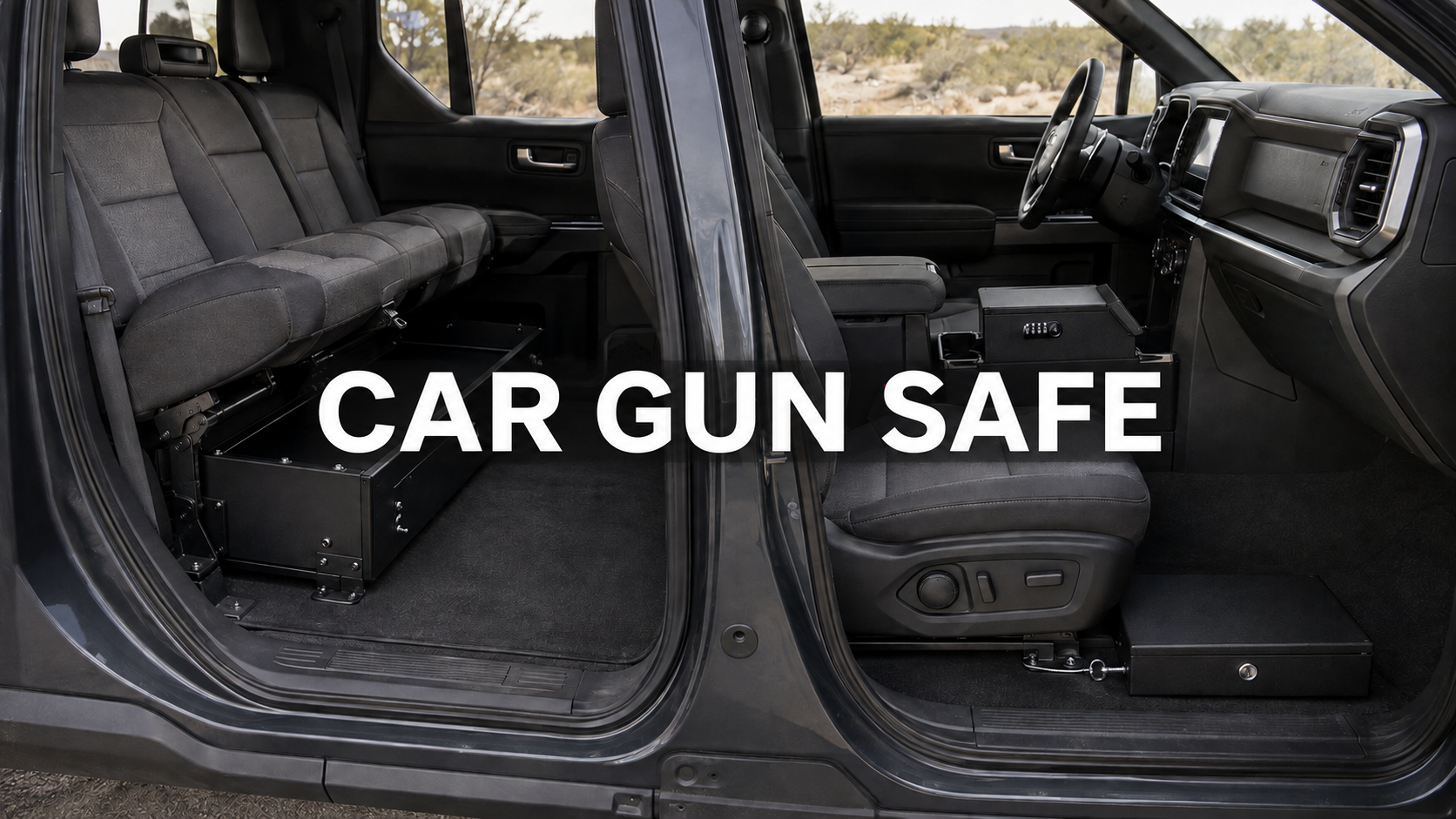
The best car gun safe is one that fits your firearm and vehicle, remains hidden, attaches to a structural point, and complies with the laws where you travel. For portable storage, the Vaultek LifePod 2.0 is lightweight and weather-resistant. The Hornady Alpha Elite offers stronger steel construction at a lower price, while Console Vault is better for a discreet, vehicle-specific installation. Truck owners needing more capacity should consider a fitted rear under-seat lockbox. No vehicle safe is theft-proof, so use it for temporary storage, keep it out of sight, and avoid leaving a firearm in your vehicle longer than necessary.
| Safe Model | Best For | Lock Type | Construction | Weight | Attachment |
|---|---|---|---|---|---|
| Vaultek LifePod 2.0/LifePod 20 | Portable travel | Keypad and backup key | Proprietary composite | 3.3 lb | 48-inch cable |
| Hornady Alpha Elite | Budget under-seat storage | Barrel key | 16-gauge steel | 5.3 lb | 3-foot security cable |
| Console Vault | Factory-style console fit | Key, combination, or electronic | 12-gauge steel product line | Varies | Factory console mounting |
| Fort Knox Auto Pistol Box | Heavy-steel mechanical security | Simplex push-button | 10-gauge body | 14 lb | Four bolt holes |
| Tuffy 353-01 RAM Lockbox | High-capacity truck storage | Double-bitted key | Welded steel | Not listed by manufacturer | Factory hardware |
Disclosure: This is a research-based comparison using current manufacturer specifications, published safety information, and recurring owner concerns. These products were not physically tested for this article. If affiliate links are added, the publisher may earn a commission without changing the price paid by the reader.
Why Use a Dedicated Car Gun Safe?
A locked car is not a locked firearm container. Once someone breaks a window, an unlocked glove box or standard center console can often be opened within seconds. These compartments may keep a firearm out of sight, but most are not designed to resist prying or prevent the entire container from being removed.
Firearms stolen from parked vehicles are a serious concern in the United States. Research published in 2025 found 2,465 firearms were reported stolen from vehicles in San Antonio during 2024. Handguns accounted for most of those thefts. National analyses have also found that parked vehicles have become a leading source of stolen guns. [Insert Link to Authoritative Source Here]
A dedicated vehicle safe adds three useful barriers:
- It prevents casual access by children, passengers, valets, or other unauthorized people.
- It makes a quick smash-and-grab theft more difficult.
- It may help satisfy locked-container requirements when the safe and storage method meet applicable laws.
These benefits have limits. A lightweight portable lockbox can be carried away if it is not tethered. A security cable can be cut by a prepared thief. Even a bolted steel vault can eventually be defeated with enough time and tools.
For that reason, a portable vehicle firearm safe should be treated as temporary security. If you can lawfully take the firearm with you or store it securely at home, those options generally expose it to less vehicle-theft risk.
How These Car Gun Safes Were Selected
The recommendations were divided by use case rather than placing every product in one misleading security ranking. A portable composite case and a 50-pound truck lockbox solve very different problems.
Products were assessed according to:
- Current manufacturer availability
- Verified exterior and interior measurements
- Firearm fit information
- Lock type and backup entry
- Material and steel thickness
- Cable, bolt, or factory mounting options
- Concealment inside the vehicle
- Electronic power requirements
- Weather resistance
- Recurring fit and usability problems reported by owners
- Manufacturer-stated safety certifications where available
Steel gauge was considered, but it was not used as the only measure of security. Door design, latch construction, hinges, lock protection, mounting, and visibility also affect how easily a safe can be removed or forced open.
No manufacturer can guarantee that a firearm will fit based only on broad labels such as “compact,” “full-size,” or “1911 size.” Accessories can substantially change the required space. Measure the firearm in the exact storage configuration before ordering.
Top Five Best Car Gun Safes for Different Vehicles
1. Vaultek LifePod 2.0: Best Portable Vehicle Firearm Safe
The current product page calls this model the LifePod 20, although many buyers still search for it as the Vaultek LifePod 2.0. It is designed for people who want one lockable case for a car, hotel, rental vehicle, and other temporary storage situations.
Unlike traditional steel lockboxes, the LifePod uses an impact-resistant proprietary composite. That keeps its weight at 3.3 pounds and provides resistance to water, dust, and ordinary travel conditions. It is not a fire-rated safe and should not be compared with a permanently mounted steel vault.
Verified specifications:
- Exterior: 12.25 × 8.5 × 2.875 inches
- Interior: 9.625 × 7.25 × 2.125 inches
- Weight: 3.3 pounds
- Firearm fit: One handgun measuring up to 9.25 inches long
- Lock: Touch-activated electronic keypad
- Backup access: Two manual keys and a backup power port
- Power: One 9V alkaline battery
- Attachment: Included 48-inch steel cable
The removable tray can organize a subcompact handgun and smaller everyday-carry items. For a full-size handgun, the tray may need to be removed. Length alone does not guarantee fit; a red-dot sight, tall sights, weapon light, or attached holster may exceed the 2.125-inch internal height.
The security cable lets you loop the case around an appropriate fixed seat structure. Check that the cable cannot interfere with seat rails, wiring, airbags, motors, or heating components.
Best for: Travellers, rental-car users, and people who need to move the same lockbox between vehicles.
Skip it if: You need thick steel, permanent installation, or stronger resistance to cutting and prying.
The keypad requires a separate locking action after closing. Build the habit of confirming that the case is locked before leaving the vehicle.
2. Hornady Alpha Elite: Best Budget Under-Seat Car Gun Safe
The Hornady Alpha Elite is a straightforward steel lockbox without batteries, biometric sensors, or electronic controls. Its low profile works well beneath many vehicle seats, provided there is enough clearance for the box and its lid.
Its 16-gauge steel housing is strengthened with a pry-resistant security band and a dual-crossbar latch. The included three-foot cable is rated by Hornady at 1,500 pounds and attaches through a space-saving receiver.
Verified specifications:
- Exterior: 10.25 × 8 × 2.75 inches
- Weight: 5.3 pounds
- Lock: Circular barrel key
- Construction: 16-gauge steel
- Attachment: Three-foot steel security cable
- Capacity: One 1911-size pistol or a revolver with a four-inch barrel
There is a specification discrepancy worth knowing. Hornady’s current product page lists interior dimensions of 9.75 × 7.5 × 2.25 inches, while its downloadable Alpha Elite manual lists 8.5 × 7.5 × 2.25 inches. Confirm the current usable length with Hornady before purchasing for a handgun longer than 8.5 inches.
Hornady states that the Alpha Elite meets ASTM F2456 requirements and is listed as a California-approved firearm safety device. Certification does not make it theft-proof or automatically legal for every storage situation.
Best for: Short-term under-seat storage without batteries or electronic-lock maintenance.
Skip it if: You require keyless entry, room for multiple handguns, or permanent bolt-down installation.
The barrel key is simple, but losing both keys can be a serious problem. Hornady states that it does not supply replacement barrel keys for security reasons. Store the second key securely outside the vehicle.
3. Console Vault: Best Handgun Safe for a Car Console
Console Vault creates vehicle-specific steel inserts that mount inside factory center consoles. The main benefit is concealment. The safe resembles part of the original interior and cannot simply be pulled from beneath a seat.
The company offers fitments for selected Ford, Chevrolet, GMC, Toyota, Ram, Jeep, and other vehicles. Its in-vehicle safes use 12-gauge steel, but dimensions and capacity vary by model.
For example, the Console Vault for a 2025–2026 Ford F-150 with a 12.25-inch full-floor console lists:
- Interior: 13 × 11.4 × 8.8 inches
- Lid opening: 6.3 × 7.9 inches
- Construction: Heavy-gauge cold-rolled plate steel
- Lock choices: Barrel key, three-digit combination, four-digit combination, Elite combination, or electronic options
- Installation: Approximately 10–15 minutes using the factory-console location
- Weight: Not published on the current product page
- Handgun capacity: Not officially rated; depends on firearm size, holster, accessories, and lid opening
The internal volume may hold more than one handgun, but buyers should not estimate capacity from volume alone. The lid opening can be much smaller than the full interior, which may prevent a large handgun or bulky holster from passing through comfortably.
Console compatibility is extremely specific. Two trucks from the same model year may have different console lengths or interior layouts. Measure the console and confirm the make, model, year, trim, seat configuration, and console style before ordering.
Best for: Drivers who want a discreet, integrated safe without a visible cable.
Skip it if: You change vehicles frequently, need portable storage, or use the console for everyday items.
A console vault offers better removal resistance than a loose box, but it still should be described as a theft deterrent. It also consumes most or all of the usable factory-console space.
4. Fort Knox Auto Pistol Box: Best Heavy-Steel Mechanical Option
The Fort Knox Auto Pistol Box is substantially heavier than most portable vehicle lockboxes. It combines a 10-gauge steel body with a 3/16-inch plate door and a Simplex mechanical push-button lock.
There are no batteries, scanners, apps, or charging cables. The mechanical lock is useful for buyers who prefer predictable operation and are willing to accept a larger, heavier installation.
Verified specifications:
- Exterior: 6 × 9.5 × 5 inches
- Interior: 4.75 × 8.5 × 4 inches
- Weight: 14 pounds
- Body: 10-gauge steel
- Door: 3/16-inch steel plate
- Lock: Simplex mechanical push-button
- Mounting: Four pre-drilled 3/8-inch holes
- Capacity: Manufacturer does not state a maximum handgun count
The unusual internal proportions make measurement essential. An 8.5-inch internal length may accommodate many compact and medium-size pistols, but the usable space depends on orientation, grip width, sights, accessories, and lining.
Unlike the Vaultek and Hornady models, the Fort Knox box does not depend on a light cable. Its security advantage comes from bolting the box to a strong mounting surface. Installation may require drilling and professional help to avoid damaging wiring, fuel lines, brake lines, batteries, sensors, or other components beneath the vehicle floor.
The manufacturer’s website listed the Auto Pistol Box as out of stock at the time of research, so buyers may need to check authorized retailers or consider another Fort Knox pistol-box size.
Best for: Buyers prioritizing thick steel and a battery-free mechanical lock.
Skip it if: You want a slim under-seat case, easy portability, or installation without drilling.
5. Tuffy 353-01: Best Truck Gun Safe for RAM Crew Cabs
Truck owners often need more storage than a portable handgun case provides. The Tuffy 353-01 uses the space beneath the rear bench in compatible RAM 1500 Crew Cab trucks.
It mounts with original factory hardware, so drilling is not required. The box remains hidden when the rear seat is lowered and provides over 3,000 cubic inches of lockable storage.
Manufacturer-listed specifications:
- Compatibility: Selected 2019–2027 RAM 1500 Crew Cab trucks
- Exclusions: RAM Classic and TRX models
- Storage volume: More than 3,000 cubic inches
- Lock: Ten-tumbler double-bitted key lock
- Construction: Welded steel
- Pry protection: 1/8-inch welded steel components
- Mounting: Original factory hardware
- Exact weight: Not published on the current manufacturer page
- Maximum firearm capacity: Not officially stated
Third-party sellers publish inconsistent weights and dimensions for this model, so those figures should not be presented as verified manufacturer specifications. Confirm measurements directly with Tuffy before ordering, especially if you intend to store a long gun or a firearm inside a fitted case.
The 353-01 provides much more volume than a console safe, but it is not universal. It also uses rear passenger space that may already contain floor mats, factory storage compartments, tools, child-seat hardware, or other equipment.
Best for: Compatible RAM Crew Cab owners who need hidden, high-capacity storage.
Skip it if: You own a different trim, need a transferable safe, or only require a small handgun box.
How to Choose the Right Vehicle Gun Safe
Start With Your Storage Situation
The safest choice depends on when and why the firearm will be left in the vehicle.
For a short stop at a location where lawful carry is prohibited, a hidden portable box attached to the seat frame may be practical. Someone parking for an entire work shift may prefer a hard-mounted console or under-seat installation. A truck owner transporting larger equipment will have different requirements again.
Ask these questions:
- How long will the firearm remain unattended?
- Is the vehicle parked in a public lot, garage, driveway, or secured facility?
- Do you need to move the safe between vehicles?
- Are you willing and able to drill into the vehicle?
- Does anyone else use or have access to the vehicle?
- Are children likely to enter the vehicle?
- Which federal, state, and local rules apply?
- Can the safe remain completely hidden?
If the firearm will routinely remain in the vehicle overnight, reconsider the storage plan. Even a strong truck gun safe remains vulnerable if a thief steals the entire vehicle or has extended time to work.
Compare Lock Types Carefully
Mechanical push-button locks require no power and can be dependable when maintained correctly. They are often bulkier and may offer fewer possible combinations than digital keypads.
Digital keypads provide keyless access but require battery checks. Look for backup power and manual-key options. Test the lock regularly in the environmental conditions where it will be used.
Biometric locks can be convenient, but fingerprint recognition may be affected by finger position, dirt, moisture, cuts, or sensor condition. A biometric car gun safe should always have a dependable secondary entry method.
RFID locks use a programmed fob, card, sticker, or wearable tag. They reduce code entry but create another item that must be controlled. Do not leave an RFID tag inside the vehicle where an unauthorized person could find it.
Traditional keys are simple and affordable. Their main weakness is key management. The key should not be stored in the vehicle or attached to an obvious safe label.
Evaluate Mounting Before Steel Thickness
A thick steel box is of limited value if a thief can pick it up and remove it. Before buying, identify a safe attachment point.
A cable should loop around a structural metal component, not plastic trim, a removable seat accessory, a thin wire, or a component connected to an airbag system. Confirm that the cable cannot slide free when the seat is moved.
Hard mounting is normally more resistant to removal, but installation requires care. Never drill blindly through a vehicle floor or console. Check the manufacturer’s instructions, inspect both sides of the proposed mounting area, and use professional installation when the location is uncertain.
Understand Steel Gauge and Pry Resistance
With sheet steel, a lower gauge number generally indicates thicker material. A 10-gauge body is thicker than 12-gauge, while 12-gauge is thicker than 16-gauge.
Gauge is only part of the design. A secure vehicle safe should also have:
- Protected or internal hinges
- Minimal gaps around the lid
- Reinforced latches
- Lock protection
- Strong mounting points
- Welded or reinforced seams
- A design that prevents easy tool placement
Composite cases trade steel thickness for lower weight, corrosion resistance, and portability. They can be appropriate for travel but should not be presented as equal to a hard-mounted steel enclosure.
Measure the Firearm and Vehicle
Measure the firearm’s total length, height, and width in the exact configuration that will be stored. Include:
- Red-dot optic
- Weapon-mounted light
- Extended magazine base
- Tall sights
- Manual safety levers
- Holster, if the manufacturer permits storage in one
Leave clearance for interior foam and the lid. A safe with an internal length of 9.5 inches may not accept a 9.5-inch firearm comfortably.
For an under-seat car gun safe, measure clearance with the seat in its lowest, highest, most-forward, and most-rearward positions. Check for:
- Seat motors
- Moving rails
- Electrical connectors
- Heater vents
- Floor humps
- Thick all-weather mats
- Rear-passenger foot space
The safe should not obstruct seat movement, wiring, ventilation, pedals, airbags, or emergency vehicle controls.
Console vs. Under-Seat vs. Trunk Placement
| Placement | Main Advantage | Main Limitation | Best Use |
|---|---|---|---|
| Center console | Hidden and easy to integrate | Vehicle-specific and reduces console space | Regular temporary storage |
| Front under-seat | Concealed and works with portable boxes | Tight clearance and vulnerable cables | Short stops |
| Rear under-seat | Higher capacity in trucks and SUVs | Limited vehicle compatibility | Tools, gear, or larger storage needs |
| Trunk | Separated from passenger area | Access can be visible in public | Interstate transport and longer items |
| Cargo area | More installation options | Often visible in SUVs and hatchbacks | Hard-mounted fitted vaults |
The safest location is normally the one that is hidden, structurally secured, legally appropriate, and least likely to interfere with the vehicle.
Do not place a loose safe on a seat or floor. Sudden braking or a collision can turn any unsecured metal box into a dangerous projectile.
Legal Car Gun Storage by State
There is no single storage method that is automatically legal in every state. Vehicle carry, temporary unattended storage, routine transportation, and interstate travel can be governed by different rules.
Federal Interstate Transportation Under FOPA
The federal safe-passage provision in 18 U.S.C. § 926A can protect eligible interstate transportation between places where the person may lawfully possess and carry the firearm.
The firearm must be unloaded, and neither the firearm nor ammunition may be readily accessible from the passenger compartment. If the vehicle has no separate trunk, the firearm or ammunition must be in a locked container other than the glove compartment or console. [Insert Link to Authoritative Source Here]
This means that a quick-access console safe should not automatically be assumed to satisfy FOPA in a trunkless vehicle. FOPA also should not be treated as blanket protection for extended stays, unrelated side trips, prohibited destinations, or possession that is unlawful at the start or destination.
State Storage and Transport Rules
State requirements can be stricter or address situations not covered by FOPA.
California generally requires a transported handgun to be unloaded and secured in the vehicle’s locked trunk or an appropriate locked container. A utility or glove compartment does not qualify as the locked container described by the state.
Colorado requires an unattended handgun to be stored out of plain view in a locked, hard-sided container inside a locked vehicle, locked trunk, or locked recreational vehicle, subject to specific exceptions.
Other states may regulate loaded firearms, ammunition placement, concealed carry, school zones, prohibited locations, child access, employer parking lots, or the duty to inform law enforcement. Laws and court interpretations can change. [Insert Link to Authoritative Source Here]
Before travelling:
- Check the official firearm or attorney general website for each state.
- Review local rules at the destination.
- Confirm whether a console, glove box, trunk, or portable safe qualifies.
- Check whether the firearm must be unloaded.
- Confirm ammunition and magazine requirements.
- Review prohibited locations and school-zone rules.
- Do not rely solely on retailer descriptions or forum answers.
This article provides general purchasing and safety information, not legal advice.
Problems People Face With Car Gun Safes
The Box Does Not Fit Under the Seat
Under-seat clearance is often smaller than it appears. Measure the safe’s height with its feet, handle, cable connector, and lid hardware included. Test the entire range of powered-seat movement before leaving the safe installed.
The Security Cable Has No Safe Anchor Point
Do not attach the cable to wiring, plastic trim, a removable bracket, or an airbag component. If no structural attachment point is available, choose a factory-mounted console safe, a bolted installation, or another location.
The Lockbox Rattles While Driving
Movement can damage the vehicle interior and draw attention to the hidden container. Use only manufacturer-approved foam, padding, brackets, or straps. Do not add material that prevents the safe from closing and locking completely.
The Electronic Lock Is Unreliable
Replace batteries on a fixed schedule instead of waiting for a failure. Keep the backup key secure and available outside the vehicle. Test the keypad or biometric reader regularly, especially after exposure to extreme temperatures.
The Firearm Does Not Fit With Its Accessories
Do not force the lid shut or remove essential protective foam just to make the firearm fit. Choose a larger container and verify internal height as well as length.
The Safe Is Visible From Outside
Concealment is part of theft deterrence. Avoid firearm-related stickers or visible cases that suggest a gun may be inside. Place the safe out of sight before arriving at the destination when it is safe and lawful to do so.
Vehicle Safe Installation and Safety Checklist
Before using the safe:
- Read the safe and firearm manufacturers’ instructions.
- Verify the firearm is stored in the condition required by law and the safe manufacturer.
- Measure the firearm and storage opening.
- Confirm full seat, console, and vent operation.
- Attach the safe to a structural point or approved factory mounting location.
- Keep backup keys and access devices away from unauthorized users.
- Check that the safe is completely locked.
- Lock the vehicle and remove valuables from view.
- Do not leave the firearm unattended longer than necessary.
- Inspect cables, bolts, hinges, batteries, and locks regularly.
- Follow established safe-storage principles whenever the firearm is not under your direct control. [Insert Link to Authoritative Source Here]
Which Car Gun Safe Should You Buy?
Choose the Vaultek LifePod 2.0/LifePod 20 if portability, weather resistance, and transfer between vehicles matter most.
Choose the Hornady Alpha Elite if you want an affordable steel lockbox with no batteries and can secure it beneath the seat for short-term storage.
Choose a Console Vault if your vehicle has a compatible model and you want a discreet installation that is more difficult to remove than a cable box.
Choose the Fort Knox Auto Pistol Box if thick steel and a mechanical lock are more important than portability, and you can install it safely.
Choose a Tuffy rear under-seat lockbox if you own a compatible pickup and need significantly more storage space.
The strongest purchase is not necessarily the heaviest or most expensive model. It is the safe that fits correctly, is secured to the vehicle, remains concealed, works every time, and meets the laws governing your specific situation.
Frequently Asked Questions
Is it legal to keep a gun in a car safe?
It depends on the state, firearm condition, location, permit status, and whether the vehicle is occupied or unattended. Check current official state and local requirements before storing or transporting a firearm.
Does a locked glove box count as a gun safe?
Not universally. Some state laws may recognize certain locked compartments, but federal FOPA rules for a vehicle without a separate trunk specifically exclude the glove compartment and console as the required locked container.
What is the best place to install a car gun safe?
A hidden location secured to a structural component is generally preferable. Common options include a fitted center console, beneath a seat, under a truck’s rear bench, or inside a trunk.
Is a biometric car gun safe reliable in extreme heat?
Quality biometric locks may work in vehicles, but heat, batteries, moisture, dirty fingers, and sensor condition can affect operation. Select a model with a keypad, key, or backup-power option and test it regularly.
Can a security cable stop a car gun safe from being stolen?
A cable can deter a quick theft and prevent someone from simply carrying the box away. It can still be cut with suitable tools, so it should not be described as theft-proof.
Can ammunition be stored in the same car gun safe?
Federal and state requirements vary. FOPA focuses on firearms and ammunition being inaccessible, while some jurisdictions impose additional conditions. Follow the strictest rule along your route and the safe manufacturer’s instructions.
Should a firearm be left in a vehicle overnight?
Avoid it whenever a more secure lawful option is available. A vehicle is vulnerable to break-ins, environmental changes, and complete vehicle theft, even when a firearm is stored in a lockbox.
You May Also Like: Erothtos Safety Review: Risks and Legal Alternatives
