


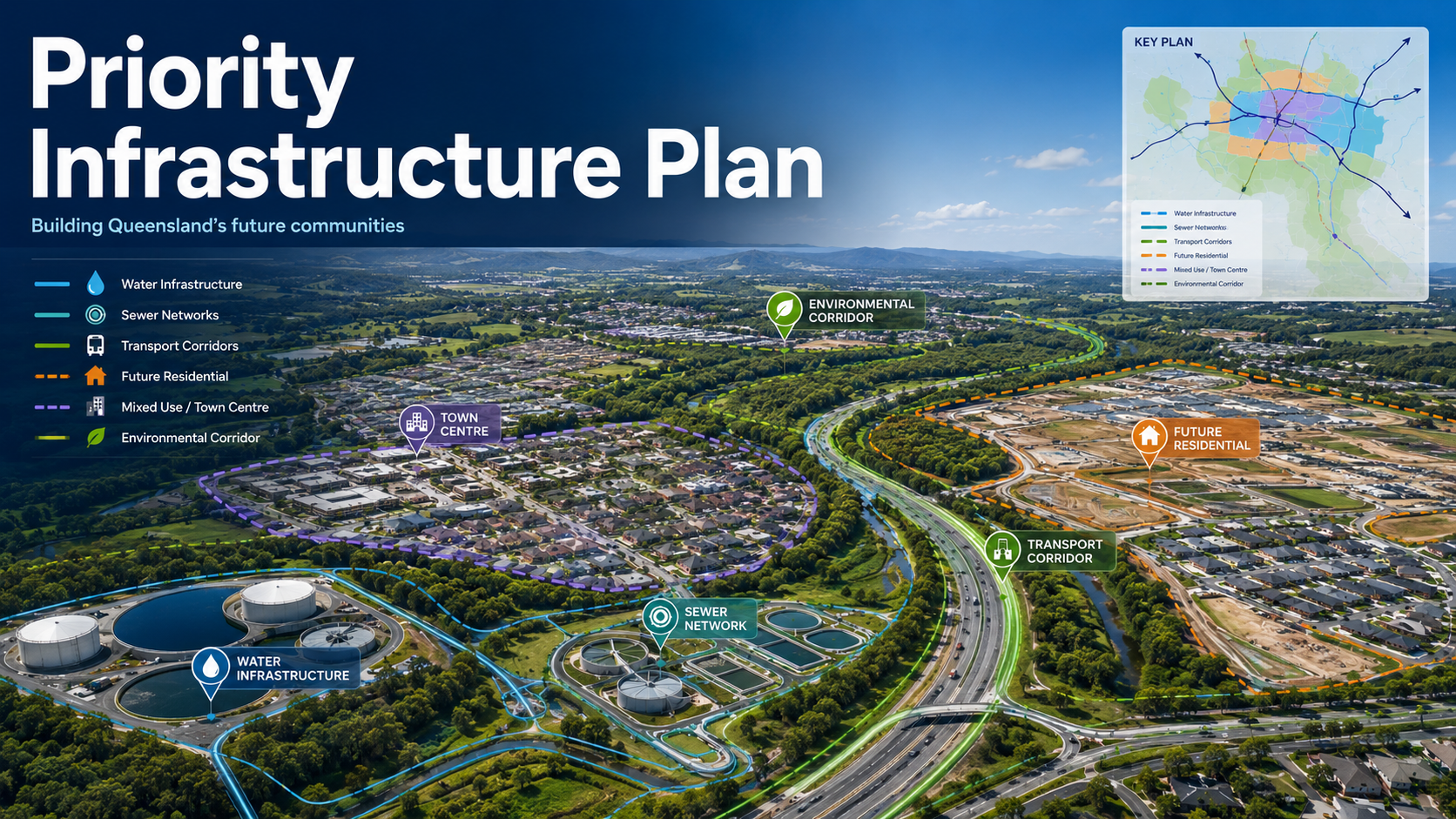
If you have come across the term Priority Infrastructure Plan (PIP) while researching Queensland property, development or planning, there is an important distinction to understand: PIP is largely a former planning term. Queensland’s current local infrastructure framework uses Local Government Infrastructure Plans (LGIPs). LGIPs identify the trunk infrastructure needed to support planned growth and are incorporated into local planning schemes. They can also provide the basis for infrastructure charges and infrastructure-related development conditions.
For a property owner or developer, the practical issue is not simply what a PIP was called. The bigger question is whether the land can be adequately serviced, when infrastructure is expected to be available, and what infrastructure costs may arise from the proposed development.
What Was a Priority Infrastructure Plan?
A Priority Infrastructure Plan was a planning instrument used under Queensland’s previous planning framework to coordinate infrastructure with anticipated urban growth.
Its basic purpose was to answer several connected questions:
- Where is population and development expected to grow?
- What infrastructure will that growth require?
- When will the infrastructure be needed?
- Which infrastructure should be treated as trunk infrastructure?
- How should infrastructure provision relate to development?
- How can councils plan and fund infrastructure over time?
The concept linked land-use planning with infrastructure delivery. Instead of allowing development and infrastructure decisions to occur independently, the planning system sought to coordinate growth with services such as roads, water, sewerage, stormwater and community facilities.
This is why the term can still appear in older planning documents, property research and discussions about Queensland development.
The terminology has since changed.
Is a Priority Infrastructure Plan Still Used in Queensland?
Not as the current local government infrastructure-planning instrument.
Queensland’s current planning framework uses Local Government Infrastructure Plans (LGIPs). The Queensland Government describes an LGIP as an integral component of a local planning scheme that identifies the local shared infrastructure required to support planned urban development.
Brisbane is a straightforward example. Its current LGIP replaced the council’s previous Priority Infrastructure Plans.
This distinction matters when researching an older property report or planning document. A reference to a PIP does not necessarily mean that the document represents the council’s current infrastructure-planning position.
If you are assessing a property today, you should check the current planning scheme and current LGIP, rather than relying solely on an old PIP.
What Replaced the Priority Infrastructure Plan?
The modern replacement is the Local Government Infrastructure Plan.
An LGIP brings infrastructure planning into the local planning scheme. Queensland’s current system allows councils to plan for infrastructure required to service future development and provides a framework for infrastructure charges and infrastructure-related conditions on development approvals.
An LGIP can cover five major local trunk infrastructure networks:
- Water
- Sewerage
- Transport
- Stormwater
- Public parks and land for community facilities
Infrastructure that is primarily internal to a development, such as a local access street within a subdivision, can instead be treated as non-trunk infrastructure.
Why Does the LGIP Matter?
An LGIP is not simply a list of future government projects.
It connects expected growth with the infrastructure required to support that growth. It also gives councils a basis for understanding the likely cost and timing of trunk infrastructure and for imposing appropriate infrastructure-related conditions on development approvals.
For a developer, that can affect whether a proposed project is practical, how much infrastructure work may be required and how much money needs to be allowed for infrastructure contributions.
What Is a Priority Infrastructure Area?
One of the easiest mistakes is confusing a Priority Infrastructure Plan with a Priority Infrastructure Area.
They are different things.
A Priority Infrastructure Area (PIA) is a geographic area identified through the current infrastructure-planning framework for priority servicing and planned urban growth.
In simple terms, it helps identify where infrastructure is intended to support growth as a priority.
The PIA therefore relates to a location, whereas the old PIP was a planning instrument.
This distinction becomes particularly relevant when assessing land on the edge of an established urban area.
A block might have development potential under the planning scheme but still face infrastructure constraints if the necessary trunk infrastructure has not been planned or funded for that location.
Why the Priority Infrastructure Area Matters to Developers
Suppose you find a large parcel of land on the outskirts of a Queensland regional city.
The planning controls might make residential development appear attractive. You might calculate a potential yield of 100, 200 or even 1,000 lots.
That calculation alone does not establish that the development is feasible.
You also need to investigate:
- Water capacity
- Sewerage capacity
- Transport infrastructure
- Stormwater infrastructure
- Existing network capacity
- Planned trunk infrastructure
- Infrastructure sequencing
- Infrastructure charges
- Development conditions
- Whether the site is within the relevant Priority Infrastructure Area
This is one reason infrastructure planning can have a major effect on land value.
A parcel that appears inexpensive on a per-square-metre basis can become considerably more expensive to develop if substantial infrastructure upgrades are required.
Can You Develop Outside a Priority Infrastructure Area?
Being outside a Priority Infrastructure Area does not automatically mean that development is impossible.
However, it can make the infrastructure side of a project more complicated.
The key issue is whether the development can be adequately serviced and whether additional infrastructure needs to be provided.
If a development is outside the area planned for near-term infrastructure provision, the developer may face infrastructure requirements that would not arise in the same way for a development within an established servicing area.
The Queensland Government’s infrastructure-charging framework recognises the connection between planned infrastructure, development demand and infrastructure costs. Councils can levy infrastructure charges where an LGIP is in place and development creates additional demand on trunk infrastructure.
That means a developer should never treat a property’s location on a map as a minor technical detail.
It can affect the financial model for the entire project.
How Infrastructure Charges Work
Infrastructure charges are one of the most practical consequences of Queensland’s infrastructure-planning system.
A local government can levy an infrastructure charge where it has an LGIP in place and the development creates additional demand on the trunk infrastructure network.
The charge is intended to contribute towards infrastructure needed because of development.
Depending on the development, the relevant infrastructure can include:
- Roads and transport infrastructure
- Water infrastructure
- Sewerage
- Stormwater
- Parks
- Community-facility land
Queensland legislation and regulations establish maximum infrastructure-charge amounts, subject to the applicable rules and indexation.
What Is an Infrastructure Charges Notice?
A council can issue an Infrastructure Charges Notice (ICN) to impose an infrastructure charge associated with a development.
This is particularly relevant when assessing development feasibility because the charge needs to be considered alongside other costs.
For example, a subdivision budget may include:
- Land acquisition
- Planning and consultant fees
- Surveying
- Engineering
- Site works
- Roads
- Drainage
- Sewer connections
- Water connections
- Electricity and telecommunications
- Council fees
- Infrastructure charges
- Financing costs
- Marketing and sales costs
Ignoring infrastructure charges until late in the project can distort the expected profit substantially.
Can Infrastructure Charges Be Offset or Refunded?
Yes, under the Queensland framework there are circumstances where infrastructure charges can be offset or refunded when a developer provides qualifying trunk infrastructure as part of a development approval condition.
This is an area where developers should obtain project-specific advice.
A developer may be required to construct infrastructure that benefits a wider network. The financial treatment of that infrastructure is not necessarily the same as simply paying a council charge.
The interaction between the development approval, infrastructure conditions, trunk infrastructure planning and applicable council policies needs to be examined together.
Why Infrastructure Planning Can Make or Break a Development
A common mistake in property development is to look at planning controls without looking closely enough at infrastructure.
Imagine two properties with similar zoning and similar potential development yields.
Property A already has:
- Adequate water capacity
- Nearby sewer infrastructure
- Suitable road access
- Established stormwater infrastructure
- Planned trunk infrastructure
Property B has:
- Limited water capacity
- Significant sewer constraints
- Poor road connections
- Difficult stormwater conditions
- No immediate trunk infrastructure planned for the proposed scale of growth
On paper, both properties may look developable.
Financially, they could be completely different projects.
This is why an infrastructure plan should be treated as part of the development feasibility assessment rather than as a document that only town planners need to understand.
A Current Queensland Example: Toowoomba
Toowoomba provides a useful example of the relationship between infrastructure and housing growth.
In 2026, the Queensland Government committed $145 million towards a new Southern Water Treatment Plant at Westbrook as part of a broader $195 million project. The project is intended to address water-capacity constraints and support future development in southern and western Toowoomba.
Recent reporting says the wider infrastructure investment is expected to support substantial additional housing capacity, with estimates of up to 17,000 homes in southern and western areas over the next decade.
The significance for property developers is straightforward.
Land-use planning can identify where growth is desirable, but growth still depends on physical infrastructure.
If water treatment, reservoirs, trunk mains or other essential infrastructure cannot support additional development, projects can be delayed, conditioned differently or become more difficult to finance.
In the Glenvale area, a proposed masterplanned development received approval for its first lots following funding for the Southern Water Treatment Plant, while another nearby project was reported as needing inclusion within the Priority Infrastructure Area to progress.
That is a good illustration of why infrastructure planning can have a direct commercial effect on development opportunities.
Problems People Face With Priority Infrastructure Planning
Unexpected infrastructure costs
One of the most common frustrations among property owners is discovering infrastructure charges after they have already committed to a property or development.
Community discussions show that infrastructure charges can be a significant concern for people subdividing land.
For example, one Queensland property owner discussing an eight-lot subdivision reported estimated council infrastructure charges of around $21,000 per block and asked whether the charges could be deferred until settlement.
The precise amount will vary considerably between councils, development types and circumstances, so this should not be treated as a standard Queensland charge.
The lesson is more useful than the individual figure: infrastructure costs need to be investigated before you commit to a development strategy.
Confusion about who pays
Another recurring issue is misunderstanding the contractual responsibility for infrastructure charges.
A charge associated with a property does not necessarily mean that the person currently living in the property is economically responsible for it in every circumstance.
For house-and-land purchases, subdivisions and development projects, responsibility can depend on the development approval, contract and other legal arrangements.
A Queensland community discussion described a homeowner being pursued for an infrastructure charge that the homeowner believed had been included in the builder’s contract price.
That is fundamentally a contractual and legal issue, not something that should be resolved by assuming the term “developer charge” tells you who must ultimately pay it.
Assuming zoning guarantees development
Zoning is important, but it is only one part of development feasibility.
You also need to establish whether the site can be physically serviced.
That means investigating:
- Water
- Sewer
- Stormwater
- Road access
- Flooding
- Environmental constraints
- Easements
- Network capacity
- Infrastructure sequencing
- Infrastructure charges
Relying on old planning documents
If a property report refers to a Priority Infrastructure Plan, check when that document was prepared.
The planning framework has changed, and an older PIP should not automatically be treated as the current position.
Queensland’s current guidance also provides for LGIP reviews, with local governments generally required to review an LGIP within five years of it being included in the planning scheme.
How to Check Infrastructure Planning for a Property
If you’re considering buying land for development, use a structured process.
1. Identify the local government
Start with the council responsible for the property.
Do not assume that a neighbouring council has the same infrastructure policies, charges or planning framework.
2. Find the current planning scheme
Check the current planning scheme rather than relying on an old property listing or previous planning report.
The planning scheme establishes the broader land-use framework.
3. Find the current LGIP
Look for the council’s Local Government Infrastructure Plan.
This is the modern document you should investigate where applicable.
4. Check the Priority Infrastructure Area
Determine whether the property falls inside the relevant PIA.
Do not confuse the PIA with the property’s zoning.
They answer different questions.
5. Investigate the infrastructure networks
Look at the infrastructure relevant to your proposed development:
- Water
- Sewerage
- Transport
- Stormwater
- Parks and community facilities
6. Check infrastructure charges
Find the council’s current infrastructure charges resolution and determine what could apply to your development.
Do not use an old online example as your budget.
Charges and applicable rules can change.
7. Ask about actual capacity
A map showing planned infrastructure is not the same thing as confirmation that the network currently has sufficient capacity.
For a substantial development, obtain advice on actual servicing requirements.
8. Model the infrastructure cost before buying
If you’re buying land specifically because you believe it can be subdivided or developed, infrastructure costs should be part of the acquisition decision.
Do not calculate your expected profit from the eventual sale value alone.
Calculate:
Expected revenue − land − construction − infrastructure − professional fees − finance − statutory costs − contingency = estimated project return
If infrastructure is uncertain, model multiple scenarios.
Common Questions About Priority Infrastructure Plans
Is a Priority Infrastructure Plan still current in Queensland?
The current local government infrastructure-planning instrument is the Local Government Infrastructure Plan (LGIP). PIP is mainly encountered as a historical term or in older planning material. Queensland’s current planning framework identifies LGIPs as the plans local governments use to identify infrastructure needed to service local areas.
What is the difference between a PIP and an LGIP?
A PIP was part of Queensland’s former infrastructure-planning framework. An LGIP is the current framework integrated into a local planning scheme.
If you are assessing a property today, the current LGIP should generally be your starting point rather than an old PIP.
What is a Priority Infrastructure Area?
A Priority Infrastructure Area is a defined geographic area used within infrastructure planning to identify where infrastructure and urban growth are prioritised.
It is not the same as a planning zone.
Can land outside a Priority Infrastructure Area still be developed?
Potentially, yes. But development outside the planned infrastructure area can face additional servicing, infrastructure and cost issues. Whether a particular project can proceed depends on its planning controls, infrastructure requirements, servicing arrangements and development assessment.
Do all developments pay infrastructure charges?
Not necessarily.
Infrastructure charges depend on the applicable Queensland framework, the local government, whether an LGIP is in place, the type of development and the additional demand created by the development.
Can infrastructure charges be reduced?
There can be circumstances involving offsets, refunds or other mechanisms, particularly where qualifying trunk infrastructure is provided by a developer. The outcome depends on the development and applicable council and legislative requirements.
Should I rely on a PIP mentioned in an old property report?
Not without checking the current planning framework.
An older PIP can provide useful historical context, but development decisions should be based on current planning documents, infrastructure information and professional advice.
Mistakes to Avoid With Priority Infrastructure Plans
Mistake 1: Treating PIP as the current Queensland system
Start with the current LGIP.
Mistake 2: Confusing PIA with zoning
A property’s zone does not tell you everything about infrastructure availability or sequencing.
Mistake 3: Assuming infrastructure shown as planned is already available
Future infrastructure and existing capacity are different things.
Mistake 4: Leaving infrastructure charges out of the feasibility model
A development can look profitable until infrastructure costs are properly included.
Mistake 5: Using outdated charge figures
Always check the current council information and applicable Queensland requirements.
Mistake 6: Assuming council approval solves every infrastructure issue
A development approval may contain infrastructure conditions. Physical network capacity and delivery timing still matter.
Mistake 7: Buying land before obtaining servicing advice
If the development case depends on new roads, sewerage, water capacity or other major infrastructure, investigate those requirements before committing significant capital.
The Bottom Line
If you’re searching for a Priority Infrastructure Plan because you’ve found the term in a Queensland property or planning document, the first thing to establish is whether you’re looking at an old PIP or the current LGIP framework.
For current development decisions, the LGIP is the more relevant document. It connects planned growth with local trunk infrastructure and sits alongside the planning scheme and infrastructure-charging framework.
For property owners and developers, the most valuable information is not the terminology itself. It is knowing whether your site can be serviced, what infrastructure is planned, when it is expected, whether your development creates additional demand, and what costs or conditions may result.
That is where infrastructure planning moves from a technical planning document to a genuine property-feasibility issue.
You May Also Like: Alhambra Palace Night Tour Attendance Revenue
