


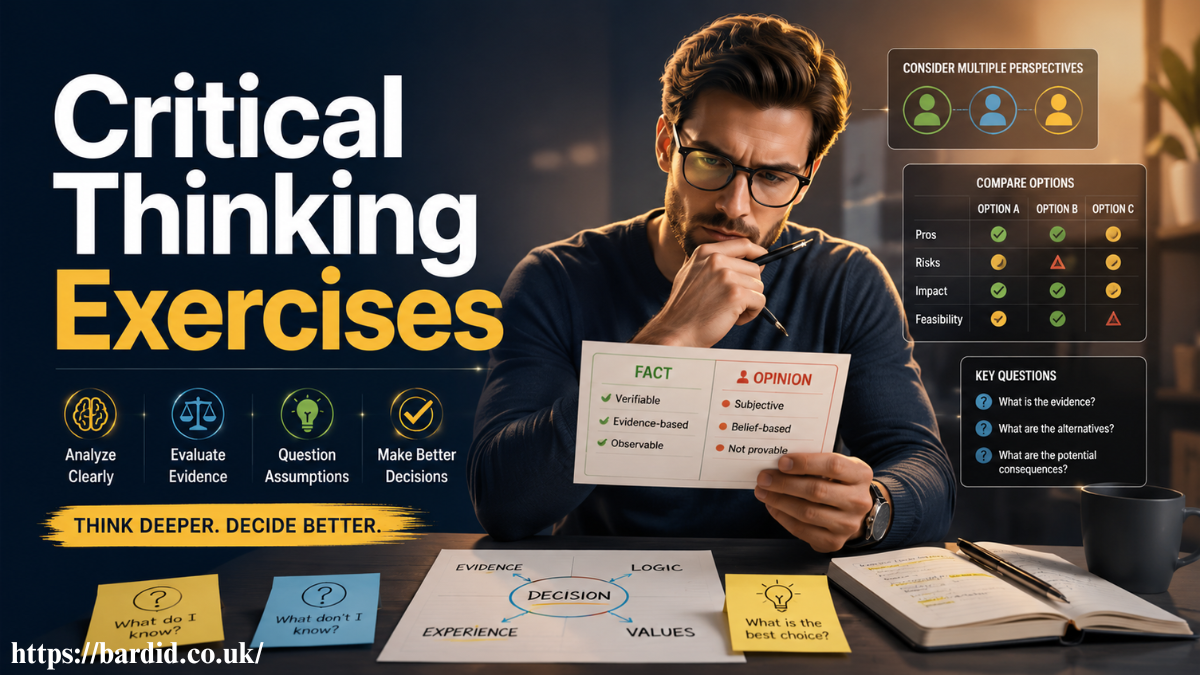
Critical thinking exercises are structured activities that help you question assumptions, evaluate evidence, spot weak reasoning, and make better decisions. They work best when you use them on real problems, not just puzzles. In 2026, these exercises matter more because AI tools, fast content, and workplace pressure make it easier to accept answers without checking them.
What Are Critical Thinking Exercises in Simple Terms?
Critical thinking exercises are practical thinking drills that train your brain to slow down, compare evidence, and make a reasoned choice. Instead of reacting quickly, you learn to ask, “What do I know, what am I assuming, and what proof supports this?”
A simple example is fact vs opinion sorting. You take a blog post, social media claim, or news article and separate what can be proven from what is only someone’s view. This builds stronger critical thinking skills because it teaches your mind to pause before believing or sharing something.
Critical thinking is evidence-based judgment.
Why Critical Thinking Exercises Matter More in 2026
In 2026, people are surrounded by AI answers, short videos, quick summaries, and endless online opinions. Tools like ChatGPT and Google Search can help you collect ideas faster, but they can also make weak thinking feel polished. That is why critical thinking practice now needs to include AI-generated content review and source checking.
From what I’ve seen, many people do not fail because they lack information. They fail because they trust the first clear answer. Critical thinking activities help you compare sources, question assumptions, and notice when an answer sounds good but lacks evidence.
The real 2026 skill is not finding information; it is knowing what to trust.
How Critical Thinking Exercises Improve Real-Life Decisions
Good critical thinking exercises improve decision-making skills by turning a messy problem into a clear thinking process. For example, if a business campaign fails, you do not start by blaming the team. You ask what changed, what data you have, what assumptions were made, and what other explanation could be true.
This is useful in workplace decision-making, student learning, leadership training, project planning, and daily life. It also helps with remote work communication because written messages often hide tone, missing context, and unclear reasoning.
A good exercise turns a vague problem into a testable question.
Beginner Critical Thinking Exercises You Can Try in 10 Minutes
Start with simple problem-solving exercises before moving into advanced reasoning. The easiest option is the 5 Whys, a root cause analysis method often linked with Toyota-style problem-solving. You choose one issue and ask “why?” until you find the deeper cause.
Another strong beginner method is “explain it simply.” If you cannot explain a topic to a child or beginner, your own understanding may still be unclear. Observation drills also help. Look at an image, chart, report, or situation and write only what you can see before adding your interpretation.
Practical Critical Thinking Exercises for Work and Team Decisions
In real use, workplace critical thinking works best when it fits into a normal workflow. Before a meeting, write the decision in one sentence. Then identify the evidence, assumptions, risks, and the one fact that could change your mind.
For team problem-solving, reverse brainstorming is useful. Instead of asking, “How do we fix this?” ask, “How could we make this worse?” That reveals weak points quickly. Six Thinking Hats, created by Edward de Bono, also helps teams separate facts, risks, benefits, emotions, creative ideas, and process.
A clear team decision needs evidence, risk review, and disagreement before action.
Critical Thinking Exercises for Students and Learning
Critical thinking for students should go beyond memorizing answers. Students need reasoning exercises that help them read carefully, compare sources, and build stronger arguments. Good options include argument mapping, Socratic questioning, debate practice, reflective journaling, and logical fallacy spotting.
For example, a student can read a history claim and ask who made the claim, what evidence supports it, what other views exist, and what may be missing. This creates better critical reading and stronger study skills.
Learning improves when students explain why an answer makes sense.
My 7-Day Experience Testing Critical Thinking Exercises
From what I’ve seen, the most useful daily exercise is a short decision review. At the end of the day, choose one decision and ask what information you used, what you assumed, and what you would do differently.
By day three, this starts showing patterns. You may notice that you decide too quickly when tired, trust familiar voices too easily, or avoid uncomfortable evidence. This is where a simple daily thinking routine becomes valuable.
A decision review turns experience into usable feedback.
What Happened When I Used the 5 Whys on a Real Problem
Here is a real problem-solving example. A weekly report was always late. Why? The data arrived late. Why? The team waited for manual updates. Why? No one owned the update process. Why? The task was shared informally. Why? The workflow was never written down.
The real issue was not laziness. It was unclear ownership. The fix was to assign one owner, create one Google Docs template, and set one deadline.
A common mistake is blaming people before checking the system.
Advanced Critical Thinking Exercises for Deeper Reasoning
Once the basics feel easy, move to advanced analytical thinking exercises. Steelmanning helps you build the strongest version of the opposite view before responding. Socratic questioning helps you test meaning, evidence, limits, and assumptions. Argument mapping helps you place the main claim, reasons, evidence, and counterarguments into a clear structure.
You can also practice spotting logical fallacies such as false dilemmas, ad hominem attacks, circular reasoning, and hasty generalizations. These skills matter in media literacy, social media fact-checking, workplace debates, and AI fact-checking.
Advanced reasoning means testing your own view, not only someone else’s.
Critical Thinking Exercises vs Brain Games: Which Works Better?
Brain games like Wordle, Lumosity, Peak, and Elevate can support focus, memory, and pattern recognition. They are useful, but they are not the same as real-world critical thinking exercises. A puzzle trains a narrow skill. A real decision trains judgment.
| Method | Best For | Main Limit | Best Use |
| Brain games | Memory, speed, pattern recognition | May not transfer to real decisions | Warm-up practice |
| Logic puzzles | Deduction and focus | Often too narrow | Reasoning drills |
| 5 Whys | Root cause analysis | Can oversimplify complex issues | Workplace problems |
| Argument mapping | Claims, evidence, counterarguments | Takes more time | Essays, meetings, decisions |
| AI-assisted review | Fast idea testing | Can create false confidence | First draft, not final judgment |
Brain games sharpen parts of thinking, but real problems sharpen judgment.
Common Mistakes That Make Critical Thinking Exercises Less Useful
A common mistake is treating skepticism as intelligence. Doubting everything is not the same as thinking well. Strong critical thinking means you evaluate evidence fairly, even when the answer challenges your first opinion.
Another mistake is using AI tools without checking sources. ChatGPT can help with ideas, outlines, and counterarguments, but final judgment still belongs to you. Google Search, trusted reports, expert sources, and first-hand testing should support important decisions.
Critical thinking is not automatic doubt; it is disciplined checking.
What Most Guides Miss About Critical Thinking Exercises
Most guides list exercises but skip the workflow. The better approach is to observe, question, test, decide, and review. This gives you a repeatable system instead of a random list of critical thinking activities.
This is also useful for content. A blog post can explain the method in depth. A video can show the 5 Whys on a real problem. A social post can turn fact vs opinion sorting into a quick exercise. This multi-platform angle helps readers learn the same idea in different formats.
A strong thinking workflow can become a content workflow.
How to Build a Simple Weekly Critical Thinking Practice
A useful weekly plan can stay simple. Use fact vs opinion sorting on Monday, the 5 Whys on Tuesday, explain-it-simply practice on Wednesday, AI answer checking on Thursday, argument mapping on Friday, and decision review on the weekend.
This routine supports workplace decisions, classroom activities, professional development, and daily thinking habits. It also prevents overload because each exercise has one clear purpose.
A thinking habit works when it is small enough to repeat.
Are Critical Thinking Exercises Worth It?
Critical thinking exercises are worth it if you apply them to real decisions. They help students learn better, help workers solve problems faster, and help leaders avoid rushed choices. They are especially useful when paired with reflection, feedback, and evidence-based reasoning.
They are less useful if you only do random critical thinking puzzles once in a while. The value comes from repeated practice and real use.
The best critical thinking practice improves judgment that you can use outside the exercise.
Best Critical Thinking Exercises to Start With Today
The best starting exercise depends on your goal. Use the 5 Whys for problem-solving, fact vs. opinion sorting for checking online information, argument mapping for writing and debate, Socratic questioning for deeper reasoning, and decision review for daily self-awareness.
If you use AI tools often, add one more habit: ask ChatGPT for possible answers, then check the strongest claims with Google Search or trusted sources. That keeps AI helpful without letting it replace your judgment.
Critical thinking exercises work when they become part of your normal workflow. Start small, use real problems, and review your decisions often. Over time, these thinking strategies build clearer reasoning, better choices, and stronger confidence in what you believe.
You May Also Like Fenugreek
FAQs
Are critical thinking exercises always helpful?
No, critical thinking exercises are not always helpful if they make you overthink simple choices. Use them for decisions with real consequences, unclear evidence, or competing options, not for every small daily task.
Can critical thinking exercises make someone too skeptical?
Yes, they can if the person learns to question everything but never learns how to reach a fair conclusion. Good critical thinking should lead to clearer judgment, not constant doubt or automatic disagreement.
Why do critical thinking exercises fail for some people?
Critical thinking exercises fail when they are done as random puzzles instead of being applied to real problems. The long-term benefit comes from using the same thinking workflow repeatedly, then reviewing what actually happened.
Should I avoid using AI for critical thinking practice?
No, you do not need to avoid AI, but you should avoid letting AI make the final judgment for you. Use tools like ChatGPT to generate angles, counterarguments, or summaries, then verify claims with trusted sources and your own reasoning.
What is the long-term impact of practicing critical thinking exercises?
The long-term impact is better judgment, stronger problem-solving, and fewer decisions based on impulse or weak assumptions. Over time, you also become better at spotting misleading claims, emotional framing, and gaps in your own thinking.
