


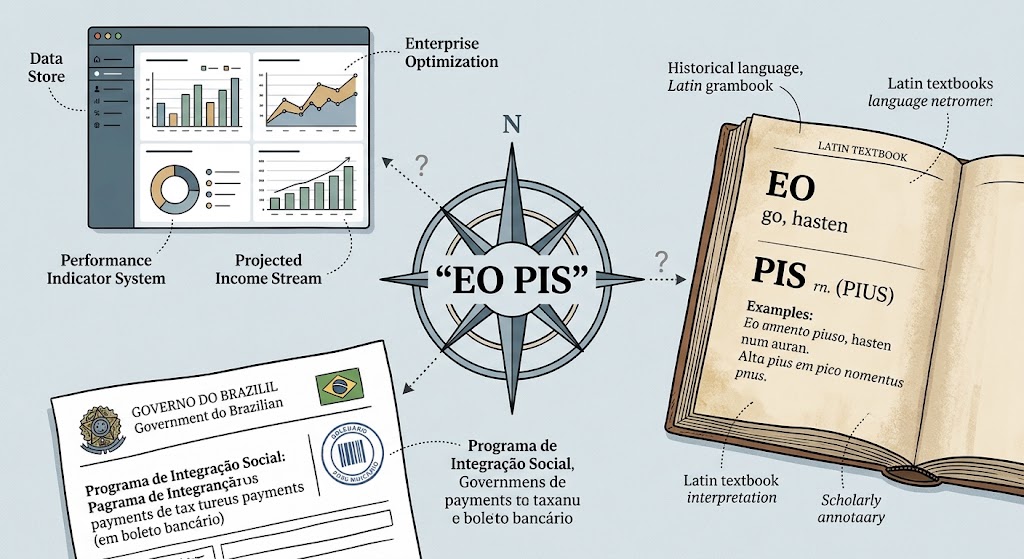
What does EO PIS mean?
If you searched for EO PIS, you may have noticed something unusual: different websites give completely different definitions.
That is because EO PIS does not appear to have one established, universally recognised meaning. Current search results assign the phrase a range of expansions, particularly in business and technology, but we could not verify those expansions through an authoritative standard, established industry organisation, academic source, or identifiable product documentation.
There is also a separate claim that “eo pis” is a Latin phrase meaning “I go to the fish,” supposedly associated with the Cambridge Latin Course. That claim is repeated online, but the official Cambridge material we checked confirms the course itself rather than confirming this particular phrase as an official Cambridge expression.
A further possibility is that a searcher means PIS in Brazil, short for Programa de Integração Social. That is a genuine, government-documented programme, but there is no evidence that the additional “EO” automatically forms a recognised term with it.
So the safest answer is: EO PIS is an ambiguous search term, not a definition you should accept without checking its context.
Is EO PIS an established acronym?
The current web results contain several proposed expansions.
One page describes EO PIS as an executive performance or information system. Another associates it with enterprise operations and personnel information systems. Other pages describe it as an end-of-period information or performance system.
The problem is not that an organisation could never use these words internally. Companies routinely create their own abbreviations.
The problem is evidence of broader usage.
A genuinely established acronym normally leaves a trail: official documentation, standards, academic literature, vendor material, professional organisations, named products, regulatory documents, or repeated independent usage.
We did not find that kind of evidence for a single standard definition of EO PIS.
That makes it risky to write:
“EO PIS stands for [one particular expansion].”
A more accurate statement is:
Several websites use different expansions for EO PIS, but no single expansion could be independently verified as the standard meaning.
Why do the business definitions sound convincing?
The proposed expansions use familiar corporate vocabulary:
- executive operations
- enterprise operations
- performance indicators
- information systems
- personnel information
- end-of-period reporting
Put together, these phrases sound like established business terminology. But sounding plausible is not the same as being documented.
This is particularly important when researching unfamiliar acronyms. A collection of recent articles repeating a definition is not necessarily independent evidence that the underlying concept exists.
For example, current results include pages describing EO PIS as a performance framework, a flexible organisational concept, an operational information system, and even a floor-to-ceiling measurement term. The definitions are not merely slightly different; they describe entirely different concepts.
That inconsistency is itself useful evidence.
Is “EO PIS” a Latin phrase?
This is another prominent interpretation of the search term.
Several recent websites claim that eo pis means “I go to the fish” and connect the phrase to the Cambridge Latin Course.
There are two separate questions here:
- Could the words eo and pis be interpreted as Latin?
- Is eo pis an established phrase from the Cambridge Latin Course?
Those questions should not be treated as the same thing.
What does eo mean in Latin?
Eo is a genuine Latin form associated with the verb ire, meaning “to go.” It can therefore occur in sentences expressing movement.
A specialist Latin dictionary such as the University of Chicago’s Logeion provides the relevant lexical evidence for eo.
What about “fish”?
The ordinary Latin noun for fish is piscis.
That matters because simply translating pis as “fish” requires more explanation than many of the pages currently ranking for EO PIS provide.
In other words, the popular explanation cannot be treated as proven merely because eo can mean “I go.”
Does the Cambridge Latin Course confirm “eo pis”?
The Cambridge Latin Course is unquestionably real. The Cambridge School Classics Project describes it as a five-book Latin course progressing from beginner level to GCSE, with Book I set in Pompeii shortly before the eruption of Vesuvius. It uses stories alongside explanations of Latin grammar and Roman culture.
However, the official Cambridge material we located does not establish “eo pis” as a recognised phrase or explain it as a Cambridge Latin Course teaching phrase.
That distinction is important.
A number of third-party websites make the Cambridge connection confidently, but repeating the claim does not independently verify it.
For anyone who encountered EO PIS in a Latin-class context, the best approach is to check the actual textbook, Stage, exercise, worksheet, or teacher material where the phrase appeared rather than relying on an SEO article’s explanation.
Could EO PIS be related to Brazil’s PIS?
Yes, PIS itself is a well-established term in Brazil, but this does not prove that “EO PIS” is the name of a Brazilian programme.
PIS stands for Programa de Integração Social. Brazilian government sources use the term in connection with employment and worker benefits, including the Abono Salarial.
Government documentation describes the Abono Salarial as an annual benefit for eligible employees of employers contributing to PIS or Pasep, subject to statutory requirements.
CAIXA also provides information concerning PIS/NIS registration and related worker services.
Is PIS the same as the Abono Salarial?
Not exactly.
PIS is the Programa de Integração Social. The Abono Salarial is a worker benefit associated with the PIS/Pasep system and subject to eligibility rules.
This distinction matters because websites sometimes use “PIS,” “PIS payment,” and “PIS bonus” loosely.
The Brazilian government’s own material separates the programme from the benefit.
If you encountered EO PIS while dealing with Brazilian payroll, employment records, or government benefits, look at the original document before assuming that “EO” is part of the official name.
Why are there so many different definitions of EO PIS?
The search results provide a useful lesson in how unfamiliar keywords can develop online.
When a short phrase has little established documentation, publishers can interpret it in different ways. One article may create an expansion; another may repeat or modify it; subsequent pages may add generic explanations around the supposed concept.
Eventually, a searcher can encounter several pages that appear to confirm one another.
But volume is not the same as independent verification.
The current EO PIS results demonstrate this clearly. One page presents it as a business performance concept, another as a personnel information system, another as an end-of-period reporting framework, and another as something completely unrelated to business.
There is even a website using “EO Pis” for essential oils, showing how easily the same string can acquire unrelated meanings online.
This is why the most reliable answer is not necessarily the most elaborate one.
How to work out what EO PIS means in your context
If you have encountered the phrase somewhere specific, use the surrounding context rather than choosing the definition that sounds most professional.
| Where you saw it | What to investigate |
|---|---|
| Business report or company dashboard | Check the organisation’s own glossary or documentation |
| HR or payroll document | Look for the full term elsewhere in the document |
| Brazilian employment context | Check whether it actually refers to PIS/Pasep |
| Latin textbook or classroom | Check the exact textbook, Stage and sentence |
| Technology documentation | Identify the software, vendor or system that uses the acronym |
| Random website or social post | Treat the definition as unverified until independently supported |
| Search result with no context | Do not assume there is one standard meaning |
This approach is more reliable than searching for the acronym repeatedly and selecting the definition that appears most often.
A useful verification checklist
Before treating EO PIS as a recognised term, ask:
- Who originally defined it?
- Is there an official organisation behind it?
- Does an identifiable company or product use the term?
- Can the same definition be found in independent authoritative sources?
- Does the proposed expansion appear in technical or academic literature?
- Does the original document where you encountered it define the abbreviation?
If the answer to most of these is no, describe EO PIS cautiously.
What should you do if you need a definitive answer?
Go back to the source where you encountered EO PIS.
An abbreviation used inside a private company can have a perfectly legitimate internal meaning without being a generally recognised acronym. Likewise, a phrase appearing in a Latin exercise may have a specific meaning within that textbook even if it is not a standard expression.
If you have a screenshot, sentence, document title, or surrounding paragraph containing EO PIS, that context can usually narrow the possibilities much more effectively than the keyword alone.
Read More: Bardid Meaning: Researcher, Place and Verified Facts
Frequently Asked Questions
Is EO PIS a real acronym?
The phrase is real in the limited sense that websites and potentially individual organisations use the letters, but we could not verify one standard, widely recognised expansion for EO PIS.
What does EO PIS stand for?
There is no reliably established single answer. Online sources propose several different expansions, particularly involving executive operations, enterprise operations, performance indicators and information systems. These should not be presented as an official definition without supporting evidence.
Is EO PIS Latin?
The words involved have Latin associations, but the popular claim that “eo pis” definitively means “I go to the fish” and comes from the Cambridge Latin Course is not sufficiently established by the official Cambridge material we found.
Does EO PIS mean “I go to the fish”?
That translation is widely claimed by recent websites, but it should be treated cautiously. Eo is a genuine Latin form related to “to go,” while the standard Latin noun for fish is piscis. The claimed phrase and Cambridge attribution require more evidence than the current secondary pages provide.
Is EO PIS the same as PIS in Brazil?
Not necessarily. PIS is an established Brazilian programme, the Programa de Integração Social. There is no evidence that the additional letters “EO” automatically make the phrase an official Brazilian government term.
Why does every website seem to define EO PIS differently?
Because the term appears to have little established public documentation and is being interpreted in multiple ways online. Different pages currently attach different meanings to the same letters, which is a strong reason to verify the original context.
The bottom line
EO PIS does not currently have one meaning that can be confidently presented as the universal definition.
If you encountered it in a business document, find the organisation’s own definition. If it appeared in a Brazilian employment context, investigate PIS/Pasep. If you saw it in connection with Latin or the Cambridge Latin Course, check the original educational material rather than relying on third-party explanations.
The most important lesson is simple: an acronym does not become an established term just because several websites repeat the same expansion. For an unfamiliar phrase like EO PIS, the original source and independent evidence matter more than the number of search results.
