


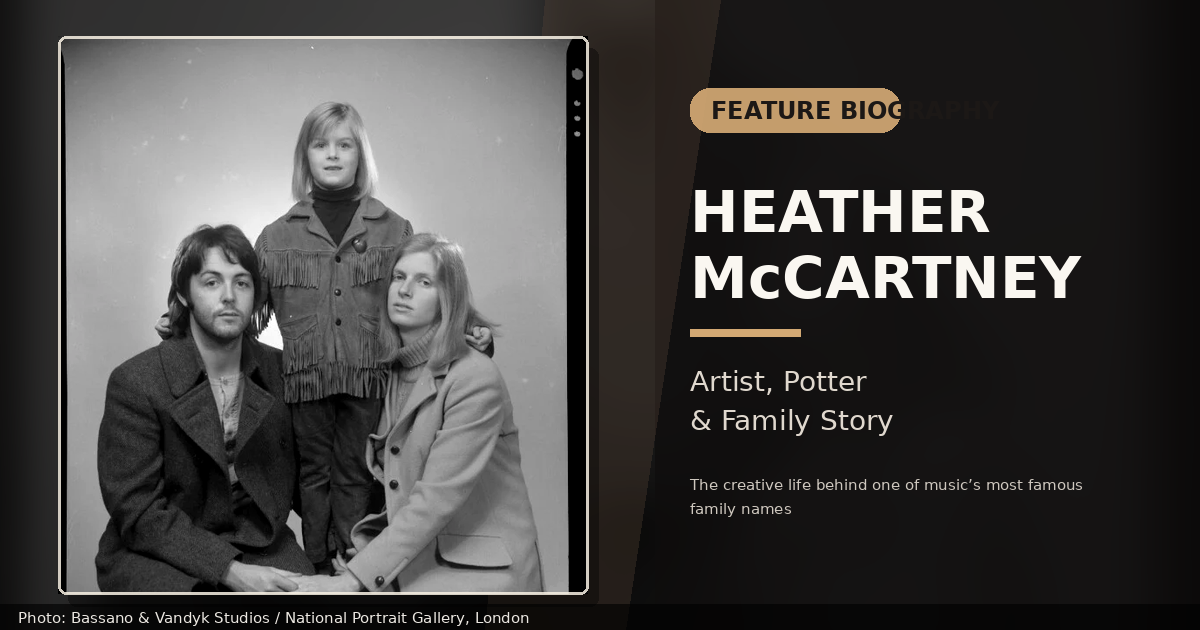
Heather McCartney is the eldest daughter of Linda McCartney and the legally adopted daughter of Paul McCartney. Born Heather Louise See in Tucson, Arizona, she grew up inside one of the world’s most famous musical families but followed a quieter creative path. Rather than building a career around celebrity, she became an artist, printmaker, potter and houseware designer.
She is also the young girl seen visiting the Beatles during the filming connected with Let It Be, footage later revisited in The Beatles: Get Back. Although her surname attracts attention, Heather’s own story is mainly about family, visual art, ceramics and a deliberate life outside the celebrity spotlight.
Who Is Heather McCartney?
Heather Louise McCartney was born Heather Louise See on 31 December 1962 in Tucson, Arizona. Her mother was photographer, musician and animal-rights advocate Linda Eastman, later known as Linda McCartney. Her biological father was geologist Joseph Melville See Jr.
After Linda married Paul McCartney in 1969, Paul formally adopted six-year-old Heather. She therefore became his legal daughter, not simply a child who happened to live with a stepfather.
As an adult, Heather pursued photography, printing, pottery and product design. She has generally avoided the level of publicity associated with her father and some of her siblings.
Heather McCartney at a glance
- Full name: Heather Louise McCartney
- Birth name: Heather Louise See
- Date of birth: 31 December 1962
- Birthplace: Tucson, Arizona, United States
- Mother: Linda McCartney
- Biological father: Joseph Melville See Jr.
- Adoptive father: Paul McCartney
- Profession: Artist, potter and designer
- Known for: Pottery, houseware design and appearances in Beatles footage
- Nationality and background: Commonly described as British-American
Why her name is often confused
Three different naming issues regularly cause confusion.
First, “Heath McCartney” is a misspelling when the intended subject is Linda and Paul McCartney’s daughter. Heather’s first name includes the final letters “er”.
Second, Heather is sometimes described only as Paul McCartney’s stepdaughter. While she entered his life through his marriage to Linda, Paul legally adopted her. Calling her his adopted daughter is therefore more accurate.
Third, Heather McCartney is not Heather Mills. Heather Mills was Paul McCartney’s second wife, whom he married years after Linda’s death. The similarity between the two names has led to misleading headlines and incorrect family descriptions.
Heather McCartney’s Early Life and Adoption
Heather’s early childhood began in the United States. Her parents’ marriage was short, and she was primarily raised by Linda following their separation. Linda was developing her career as a photographer and became particularly recognised for photographing musicians and major figures in the 1960s rock scene.
Linda met Paul McCartney during that period. Their relationship became serious, and Linda moved to England with Heather. Linda and Paul married in March 1969, when Heather was six.
Paul adopted Heather around the time of the marriage. This changed more than her surname. It placed her within the McCartney household during the final period of the Beatles and the beginning of Paul and Linda’s life as a married couple.
Her birth parents and childhood
Heather’s biological parents were Linda Eastman and Joseph Melville See Jr. Public biographies sometimes give inconsistent versions of her father’s name, but recent and more carefully referenced accounts identify him as Joseph Melville See Jr.
Heather was still very young when her parents separated. She later maintained that her biological father had influenced her life, while also recognising Paul as her father after his adoption of her. This distinction is important: acknowledging her biological background does not reduce the significance of her relationship with Paul.
Her childhood connected two different environments. She was born in the American Southwest but spent much of her formative life in Britain. She also grew up around photography, music, animals and rural family life rather than being raised only inside the formal world of show business.
How Paul McCartney became her father
Paul did not remain a distant celebrity stepfather. He formally became Heather’s parent and raised her alongside the children he later had with Linda.
Recent family profiles describe Heather as Paul’s eldest child. Paul has also publicly referred to himself as the father of five children, a group that includes Heather, Mary, Stella, James and Beatrice.
The adoption is one reason viewers respond warmly to scenes of Paul and the young Heather together. These moments show an emerging family relationship during a period more commonly discussed in terms of Beatles disagreements, recording sessions and the group’s approaching break-up.
Growing Up in the McCartney Family
Paul and Linda created a family life that combined extraordinary fame with relatively ordinary routines. Heather was the eldest child in the household and was later joined by Mary, Stella and James.
The children spent time in London, Scotland and the English countryside. Linda’s photography and concern for animals shaped the household, while Paul’s work meant that music was always present.
Heather did not follow exactly the same professional route as her siblings. That difference has sometimes caused the public to overlook her, but it also demonstrates that the McCartney children developed distinct identities.
Heather’s brothers and sisters
Heather’s maternal half-siblings are:
- Mary McCartney, a photographer, filmmaker and writer.
- Stella McCartney, an internationally recognised fashion designer.
- James McCartney, a musician and songwriter.
Paul’s daughter Beatrice, born during his later marriage to Heather Mills, is Heather’s adoptive half-sister.
Heather is occasionally omitted from simplified descriptions of Paul McCartney’s family because she is not his biological child. That omission is misleading. Adoption made her his daughter, and reliable modern profiles include her among his five children.
Her appearances in Let It Be and Get Back
As a child, Heather visited the Beatles while they were working on the sessions filmed in January 1969. Some of that material appeared in the 1970 film Let It Be.
Decades later, restored and previously unseen footage from the same recording period became the basis of Peter Jackson’s documentary series The Beatles: Get Back. Heather can be seen interacting playfully with the musicians, including moments in which she approaches microphones and joins the activity in the studio.
The scenes attracted fresh interest because they offered a different view of the sessions. Instead of showing only four musicians under professional pressure, they captured a child responding naturally to the sounds, equipment and people around her.
These appearances did not make Heather a professional performer. They are better understood as informal family moments preserved inside an important piece of music history.
Heather McCartney’s Career as an Artist
Heather chose a visual and practical form of creativity. Her work developed through photography and printing before she focused more deeply on pottery and design.
This career is sometimes reduced to a single sentence in family biographies. Yet it helps explain why she has remained visible within art and design circles without pursuing the publicity usually associated with celebrity families.
Photography and printmaking
Heather’s earliest recognised creative work was connected with photography. This interest made sense within a family shaped by Linda McCartney’s photographic career.
She studied printing at the Photographers’ Workshop in Covent Garden, London. She later received the Young Black and White Printer of the Year award for a photograph called “Waterfall”.
Printmaking requires more than taking a photograph. It involves decisions about exposure, contrast, tonal range, paper and the physical development process. Heather’s training therefore gave her experience in both artistic composition and hands-on production.
That combination would remain relevant when she moved into ceramics. Pottery also requires an artist to connect a visual idea with materials, physical technique and functional design.
Moving into pottery and design
Heather later attended art school, where she concentrated on pottery and design. She also travelled in Mexico and spent time in communities connected with the Wixárika and Rarámuri peoples, historically referred to in many English biographies as the Huichol and Tarahumara.
Her travels are often included in accounts of her artistic development. However, responsible descriptions should avoid claiming that particular cultural symbols or traditions belonged to her work unless a specific design has been properly documented.
She eventually returned to England and worked professionally as a potter. Her output included decorative and functional objects, allowing her to combine ceramic craftsmanship with accessible home design.
The Heather McCartney Houseware Collection
In 1999, Heather launched the Heather McCartney Houseware Collection. The range expanded her work beyond individual pottery pieces and into products intended for everyday homes.
Contemporary descriptions of the collection referred to items for kitchens and interiors, including ceramics and other decorative household products. Paul attended promotional activity supporting the launch and expressed pride in his daughter’s work.
The collection was significant because it presented Heather under her own creative identity. Her surname naturally attracted media attention, but the products were connected with her training in pottery and design rather than with Paul’s musical business.
Examples of her ceramics occasionally appear through specialist dealers and secondary sellers. Buyers should carefully check provenance, condition, maker’s marks, certificates and edition information before assuming that an item is an authenticated Heather McCartney design.
Her Contributions to Paul McCartney’s Music
Although Heather became known primarily as a visual artist, she also has a small and interesting place in Paul McCartney’s recording history.
Her contributions should not be exaggerated into a separate music career. They were family appearances made within Paul and Linda’s recording environment.
Backing vocals on Ram
Heather is credited with backing vocals on “Monkberry Moon Delight”, a track from Paul and Linda McCartney’s 1971 album Ram.
The recording is known for its forceful lead vocal, unusual imagery and densely layered sound. Heather’s part sits inside the group of backing voices rather than operating as a featured solo performance.
She was only a child when the album was recorded. Her involvement therefore reflects the informal, family-centred atmosphere surrounding parts of Paul and Linda’s early post-Beatles work.
It also provides a direct musical connection between Heather and the album, rather than relying only on her presence in family photographs from the period.
Mama’s Little Girl and later credits
Heather also received a backing-vocal credit on “Mama’s Little Girl”, a Paul McCartney and Wings recording made during the 1970s and officially released later.
Some descriptions state that the song was written specifically about Heather. What can be stated more firmly is that she appears in the recording credits alongside family and Wings contributors.
Heather is also associated with Paul’s 2013 album New. Public personnel summaries list a “McCartney Family Chorus” on the album, while several biographies identify Heather as one of the family contributors.
Because commonly available credits name the ensemble rather than clearly separating every individual voice, it is safer to describe her contribution to New as a family-chorus credit rather than assigning her a distinct solo part.
Why Heather McCartney Lives Privately
Heather has maintained a far lower public profile than Paul, Stella or Mary. She has appeared at selected family and professional events, but she has not built an ongoing media career around interviews, television appearances or personal publicity.
That privacy creates strong public curiosity. It also creates conditions in which unverified stories can spread.
What is publicly confirmed
Reliable public information supports the following points:
- Heather pursued printing, pottery and design.
- She launched a houseware collection in 1999.
- She appeared in footage used for Let It Be and Get Back.
- She contributed backing vocals to recordings connected with Paul McCartney.
- She has largely stayed outside public life in recent years.
There is much less dependable information about her daily routine, current work, property, relationships or long-term personal plans.
Claims readers should treat cautiously
Online biographies often claim to know exactly where Heather lives, whether she is married, how much money she has or why she avoids publicity. Many such claims are repeated without direct statements or dependable records.
The absence of public information does not prove that she has never married, never had children or permanently stopped making art. It means those details have not been reliably established in the public material available.
Claims about a private person’s physical or mental health deserve particular caution. A responsible biography should not present online comments, anonymous claims or recycled tabloid language as medical fact.
Heather’s limited public presence should therefore be treated as a personal boundary rather than as a mystery that must be solved.
Heather McCartney’s Place in the Family Legacy
Heather McCartney occupies an unusual position in popular culture. She was close to the Beatles during their final period but was not a musician seeking a career through the group. She was raised by Paul and Linda but developed a professional identity separate from their work.
Her artistic life also reflects several values associated with the wider McCartney family: creativity, craftsmanship, respect for animals and an interest in making everyday objects more thoughtful and expressive.
The most accurate way to describe her is not merely as a celebrity daughter. She is an artist and potter whose work received public attention, a participant in a small number of family recordings and a child whose spontaneous studio appearances became part of Beatles history.
Heather McCartney remains interesting precisely because she did not follow the most obvious path available to her. She carried a famous name while choosing work based on clay, images, form and design—and largely protected the rest of her life from public ownership.
FAQ
Is Heather McCartney Paul McCartney’s biological daughter?
No. Heather is the biological daughter of Linda McCartney and Joseph Melville See Jr. Paul formally adopted her after marrying Linda in 1969, making Heather his legal daughter.
Is Heather McCartney the same person as Heather Mills?
No. Heather McCartney is Paul’s adopted daughter. Heather Mills is Paul’s former wife and the mother of his youngest daughter, Beatrice.
How old is Heather McCartney?
Heather was born on 31 December 1962. She is 63 years old as of July 2026 and will turn 64 in December 2026.
What does Heather McCartney do?
She is an artist, potter and designer. She studied photography printing, pottery and design before launching a houseware collection under her own name in 1999.
Was Heather McCartney in The Beatles: Get Back?
Yes. She appears as a child in footage recorded during the Beatles’ January 1969 sessions. The material appeared in Let It Be and was later revisited in The Beatles: Get Back.
Did Heather McCartney sing with Paul McCartney?
She contributed backing vocals to “Monkberry Moon Delight” from Ram and “Mama’s Little Girl”. She has also been associated with the McCartney Family Chorus credited on New.
Does Heather McCartney have a husband or children?
Dependable public information does not clearly confirm her present marital or parental status. Articles making definite claims should be treated cautiously unless they rely on a direct statement or trustworthy record.
You May Also Like: Rosa Collier: Acting Career, Music and Sam Fender Relationship
