
Ghostwriting: What It Is, How It Works, Costs & How to Hire a Ghostwriter
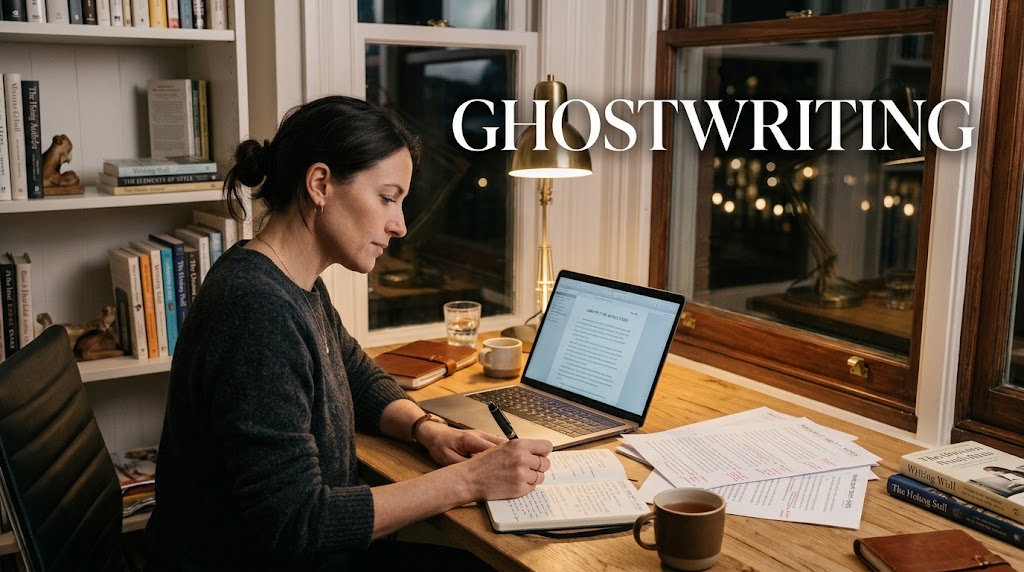
Ghostwriting is a professional writing service in which a writer creates content for another person who is publicly presented as the author or creator. It can be used for books, memoirs, speeches, articles, newsletters, LinkedIn posts, scripts and business content.
The best ghostwriting is not simply outsourcing words. You provide the knowledge, experiences, opinions and direction; the ghostwriter turns those raw materials into polished writing that sounds like you. Before hiring one, you should understand the process, realistic costs, ownership rights, confidentiality, revisions and how the writer will capture your voice.
What Is Ghostwriting?
Ghostwriting is the practice of writing content for a client without receiving the usual public byline.
The person hiring the ghostwriter may be:
- An entrepreneur with a business idea but little time to write
- An executive building a thought-leadership profile
- An author with a story but limited writing experience
- A public speaker who needs speeches
- A professional writing a memoir or biography
- A creator producing newsletters, articles or social content
- A company executive who wants a consistent personal brand
The ghostwriter may contribute substantially to the writing while remaining behind the scenes.
That arrangement is usually agreed upon before work begins. The contract can establish confidentiality, attribution, payment, revisions and ownership of the finished material.
For US projects, copyright ownership should not be assumed simply because someone paid for the writing. The US Copyright Office explains that copyright initially belongs to the author in ordinary circumstances, while specific legal requirements apply to works made for hire.
That is one reason a properly drafted agreement matters.
What Does a Ghostwriter Actually Do?
A ghostwriter’s job depends on the project, but professional ghostwriting usually involves considerably more than typing paragraphs.
Research and information gathering
For nonfiction, the writer may research the subject, industry, historical background, competitors, supporting evidence and relevant sources.
The client may also provide:
- Existing documents
- Interviews
- Presentations
- Emails
- Personal notes
- Recordings
- Previous articles
- Research files
- Company information
The quality of these materials can affect both the speed and cost of the project.
Interviews and idea development
Many ghostwriters interview clients before writing.
This is particularly useful for memoirs, biographies, business books and executive thought leadership because the client’s spoken language often reveals things that don’t appear in a written questionnaire.
A good interview can uncover:
- Stories
- Opinions
- Personal experiences
- Examples
- Arguments
- Humor
- Vocabulary
- Strong beliefs
- Details that make the writing distinctive
Outlining
Before a long manuscript is drafted, the ghostwriter may create a detailed outline.
For a business book, that could mean determining:
- The central promise of the book
- The target reader
- The main argument
- Chapter topics
- Supporting stories
- Examples and case studies
- The sequence of ideas
- The desired conclusion
The outline gives the client an opportunity to correct the direction before thousands of words are written.
Writing in the client’s voice
Voice is one of the defining skills of good ghostwriting.
The objective isn’t necessarily to make the writing sound like the ghostwriter. It should sound appropriate for the credited author.
That can involve studying:
- Previous writing
- Interviews
- Speeches
- Social posts
- Emails
- Word choices
- Sentence length
- Humor
- Formality
- Opinions
- Recurring expressions
Professional ghostwriting marketplaces also describe questionnaires, interviews and sample drafts as techniques for developing a client’s voice.
Editing and revisions
The first draft is rarely the final draft.
A client may say:
“This sounds too formal.”
Or:
“I would never say it that way.”
That feedback is valuable. Ghostwriting is collaborative, and revisions help the writer move closer to the client’s natural voice and intended message.
The contract should establish how many revision rounds are included and what happens when additional work is requested.
Confidentiality
Ghostwriters can receive sensitive information, particularly when working on memoirs, corporate projects or executive communications.
A project may therefore involve confidentiality provisions or a separate nondisclosure agreement.
The exact terms should be reviewed carefully, especially if the project involves trade secrets, private business information or unpublished material.
How Does Ghostwriting Work?
Although every project is different, the process generally follows a predictable sequence.
1. Define the project
Start by deciding exactly what you need.
“Write my book” isn’t enough.
You should know:
- The type of project
- Approximate length
- Target audience
- Subject
- Purpose
- Desired deadline
- Publishing or distribution plans
- How much research is required
- Whether interviews are necessary
A 1,500-word LinkedIn article and an 80,000-word memoir are both ghostwriting projects, but they require very different workflows and budgets.
2. Find potential ghostwriters
Look for writers with relevant experience rather than simply choosing the person with the lowest quote.
If you’re writing a memoir, look for someone who understands memoir.
If you’re creating a business book, look for someone comfortable with business concepts and interviews.
For executive content, examine whether the writer can turn complex ideas into clear, credible communication.
3. Review samples
Ask to see relevant samples where the writer is legally and contractually permitted to share them.
Don’t judge only grammar.
Look for:
- Clarity
- Structure
- Narrative flow
- Tone
- Ability to explain difficult concepts
- Audience awareness
- Emotional range
- Consistency
A technically flawless writer may still be the wrong ghostwriter for your voice.
4. Discuss the working relationship
Ask how the writer prefers to work.
For example:
- How often will you meet?
- Will interviews be recorded?
- Who creates the outline?
- How will feedback be delivered?
- How many revisions are included?
- What happens if the scope changes?
- Who researches factual claims?
- How will confidential information be handled?
These questions can prevent major misunderstandings later.
5. Sign a contract
Before substantial work begins, establish the commercial and legal terms in writing.
The agreement should address scope, payment, deadlines, revisions, confidentiality and rights.
6. Gather source material
Give the writer enough information to do the job properly.
For a memoir, this could include photographs, journals, family records and interviews.
For a business book, it could include presentations, reports, research, customer stories and company documentation.
7. Create the outline
The writer develops the structure and gets your approval.
This is one of the cheapest points in the project to make major changes.
Changing the direction of a ten-page outline is much easier than restructuring a completed 70,000-word manuscript.
8. Draft the material
The writer produces the agreed content.
Long projects may be delivered chapter by chapter rather than as one enormous document.
9. Review and revise
You provide specific feedback.
The most useful feedback isn’t simply “I don’t like it.”
Instead, explain:
- What feels wrong
- What you would say differently
- What information is missing
- Which examples are inaccurate
- Which sections don’t sound like you
10. Finalise the project
The final stage may include structural editing, copyediting, proofreading or formatting depending on the contract.
Publishing services such as cover design, typesetting, distribution and marketing are normally separate from ghostwriting unless specifically included.
How Much Does Ghostwriting Cost?
There is no single ghostwriting rate.
The price depends on the type of content, word count, research, interviews, deadline, writer’s experience and complexity of the assignment.
For book projects, current 2026 Reedsy marketplace data gives a useful benchmark. It reports typical professional ghostwriting ranges of roughly $18,000–$50,000 for nonfiction books, $3,500–$18,000 for novels, and $1,500–$5,000 for picture books.
Reedsy’s broader marketplace data also puts the average cost of ghostwriting an 80,000-word book at about $32,800, while highly experienced ghostwriters can charge considerably more.
These are benchmarks, not guaranteed market prices.
What affects the price?
Several factors can move a quote substantially.
Word count
A 10,000-word project requires less writing than an 80,000-word manuscript.
But word count alone doesn’t determine the workload.
Research
A manuscript requiring extensive independent research will generally cost more than one based primarily on material supplied by the client.
Interviews
A project involving multiple interviews can require significant scheduling, preparation, transcription, analysis and follow-up.
Subject complexity
Technical, legal, scientific or highly specialised subjects may require a writer with specific expertise.
Writer experience
An established ghostwriter with a strong track record may charge substantially more than someone entering the profession.
Deadline
An unusually short deadline can increase the price because the writer may need to reserve substantial capacity for your project.
How do ghostwriters charge?
Ghostwriters may charge:
- By the word
- By the hour
- By the project
- Through staged project payments
For full-length books, project-based pricing is common because research, interviews, outlining and revisions don’t fit neatly into a per-word calculation. Reedsy’s current guidance similarly notes that professional book ghostwriters commonly quote flat project fees, with additional work sometimes billed separately.
A quote should tell you what you’re actually buying.
A $20,000 quote and a $40,000 quote are difficult to compare if one includes extensive research and multiple revision rounds while the other covers drafting only.
What Should a Ghostwriting Contract Include?
Never rely on a handshake or vague email agreement for a major ghostwriting project.
A contract should clearly establish the relationship.
Scope of work
Specify:
- Type of content
- Approximate word count
- Number of chapters or deliverables
- Research responsibilities
- Interview requirements
- Editing included
- Revision rounds
- Delivery schedule
Payment
Clarify:
- Total fee
- Deposit
- Payment milestones
- Payment dates
- Late-payment terms
- Additional-work rates
Many large projects are divided into milestones rather than requiring the entire fee upfront.
Copyright and ownership
This is a particularly important area.
Don’t assume that “I paid for it” automatically answers every copyright question.
Under US copyright law, work-made-for-hire treatment has specific requirements and categories; it isn’t a universal label that automatically applies to every commissioned writing project.
Your agreement should therefore state what rights are being transferred or licensed and when that happens.
For a substantial project, professional legal advice can be worthwhile.
Confidentiality
Specify what information must remain confidential and how confidential material may be stored or used.
Credit
Decide whether the ghostwriter:
- Receives no public credit
- Is listed as a co-author
- Is mentioned in acknowledgments
- May use the project privately as a portfolio example
- Can disclose the relationship after publication
Don’t leave this ambiguous.
Revisions
A contract should distinguish between reasonable revisions and a completely changed project.
For example, changing the tone of a chapter is different from replacing the entire subject of the book halfway through the project.
Cancellation
Establish what happens if either party ends the relationship.
The agreement should address payment for work already completed and ownership or delivery of unfinished material.
Ghostwriter vs Co-Author vs Editor
These roles are related but not identical.
Ghostwriter
A ghostwriter writes substantial material for the client, usually without a public byline.
Co-author
A co-author receives some form of public authorship or shared credit.
Editor
An editor works with material that already exists, although the scope can range from proofreading to substantial structural editing.
The distinction matters because you’re paying for different types of expertise.
If you already have a complete manuscript but need structural improvement, an editor may be more appropriate than a ghostwriter.
If you have the ideas and expertise but don’t have a manuscript, ghostwriting may be the better fit.
How Does a Ghostwriter Capture Your Voice?
Voice matching is one of the hardest parts of ghostwriting.
A strong writer doesn’t simply imitate your vocabulary. They need to understand how you think and communicate.
Start with existing material
Provide examples such as:
- Articles
- Emails
- Speeches
- Interviews
- Social posts
- Previous books
- Presentations
These give the writer evidence of your natural style.
Talk instead of only writing
Some people express themselves much more naturally when speaking.
Recorded interviews can therefore be valuable source material.
Your writer can listen for:
- Favorite phrases
- Sentence rhythm
- Humor
- Storytelling habits
- Technical language
- Emotional tone
- How you explain concepts
Approve a sample early
Before commissioning an entire manuscript, consider agreeing on a sample chapter or short paid trial where appropriate.
You want to discover voice incompatibility early.
Give precise feedback
Tell the writer what sounds unnatural.
Instead of:
“Make it more like me.”
Try:
“I use shorter sentences and fewer formal words. I normally explain this through a story rather than a list.”
That gives the writer something actionable.
When Should You Hire a Ghostwriter?
Ghostwriting makes sense when your expertise is more valuable than your ability to produce polished copy quickly.
You might benefit if:
- You have a book idea but don’t know how to structure it.
- You have years of professional knowledge but little time to write.
- You need consistent executive content.
- You have a compelling personal story.
- You want to turn interviews or presentations into written material.
- You struggle with writing but communicate ideas clearly when speaking.
- You need professional writing without building an internal writing team.
The strongest client-writer relationships usually happen when the client remains actively involved in the ideas and subject matter while the writer handles the writing craft.
When Should You Not Hire a Ghostwriter?
Ghostwriting isn’t automatically the right answer.
Consider doing the writing yourself if:
- You genuinely enjoy writing.
- Developing your writing skills is one of your goals.
- You have plenty of time.
- The project depends heavily on a highly personal writing style you already control.
- Your budget doesn’t support professional ghostwriting.
- You expect the writer to create expertise you don’t actually possess.
A ghostwriter can organise and communicate your expertise. They cannot responsibly manufacture your life experience, credentials or professional evidence.
Common Problems People Face With Ghostwriting
The writing doesn’t sound like the client
This is one of the most common problems.
The solution is usually better onboarding, more interviews, clearer examples and earlier feedback—not simply more editing at the end.
The project keeps getting bigger
A client may begin with “write a book” and later add new chapters, interviews, research and marketing materials.
Define the scope before work starts.
The client expects unlimited revisions
Revisions are part of collaboration, but unlimited revisions can make a project impossible to price accurately.
Agree on a reasonable process.
The cheapest quote wins
This can be a costly mistake.
A ghostwriter charging dramatically less may be inexperienced, may be underestimating the project, or may be offering a much narrower service.
Compare the deliverables, process and experience—not just the headline price.
The deadline isn’t realistic
An experienced writer may need months for a substantial manuscript.
Don’t assume that an 80,000-word book can be produced in a few weeks simply because the final document is digital.
Confidential information isn’t handled properly
If your project involves sensitive information, ask how the writer stores files, who can access them and whether subcontractors or AI tools are used.
How to Choose the Right Ghostwriter
Hiring a ghostwriter is partly a skills decision and partly a relationship decision.
1. Match the writer to your project
Relevant experience matters.
A successful novelist isn’t necessarily the best business ghostwriter.
A brilliant copywriter isn’t necessarily the right memoirist.
2. Ask how they work
A professional should be able to explain their workflow.
Be cautious if someone cannot clearly explain:
- How they gather information
- How they develop voice
- How they structure projects
- How they handle revisions
- How they manage deadlines
3. Ask about ownership
Get the answer in writing.
Don’t accept vague assurances such as “you own everything” without understanding what the contract actually says.
4. Ask about confidentiality
Find out whether the writer will disclose the relationship, use the project as a portfolio sample or involve another writer.
5. Compare proposals
A good proposal should make it possible to compare:
- Deliverables
- Timeline
- Fee
- Research
- Interviews
- Revision rounds
- Rights
- Additional costs
6. Pay attention to communication
If communication is difficult before you sign a contract, it probably won’t become easier once you’re halfway through a six-month project.
Is Ghostwriting Ethical?
Ghostwriting itself isn’t inherently unethical.
It is a recognised professional arrangement in publishing, business communication, speeches and other creative fields.
The ethical question depends on the context and the expectations of the audience.
For example, hiring a ghostwriter to help produce a memoir or business book under an agreed authorship arrangement is fundamentally different from submitting someone else’s work as your own academic assessment.
Academic institutions have their own rules governing authorship, assessment and academic integrity. If the work is being submitted for academic credit, you should follow the institution’s specific policies rather than treating ordinary commercial ghostwriting practices as a guide.
The same principle applies to professional credentials: a ghostwriter should not fabricate qualifications, experiences or evidence on a client’s behalf.
Ghostwriting and AI: What’s Changed?
AI has changed the tools available to writers, but it hasn’t eliminated the need for skilled ghostwriting.
A professional may use technology for tasks such as:
- Transcription
- Research organisation
- Brainstorming
- Content management
- Draft comparison
- Administrative work
But the core ghostwriting challenge remains human: understanding what the client means and communicating it convincingly in the client’s voice.
That distinction matters.
Generic AI output can produce grammatically polished material that still doesn’t sound like a particular person. A ghostwriter’s value is often in the interviewing, judgment, structure, voice development, fact-checking and revision surrounding the words themselves.
If confidentiality matters, ask a prospective ghostwriter whether they use AI tools with client material and what safeguards apply.
How to Become a Ghostwriter
Ghostwriting can also be a career path for experienced writers.
You don’t necessarily need a degree specifically in ghostwriting.
You do need strong writing skills and the ability to work with other people’s ideas.
Build writing experience
Develop expertise in:
- Storytelling
- Research
- Interviews
- Editing
- Structure
- Copywriting
- Long-form writing
Develop a portfolio
Because ghostwritten work may not carry your name, building a portfolio can be difficult.
Start with credited work where possible.
You can also ask clients whether they will permit private portfolio use or provide a testimonial.
Choose a niche
A niche can make your positioning clearer.
Potential areas include:
- Memoirs
- Business books
- Self-help
- Executive thought leadership
- Speeches
- Fiction
- LinkedIn content
- Newsletters
- Personal branding
Learn to interview
Ghostwriting isn’t only a writing job.
You need to ask good questions, listen carefully and identify the useful material hidden inside a client’s answers.
Understand contracts and pricing
Learn the basics of scope, revisions, rights, confidentiality, payment schedules and project management.
Current industry data shows just how wide ghostwriting rates can be, so learning how to estimate the actual workload is essential.
Protect your reputation
Ghostwriting depends heavily on trust.
Meeting deadlines, respecting confidentiality and producing consistent work can be more valuable to your career than a single impressive project.
Common Questions About Ghostwriting
What exactly does a ghostwriter do?
A ghostwriter writes content for another person, usually without receiving public authorship credit. Depending on the project, they may also research, interview the client, develop the structure, edit drafts and revise the work.
How much does a ghostwriter cost?
It varies widely. For books, current 2026 Reedsy data puts typical professional projects in the thousands to tens of thousands of dollars, with nonfiction often costing substantially more than fiction.
Do ghostwriters get credit?
Not necessarily. Some remain completely anonymous, while others receive acknowledgment or co-author credit. The arrangement should be agreed upon in the contract.
Who owns a ghostwritten book?
Ownership depends on the contractual arrangement and applicable law. In the US, “work made for hire” has specific statutory requirements, so payment alone shouldn’t be treated as a complete answer.
Is ghostwriting legal?
Ghostwriting is a legitimate professional service in many contexts. However, the legal and ethical considerations depend on what is being written, how authorship is represented and what the contract says.
How long does ghostwriting take?
Short-form projects can take days or weeks, while a full book may take several months or longer. Research, interviews, revisions and client availability can all affect the schedule.
Can a ghostwriter make the writing sound like me?
Yes, an experienced ghostwriter can work toward your voice by studying existing writing, interviewing you and using your feedback. But accurate voice matching requires collaboration; it isn’t something a writer can guarantee without learning how you naturally communicate.
Final Takeaway
Ghostwriting works best when you treat it as a professional collaboration rather than simply buying a block of words.
You bring the expertise, experiences, stories and point of view. The ghostwriter brings writing skill, structure, research, interviewing and editorial judgment. A strong contract then defines what happens to the finished work, who owns the rights, how confidentiality works and what each side is responsible for.
If you’re hiring a ghostwriter, focus on fit, process, scope and rights before price. If you’re becoming one, focus on writing ability, interviewing, discretion, project management and trust.
The right arrangement can turn knowledge that would otherwise remain in conversations, presentations or unfinished notes into a polished book, article, speech or personal-brand asset—without requiring you to become a full-time writer.
FAQs
1. Is ghostwriting the same as plagiarism?
No. Ghostwriting is a commissioned professional arrangement in which authorship and credit are agreed between the parties. Plagiarism involves presenting another person’s work or ideas without appropriate attribution in a context where attribution is expected.
2. Do ghostwriters sign NDAs?
They often can. Confidentiality may be covered by an NDA or by confidentiality clauses in the main contract.
3. Can I hire a ghostwriter for LinkedIn posts?
Yes. Executive and personal-brand ghostwriting commonly includes LinkedIn posts, articles, newsletters and other thought-leadership content.
4. Should I pay a ghostwriter hourly or by project?
For substantial projects, project-based pricing can make budgeting easier. Hourly or per-word pricing may make more sense for smaller assignments or clearly defined editing work.
5. Can a ghostwriter guarantee that my book will become a bestseller?
No credible writer can guarantee a bestseller. A ghostwriter can improve the manuscript, structure and presentation, but commercial success depends on factors beyond the writing itself.
6. What should I send a ghostwriter before hiring one?
Prepare your project idea, target audience, existing material, approximate length, deadline and examples of your writing or speaking style. The more clearly you define the project, the easier it is to obtain comparable proposals.
7. Is AI replacing ghostwriters?
AI can assist with parts of a writing workflow, but effective ghostwriting still requires interviewing, judgment, voice development, research, fact-checking and collaboration. For clients who value an authentic personal voice, those skills remain significant.
Read Also: European Active Projects: Jobs, Services & Reviews
