

Coomer.su in 2026: What Happened, Is It Safe, and What We Know
what is coomer su is actually. Some pages describe the domain as expired, others point to a different Coomer domain, and many repeat broad claims about malware, takedowns, copyright, or legality.
The evidence is more nuanced.
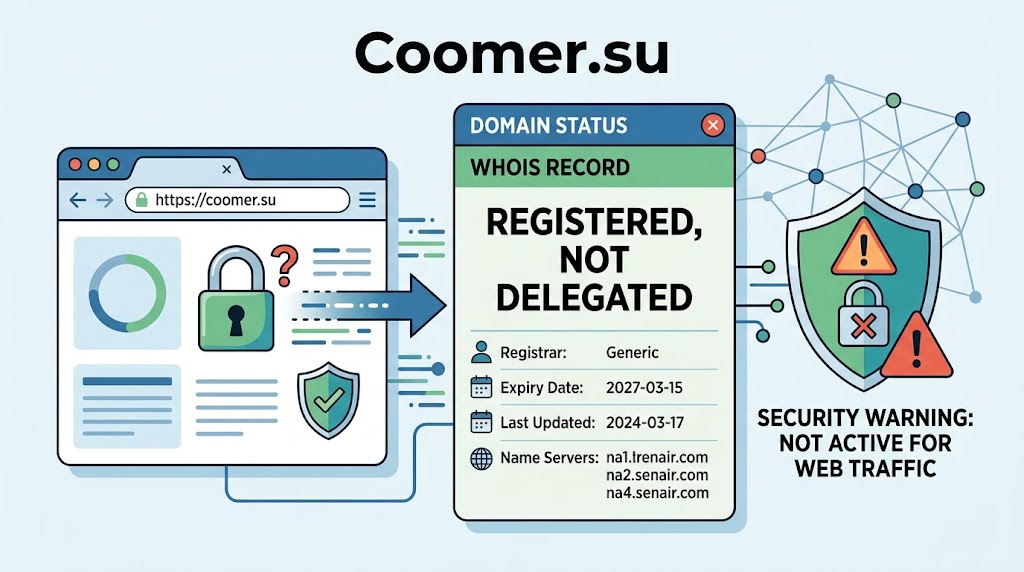
As of August 24, 2026, the original coomer.su domain is still registered. Its current WHOIS status is “REGISTERED, NOT DELEGATED,” and the registration is paid through August 25, 2027.
There is also a clear security warning: Malwarebytes says it blocks coomer.su because the domain is associated with riskware and that the platform has been abused to share malicious files.
That does not mean every page or file associated with Coomer is malware. It does mean readers should not treat the old domain as a normal, trusted website.
The more useful question is therefore not simply “Is Coomer.su down?” It is:
What can actually be verified about Coomer.su, and what should you know before trusting a site using its name?
What Was Coomer.su?
Coomer.su became associated with an unofficial archive of creator content originating from subscription-based platforms.
That distinction is important.
It was not the same thing as the creator platform where a creator originally published and monetized their work. Material appearing in an archive does not establish that the original creator uploaded it there, approved the redistribution, or continues to authorize its availability.
This creates several separate issues:
- Security: Can the website and its downloads be trusted?
- Authenticity: Is a domain actually operated by the original service?
- Copyright: Was material copied or redistributed with permission?
- Consent and privacy: Did the people depicted agree to this particular distribution?
- Practical safety: Is the site asking visitors to install software, provide credentials, or disable security protections?
These questions should not be collapsed into one simple “safe or unsafe” rating.
Does Coomer.su Still Work?
The current WHOIS record does not support the claim that coomer.su simply expired.
The domain was registered on August 25, 2022, and the current record lists an expiry date of August 25, 2027. It is registered through RUCENTER-SU, and the public registrant field identifies a “Private Person.” Most importantly, the current state is REGISTERED, NOT DELEGATED.
That distinction matters.
A domain can remain registered without functioning as an ordinary website.
So these two statements are not contradictory:
- Coomer.su is still registered.
- Coomer.su is not currently functioning as a normally delegated website.
WHOIS also cannot tell us why the domain is not delegated. It does not establish that the domain was seized, abandoned, legally taken down, or moved for any particular reason.
Those explanations require separate evidence.
What Does “Registered, Not Delegated” Mean?
A useful way to understand the status is to separate registration from DNS delegation.
Registration answers:
Is the domain still registered in the relevant registry?
For coomer.su, the answer is yes.
Delegation concerns whether the domain is configured in the DNS system so that normal internet resolution can occur.
The current WHOIS record says REGISTERED, NOT DELEGATED. That is why saying the domain is “expired” is inaccurate, while saying that the old address is not functioning normally is reasonable.
This is a good example of why checking a primary domain record is more useful than repeating an old SEO article.
Is Coomer.su Safe?
It should not be treated as a trusted website.
The strongest current evidence comes from Malwarebytes.
Its dedicated threat entry states that coomer.su is blocked because it is associated with riskware. Malwarebytes also says the domain offers a platform where users can share explicit content and that the platform has been abused to share malicious files.
That is a significant security warning.
However, there is an important distinction between what Malwarebytes actually says and what some articles claim.
What the Malwarebytes warning establishes
It supports these conclusions:
- Malwarebytes blocks
coomer.su. - Malwarebytes associates the domain with riskware.
- Malwarebytes says the platform has been abused to share malicious files.
What it does not establish
It does not prove that:
- every page contains malware;
- every image or video is malicious;
- every historical download was infected;
- every visitor was compromised;
- every file was deliberately uploaded by the site’s operator as malware.
That distinction is important for accurate reporting.
The responsible conclusion is therefore:
Coomer.su has a documented security warning and should not be treated as a trusted download environment.
That is strong enough to justify caution without exaggerating the evidence.
Why Downloads Are the Biggest Practical Concern
The risk is not limited to whether the homepage itself is malicious.
Untrusted archive environments can expose users to:
- fake download buttons;
- misleading redirects;
- executable files disguised as media;
- unwanted browser extensions;
- malicious advertising;
- suspicious file-hosting services;
- phishing pages;
- requests to disable security software.
A particularly important warning sign is a website telling you to install a special video player, codec, browser extension, desktop application, or update before you can view ordinary online media.
Do not assume that such a download is legitimate simply because the page appears to contain the video you wanted.
And do not disable antivirus or browser protection merely because a website tells you that security software is preventing access.
What About Other Coomer Domains?
This is where searchers need to be particularly careful.
A number of domains can use the word Coomer without establishing that they are controlled by the same operator.
For example, coomer.st is a separately registered domain. Its WHOIS record shows a creation date of July 24, 2025 and an expiry date of July 24, 2028.
But a domain registration does not prove common ownership.
The existence of coomer.st therefore does not, by itself, prove that it is an official successor to coomer.su.
Likewise, the existence of another domain with the same name does not prove that it is safe.
Why replacement domains are risky
When a recognizable website disappears, search demand does not disappear with it.
That creates an opportunity for:
- clones;
- impersonation sites;
- advertising pages;
- phishing domains;
- unofficial mirrors;
- unrelated businesses;
- domains trying to capture searches for the old site.
The safest approach is to verify a replacement independently rather than assuming that a familiar name means continuity.
This is the same basic principle Bardid uses when examining unfamiliar websites. For a broader example of that approach, see Voozon.com Explained: Is It Legit and How Does It Work?, which separates what a website claims about itself from what can actually be independently verified.
Does a Similar Domain Mean It Is Official?
No.
There are several pieces of evidence you would ideally want before treating a new domain as an official continuation:
- A verifiable statement from the original operator.
- A consistent technical or organizational relationship.
- A credible history connecting the domains.
- Independent evidence rather than another SEO page making the claim.
WHOIS information can establish that a domain exists and provide registration information. It does not automatically establish that two domains share the same operator.
That is why articles confidently declaring that a particular Coomer domain is “the official replacement” should be treated cautiously unless they provide evidence.
What About Copyright and Creator Consent?
Security is only one part of the story.
An unofficial archive containing creator material raises separate questions about copyright, privacy, consent, and redistribution.
These concepts are related but not identical.
For example, the fact that somebody can view a piece of content online does not automatically mean they have permission to:
- reproduce it elsewhere;
- create a permanent archive;
- redistribute it;
- sell access to it;
- upload it to another website.
Copyright rules vary by jurisdiction and by the specific circumstances.
The same is true of privacy and consent issues, particularly when intimate material is involved.
That is why it would be irresponsible to make a blanket statement such as “visiting Coomer.su is illegal.”
A more defensible statement is:
Public availability does not automatically establish that creator content was authorized for redistribution.
If you want to support a creator, the clearest route is their verified account, official website, or the legitimate platform through which they choose to publish their work.
What If You Are Looking for a Specific Creator?
If your goal is to find legitimate content from a particular creator, start with the creator rather than an archive.
Check:
- their verified social profile;
- their official website;
- their verified subscription account;
- links published through their established channels.
This has two advantages.
First, you have a better chance of finding the creator’s current and authentic material.
Second, you reduce the risk of interacting with a copycat website that happens to use the creator’s name.
Search results alone are not reliable proof of authenticity.
What If You Already Downloaded Something Suspicious?
If you downloaded a file from an untrusted website, the safest response depends on what happened.
If you have not opened it
Do not open it.
Scan it with your security software and consider deleting it if you have no legitimate reason to keep it.
If you opened or installed it
Take the possibility of compromise more seriously.
Useful steps include:
- Run a current security scan.
- Check recently installed applications.
- Review unfamiliar browser extensions.
- Review active sessions on important accounts.
- Change exposed passwords from a known-clean device.
- Enable multi-factor authentication where available.
- Watch for unusual account activity.
If you believe the device has been seriously compromised, professional technical assistance may be appropriate.
Common Claims About Coomer.su — Fact Checked
| Claim | What the evidence actually shows |
|---|---|
| “Coomer.su expired.” | Not supported by the current WHOIS record. The domain is registered through August 25, 2027. |
| “Coomer.su is a normal active website.” | Not established. Its current WHOIS status is “REGISTERED, NOT DELEGATED.” |
| “Coomer.su is safe.” | Not supported by current security evidence. Malwarebytes blocks it as riskware. |
| “Every Coomer file is malware.” | Not established. Malwarebytes says the platform has been abused to share malicious files, not that every file is malicious. |
| “Any Coomer-branded domain is official.” | Not established. Separate domain registration does not prove common ownership. |
| “Using the archive is automatically illegal everywhere.” | Too broad. Copyright, privacy, consent, and access laws vary according to jurisdiction and conduct. |
| “HTTPS means the site is safe.” | Incorrect. HTTPS protects the connection but does not establish that the website or its downloads are trustworthy. |
How to Evaluate a Coomer Replacement or Mirror
If you encounter a domain claiming to be the current Coomer site, use a simple verification process.
1. Check the exact domain
Do not rely on the name appearing in a search result.
Look carefully at the complete domain and spelling.
2. Look for independent evidence of ownership
A third-party article repeating the same claim is not strong evidence.
3. Check security warnings
If reputable security software blocks the domain, do not dismiss the warning simply because you want the page to load.
4. Avoid unnecessary downloads
A website should not need an unknown executable or browser extension merely to display ordinary media.
5. Never enter creator-platform credentials
An archive or mirror has no legitimate reason to require your password for another service unless there is a clearly documented and independently verified authentication relationship.
6. Treat “official replacement” claims skeptically
A similar name is branding, not proof.
The Practical Verdict
The current evidence gives a clearer picture than many search results suggest.
Coomer.su has not simply expired. Its current WHOIS record shows that it remains registered through August 25, 2027, but it is marked REGISTERED, NOT DELEGATED.
It should not be treated as a trusted website. Malwarebytes currently blocks the domain as riskware and says the platform has been abused to share malicious files.
A similarly named domain is not automatically an official replacement. Separate domain records cannot establish common ownership by themselves.
And publicly accessible creator content should not automatically be assumed to be authorized for redistribution.
For readers, the safest practical rule is simple:
Do not trust a Coomer-branded domain merely because it looks familiar. Verify the exact domain, respect security warnings, avoid unknown downloads and use creators’ official channels when legitimate access is available.
That answer is more useful than simply labeling Coomer.su “up,” “down,” or “safe,” because those labels leave out the evidence that actually matters.
FAQs
Is Coomer.su still registered?
Yes. The current WHOIS record lists a registration date of August 25, 2022, an expiry date of August 25, 2027, and the status REGISTERED, NOT DELEGATED.
Is Coomer.su safe?
It should not be considered a trusted website. Malwarebytes says it blocks the domain because it is associated with riskware and says the platform has been abused to share malicious files.
Does Malwarebytes say every Coomer file is malware?
No. Malwarebytes’ warning concerns the domain and says the platform has been abused to share malicious files. It does not establish that every file hosted there is malicious.
Is Coomer.st officially connected to Coomer.su?
The two domains have a connection in the wider public discussion around the Coomer service, but a separate WHOIS registration alone does not prove common ownership. The coomer.st record shows it was created in July 2025.
Is using an unofficial creator archive illegal?
There is no universal answer. The legal position can depend on the material, what the user does with it, whether it was authorized, and the applicable jurisdiction. Public availability does not automatically establish permission to reproduce or redistribute content.
What should I do if a Coomer site asks me to install software?
Do not install it merely to access the content. Treat unexpected players, codecs, browser extensions, executables, or “updates” as potential security risks, particularly when the domain itself has a security warning.
