


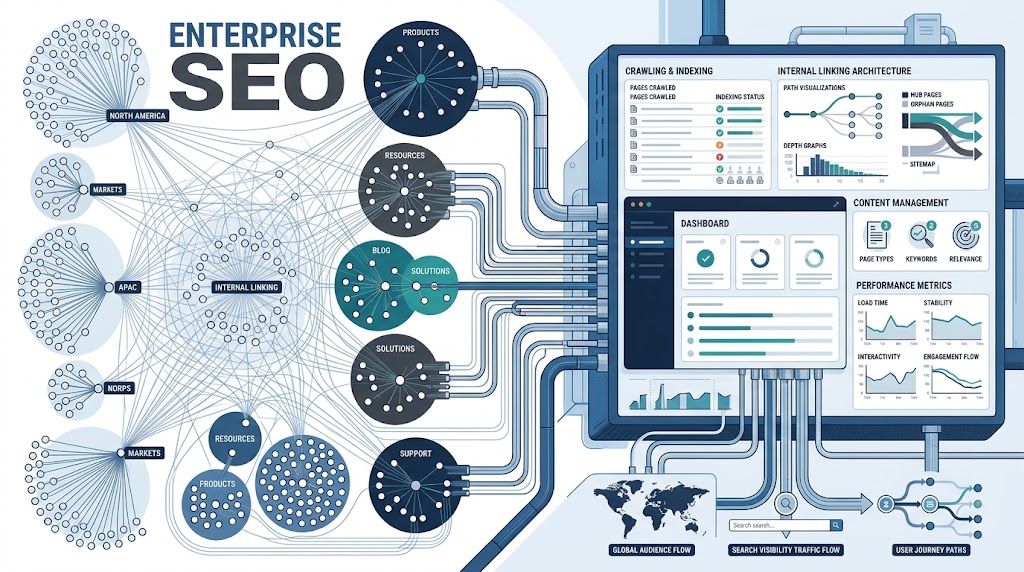
Enterprise SEO: How to Build and Scale Search Visibility Across Large Websites
Enterprise SEO is not simply “regular SEO, but with more pages.”
The real difference is scale and complexity. A single template change can affect thousands of URLs. A navigation decision can alter how search engines discover entire sections of a website. A CMS rule can generate millions of URLs. And an SEO recommendation may need approval from engineering, product, content, analytics, legal, and regional teams before it reaches production.
That changes how SEO should be managed.
Google’s current documentation does not define enterprise websites by one fixed page count. Its advanced crawl-budget guidance uses rough examples such as sites with more than 1 million unique pages or sites with more than 10,000 pages that change daily, but explicitly says these are not exact thresholds.
So enterprise SEO is better understood as the practice of improving organic search performance when a website, organization, or both have enough scale that SEO must be managed through systems, processes, automation, and cross-functional governance.
The most effective enterprise strategy therefore asks a different question from traditional page-level SEO:
What can we change once that will improve thousands of relevant pages without creating thousands of new problems?
What Is Enterprise SEO?
Enterprise SEO is the strategic and technical management of organic search visibility for large or complex organizations and websites.
The fundamentals are familiar:
- Technical SEO
- Content quality
- Site architecture
- Internal linking
- Indexation
- Structured data where appropriate
- International SEO
- Digital authority
- Measurement
What changes is the operating model.
On a small website, an SEO can often identify a problem, edit the affected pages, and see the result.
On an enterprise website, the same problem might be generated by:
- A CMS template
- A product database
- Faceted navigation
- A JavaScript application
- An international site structure
- An automated publishing workflow
- A migration
- A development release
- An internal linking rule
Fixing the individual pages without fixing the system can leave the underlying problem intact.
Enterprise SEO vs traditional SEO
| Traditional SEO approach | Enterprise SEO approach |
|---|---|
| Optimize individual pages | Optimize templates and systems |
| Build links to priority pages | Build scalable internal and external authority |
| Fix technical errors | Find the process creating the errors |
| Create more content | Decide which content deserves to exist |
| Monitor rankings | Connect search performance to business outcomes |
| Run periodic audits | Build continuous monitoring and QA |
| SEO team executes most changes | SEO works with engineering, product and content teams |
| Focus on a site | Often manage multiple markets, subdomains or properties |
This doesn’t mean every enterprise website needs every advanced SEO technique. It means the cost of getting the system wrong is much higher.
Why Enterprise SEO Is Different
One technical change can affect thousands of URLs
Imagine an ecommerce site with 300,000 product pages.
A canonical-tag problem affecting one product page is a small issue.
A template problem affecting all 300,000 product pages is an entirely different business problem.
The same applies to:
- Incorrect
noindexdirectives - Broken internal links
- Missing pagination
- Incorrect hreflang
- Duplicate title generation
- URL parameters
- Redirect rules
- Poorly implemented structured data
- Rendering failures
This is why enterprise SEO needs to prioritize root causes.
Instead of asking:
Which 500 pages should we manually fix?
Ask:
Why are 500 pages exhibiting the same problem?
That shift can turn months of repetitive work into one engineering or CMS change.
The Organization Becomes Part of the SEO Problem
Enterprise SEO is partly technical and partly organizational.
An SEO team might identify a high-impact problem but lack permission to change the underlying system. The implementation may belong to engineering. The affected content may belong to another business unit. Analytics may own the reporting. Legal may need to approve a change. A product manager may control the development roadmap.
Community discussions from enterprise practitioners repeatedly highlight this reality: SEO work often happens within development sprints, requires business justification, and involves multiple stakeholders.
That means an enterprise SEO strategy needs more than recommendations.
It needs a way to turn recommendations into implemented, tested, measurable changes.
The Core Components of an Enterprise SEO Strategy
1. Technical SEO and Crawl Efficiency
Technical SEO is particularly important at scale because structural problems can propagate across large parts of a website.
Google describes crawling as a combination of crawl capacity and crawl demand. Crawl capacity is influenced partly by how well a site’s servers respond, while crawl demand is affected by factors including site size, update frequency, popularity, quality, relevance, and the number of URLs Google knows about.
For enterprise sites, technical SEO should therefore include:
- HTTP status codes
- Redirects
- Canonicalization
- Robots directives
- XML sitemaps
- Internal links
- URL parameters
- Faceted navigation
- Duplicate URLs
- Server performance
- JavaScript rendering
- Mobile accessibility
- Structured data
- International URL structures
- Crawl and indexing monitoring
But there is an important caveat.
Don’t make crawl budget the first diagnosis
A large website does not automatically have a crawl-budget problem.
Google says its crawl-budget guidance is primarily aimed at very large and frequently updated sites, including sites with roughly 1 million or more unique pages, sites with 10,000+ rapidly changing pages, or sites with a substantial number of URLs classified as “Discovered – currently not indexed.” These are rough guidance points, not hard definitions.
For many websites, keeping a sitemap current and monitoring indexing is sufficient.
The first question should therefore be:
Are important URLs actually failing to be discovered, crawled, or updated in a meaningful way?
If the answer is no, spending months trying to “increase crawl budget” may solve the wrong problem.
2. Manage the URL Inventory
Large websites can generate enormous numbers of URLs that have little or no independent search value.
Common sources include:
- Filters
- Sorting parameters
- Search-result pages
- Tracking parameters
- Session identifiers
- Duplicate paths
- Alternative URL formats
- Calendar combinations
- Product variations
- Internal search pages
Google specifically recommends managing the URL inventory on very large sites and reducing unnecessary crawling of duplicate or unimportant URLs.
The objective isn’t simply to reduce the number of URLs.
The objective is to make the site’s searchable inventory intentional.
For every major URL type, ask:
- Does this URL represent a useful standalone resource?
- Could it satisfy a distinct search need?
- Is the content sufficiently differentiated?
- Should users be able to discover it?
- Should search engines crawl it?
- Should it be indexed?
- Is another URL the preferred representation?
Those questions are more useful than applying a blanket rule such as “index everything” or “noindex all filters.”
Enterprise Site Architecture and Internal Linking
A large website needs an architecture that works for both people and search engines.
Google’s documentation recommends organizing sites logically and using crawlable links to help Google discover pages. For ecommerce sites in particular, Google’s guidance emphasizes linking from navigation through categories to products so that important pages can be discovered.
At enterprise scale, internal linking is also a prioritization mechanism.
If a site has 500,000 URLs, it cannot give every page equal prominence.
The architecture should help communicate which pages matter.
A practical model
Consider a retailer with:
- 20 broad product categories
- 500 subcategories
- 200,000 products
- Thousands of editorial resources
The internal-linking strategy might deliberately give stronger discovery paths to:
- High-demand categories
- Important commercial landing pages
- Strategic product groups
- High-value editorial resources
- New products
- Pages with proven organic demand
That is more useful than simply telling a team to “add more internal links.”
The enterprise question
Instead of:
How can we add internal links?
Ask:
Which pages need stronger discovery and authority, and what scalable rule will provide it?
Content Strategy at Enterprise Scale
Large organizations often have an unusual SEO problem: they can produce content faster than they can determine whether it deserves to exist.
The answer is not necessarily to publish more.
Google’s people-first guidance asks whether content provides original information, research, analysis, or a substantial and complete treatment of the subject.
An enterprise content strategy should therefore distinguish between:
Content worth scaling
Examples include:
- Product information
- Location pages with genuine local value
- Category pages
- Useful comparisons
- Original research
- Expert resources
- Customer education
- Proprietary data
- Strong editorial content
Content that should be reconsidered
Examples can include:
- Automatically generated combinations with little differentiation
- Near-duplicate location pages
- Thin search-result pages
- Pages created solely because a keyword exists
- Outdated content with no continuing purpose
- Large collections of pages that satisfy no meaningful user need
The question is not:
“Can we generate another 50,000 pages?”
It is:
“What useful information can we provide at scale that users would actually want?”
International Enterprise SEO
International organizations face another layer of complexity.
A US and UK version of a site may share English but still serve different audiences, products, prices, legal requirements, availability, or terminology.
Google distinguishes between multilingual websites and multi-regional websites and recommends separate URLs for different language versions. It supports mechanisms such as hreflang annotations and sitemaps to identify language and regional alternatives.
That makes international SEO more than translation.
A multinational enterprise should consider:
- URL architecture
- Country/language targeting
hreflang- Local terminology
- Currency
- Availability
- Shipping
- Legal information
- Local search demand
- Local content requirements
- Duplicate or near-duplicate regional pages
Avoid relying on IP-based personalization alone
Google warns that locale-adaptive pages can prevent its crawlers from reliably discovering all regional variations. It recommends separate locale configurations and appropriate hreflang annotations instead.
For a global organization, making the correct regional page explicitly discoverable is generally safer than expecting search engines to infer which version should exist from a visitor’s IP address.
JavaScript and Enterprise SEO
Modern enterprise sites frequently use JavaScript frameworks and client-side applications.
That does not mean JavaScript automatically prevents SEO.
Google has supported JavaScript processing for years. The practical issue is whether the important content, links, metadata, and other search-relevant information can be correctly rendered and understood.
Enterprise teams should therefore test:
- Server responses
- Rendered HTML
- Links
- Page content
- Titles
- Canonical tags
- Robots directives
- Structured data
- Loading behavior
- Client-side routing
The useful question isn’t:
“Does this site use JavaScript?”
It is:
“After Google’s systems process this implementation, are the important pages and signals available in the way we expect?”
That is a much more productive engineering conversation.
Enterprise SEO for Migrations and Major Releases
Site migrations are one of the clearest examples of why enterprise SEO requires operational discipline.
A migration can change:
- URLs
- Internal links
- Redirects
- Canonicals
- Sitemaps
- Rendering
- Navigation
- Templates
- Metadata
- International configurations
- Structured data
- Server behavior
SEO should therefore be involved before launch, not asked to inspect the site after the migration has already shipped.
A practical migration process
Before launch:
- Crawl the existing site.
- Build a representative URL inventory.
- Identify important organic landing pages.
- Map old URLs to new URLs.
- Document canonical rules.
- Review internal-link architecture.
- Validate robots directives.
- Prepare updated sitemaps.
- Test important templates.
- Establish baseline organic performance.
At launch:
- Validate redirects.
- Check status codes.
- Check canonicals.
- Check robots directives.
- Check XML sitemaps.
- Check internal links.
- Inspect representative URLs.
- Monitor server errors.
After launch:
- Compare organic landing-page performance.
- Monitor indexing.
- Review crawl data.
- Investigate unexpected URL patterns.
- Watch high-value sections separately from the site average.
Google notes that site moves can temporarily increase crawl demand because its systems need to process URLs under the new configuration.
How to Prioritize Enterprise SEO Work
This is where enterprise SEO most clearly differs from a conventional technical audit.
A giant spreadsheet containing 50,000 SEO issues is not a strategy.
The SEO team needs to determine which problems deserve engineering, product, content, or executive attention first.
A useful prioritization framework is:
1. Scale
How many URLs, users, markets, or business units are affected?
2. Search impact
Does the issue affect:
- Discovery?
- Crawling?
- Indexing?
- Relevance?
- Search visibility?
- Conversion?
3. Business value
How commercially important are the affected pages?
A problem affecting 100 high-revenue product pages may deserve more attention than a technically larger problem affecting 100,000 low-value URLs.
4. Implementation leverage
Can one change solve the problem across thousands of URLs?
This produces a useful decision matrix:
| Issue | Scale | Business value | Leverage | Typical priority |
|---|---|---|---|---|
| Broken template canonical | High | High | High | Very high |
| Missing links to strategic category pages | High | High | High | Very high |
| Metadata issue on 20 pages | Low | Medium | Low | Medium/low |
| Duplicate parameter URLs | High | Medium | High | High if crawl/indexation is affected |
| Minor issue on low-value pages | High | Low | Medium | Usually lower |
| Critical migration redirect failure | Potentially very high | Very high | High | Immediate |
This isn’t a mathematical ranking formula. It is a way to force better decisions.
Enterprise SEO Governance and Team Structure
SEO becomes much more effective when it is integrated into existing workflows.
A mature enterprise SEO function may work with:
- SEO specialists
- Engineering
- Product management
- Content
- UX/design
- Analytics
- Data teams
- Brand
- Legal/compliance
- Regional marketing teams
- Executive leadership
The exact structure varies by organization.
The important point is that SEO should not operate as an isolated audit function.
Build SEO into engineering tickets
A useful SEO ticket should answer:
- What is wrong?
- Which URLs are affected?
- Why does it matter?
- What is the proposed implementation?
- What should the expected behavior be?
- How will it be tested?
- How will success be measured?
“Fix SEO” is not an actionable engineering requirement.
“Ensure product pages return a self-referencing canonical URL matching the final indexable URL” is much closer to one.
Add SEO checks to release processes
Where practical, automated checks can detect regressions involving:
- Status codes
- Canonicals
- Robots directives
- Titles
- H1s
- Internal links
- Sitemaps
- Structured data
- Rendering
- Redirects
The goal is to catch systemic problems before they become large-scale search problems.
How to Measure Enterprise SEO
Rankings and organic traffic still matter, but they are not enough to explain enterprise SEO performance to leadership.
A stronger measurement framework connects search visibility to business outcomes.
Business metrics
Depending on the business model:
- Organic revenue
- Qualified leads
- Transactions
- Sign-ups
- Pipeline
- Customer acquisition
- Conversion rate
Search metrics
Useful measures can include:
- Non-brand organic clicks
- Organic impressions
- Search visibility for strategic topics
- Important landing-page performance
- Search demand captured
- Organic conversions
- New versus established content performance
Technical health
Track appropriate indicators such as:
- Important pages discovered
- Indexation patterns
- Crawl errors
- Server errors
- Redirect chains
- Duplicate URL growth
- Sitemap quality
- Template-level regressions
Don’t turn every technical metric into a KPI.
A metric is useful when it helps answer a business or operational question.
Google also cautions that crawling does not guarantee indexing and that submitting a sitemap does not guarantee inclusion in search results or improve rankings by itself.
Enterprise SEO Tools and Data
The tool stack should follow the problems the organization needs to solve.
Common categories include:
| Need | Useful data/tool category |
|---|---|
| Search performance | Google Search Console |
| Traffic and conversions | Analytics platform |
| Large-scale crawling | Enterprise crawler |
| Rankings | Rank-tracking platform |
| Backlinks | Link database |
| Server behavior | Log analysis |
| Business reporting | BI/data warehouse |
| Content inventory | CMS/database |
| Technical QA | Automated monitoring |
| International SEO | Hreflang/crawl analysis |
Enterprise platforms increasingly combine crawling, rank tracking, content analysis, APIs, reporting, automation, and multi-market management. Both Ahrefs and Semrush currently position their enterprise offerings around large teams, centralized data, automation, APIs/integrations, and large-scale analysis.
But a larger tool stack is not inherently a better SEO program.
Before purchasing another platform, ask:
- What decision will this data improve?
- Who will use it?
- How often?
- Can the existing stack already answer the question?
- Can the output be connected to implementation?
A dashboard nobody acts on is not an SEO system.
Common Enterprise SEO Mistakes
Treating every URL equally
Large websites need prioritization.
Not every URL deserves the same internal prominence, content investment, crawl attention, or reporting weight.
Trying to index everything
More indexed URLs do not automatically mean more organic visibility.
Google explicitly distinguishes crawling from indexing and evaluates pages before deciding whether they belong in its index.
Fixing symptoms instead of systems
If 50,000 pages have the same problem, investigate the template, database, CMS, or process generating them.
Assuming every large site has a crawl-budget crisis
Crawl-budget optimization is an advanced concern, not a universal enterprise SEO starting point.
Publishing at scale without quality controls
Automation can multiply useful content—but it can also multiply weak content.
The greater the publishing scale, the more important editorial rules, quality checks, ownership, and monitoring become.
Treating international SEO as translation
Different markets may have different search behavior, products, legal requirements, terminology, and customer expectations.
Launching major changes without SEO QA
A successful software release can still be an SEO failure.
SEO requirements need to be part of the release process for changes that can affect search visibility.
Reporting only rankings
Executives generally need to understand what search contributes to the business, not just where thousands of keywords rank.
A Practical Enterprise SEO Roadmap
There is no universal enterprise SEO timeline, but a phased approach can make the work manageable.
First 30 days: Establish the baseline
Build a reliable view of:
- URL inventory
- Organic landing pages
- Search performance
- Indexation
- Technical health
- Site architecture
- International structure
- Content inventory
- Major business priorities
The objective is not to fix everything.
It is to understand the system.
Days 31–90: Fix high-leverage problems
Prioritize systemic issues such as:
- Incorrect templates
- Important internal-link problems
- Indexation waste
- Critical redirects
- Sitemap problems
- International configuration issues
- Major technical rendering problems
At this stage, prioritize changes that can produce broad improvements.
Months 4–6: Build repeatable workflows
Move from projects to systems:
- SEO requirements in product development
- Automated technical monitoring
- Migration checklists
- Content governance
- International SEO ownership
- Regular reporting
- Defined escalation paths
Ongoing: Monitor and improve
Enterprise SEO is not a project that reaches a permanent “done” state.
Websites change.
Products change.
Markets change.
Templates change.
Search changes.
The goal is to make the organization increasingly capable of detecting and correcting SEO problems before they become large.
The Real Role of Enterprise SEO
The most useful way to think about enterprise SEO is not as a larger version of traditional SEO.
It is SEO turned into an organizational capability.
The SEO team still needs to understand search intent, content, links, crawling, indexing, technical implementation, and measurement. But it also needs to understand systems.
That means knowing:
- How URLs are generated
- How templates work
- Who owns the CMS
- How releases happen
- How markets are structured
- Where data lives
- Which pages drive business value
- How changes are tested
- How SEO requirements enter engineering roadmaps
The highest-leverage enterprise SEO work often happens before a page exists.
A good template, navigation system, URL rule, CMS workflow, migration process, or release check can influence thousands of pages simultaneously.
That is the central advantage of thinking at enterprise scale: stop optimizing one URL at a time when the underlying system gives you a way to improve the whole class of URLs.
FAQs
What is enterprise SEO?
Enterprise SEO is the practice of managing organic search visibility for large or complex websites and organizations. It uses the same fundamental SEO principles as other websites but places much greater emphasis on scalable technical systems, automation, governance, cross-functional collaboration, and prioritization.
How is enterprise SEO different from regular SEO?
The main difference is scale and complexity. Enterprise sites may have large URL inventories, multiple templates, international markets, complex technology stacks, and many teams involved in publishing or development. A single technical or architectural decision can therefore affect thousands of pages.
How many pages does a site need to be considered enterprise?
There is no universal page-count threshold. Google’s current crawl-budget documentation uses rough examples of 1 million-plus unique pages, or 10,000-plus rapidly changing pages, when explaining which sites may need advanced crawl-budget management. Those figures are not a formal definition of an enterprise website.
Is crawl budget important for every enterprise website?
No. Crawl budget becomes particularly relevant when a site is very large or frequently changing, has substantial numbers of URLs that Google knows about but hasn’t indexed, or has other evidence that important content is not being crawled efficiently. Google’s guidance says smaller or less frequently changing sites generally don’t need to focus heavily on crawl-budget optimization.
Should an enterprise website try to get every page indexed?
No. The objective is to make valuable, useful pages discoverable and eligible for indexing rather than maximizing the raw number of indexed URLs. Google does not guarantee that crawled URLs will be indexed.
What should an enterprise SEO team measure?
The exact metrics depend on the business, but a strong measurement system connects organic search to business outcomes such as revenue, leads, transactions, or qualified traffic. It should also monitor important search and technical indicators so that the team can diagnose performance changes.
You May Also Like: Ghostwriting: How It Works, Costs & How to Hire One
