

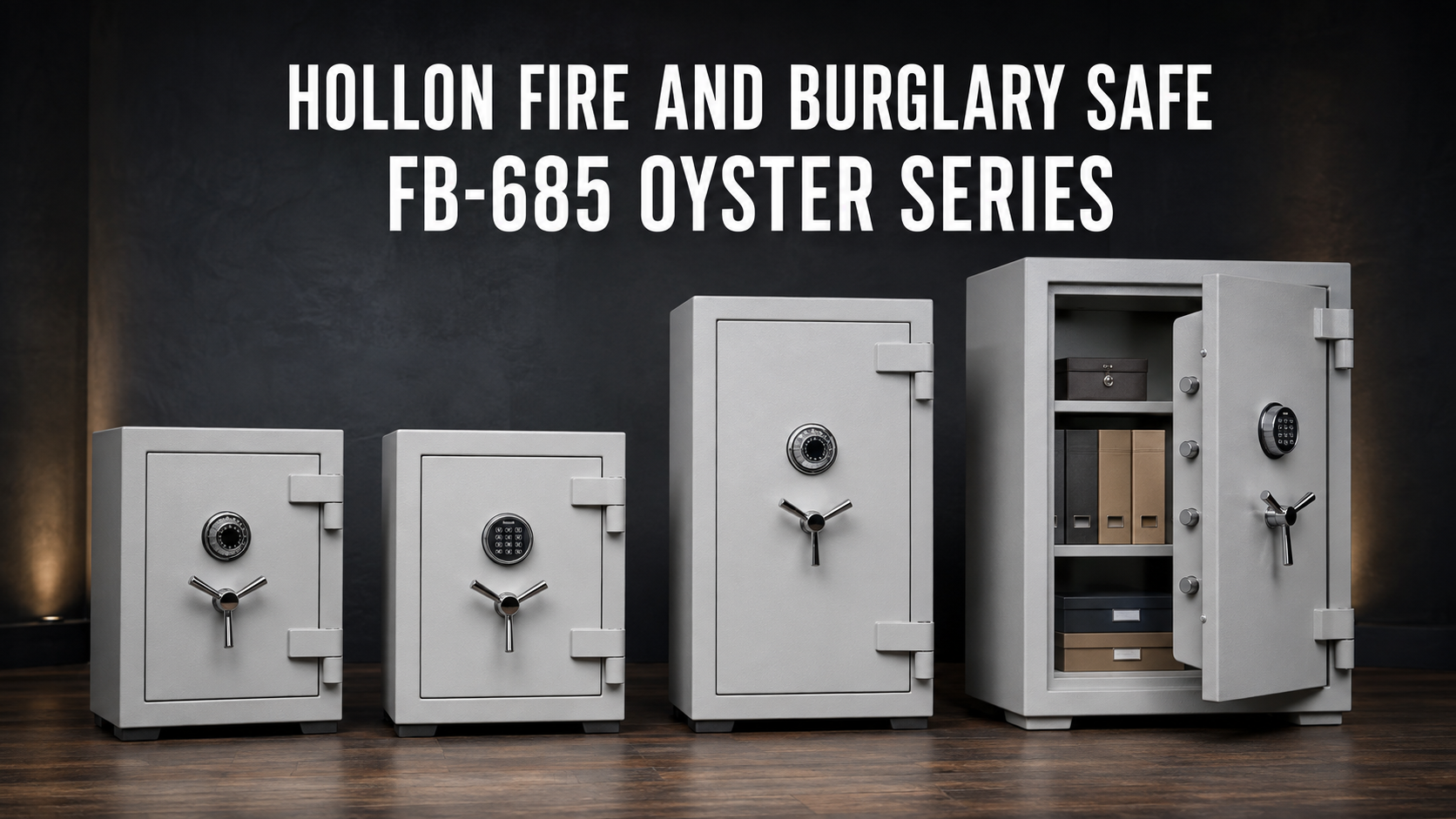
Hollon Fire and Burglary Safe FB-685 Oyster Series Review
The Hollon Fire and Burglary Safe FB-685 Oyster Series is built for homeowners and small-business owners who need more protection than a lightweight document safe can provide. It combines a manufacturer-rated two-hour fire test with three active front bolts, a glass relocker and a full-length hinge-side locking bar.
Its 2.36-cubic-foot interior is suitable for documents, jewellery, cash, watches, small valuables and some handguns. However, the safe body is not advertised as UL RSC or TL-rated. That distinction matters if your insurance company requires an independently tested burglary rating. This review explains the safe’s strengths, limitations, lock options, installation requirements and best use cases.
| Specification | Hollon FB-685 Details |
|---|---|
| Exterior dimensions | Approximately 27″ H × 21⅛″ W × 20⅜″ D |
| Interior dimensions | 21″ H × 15″ W × 13″ D |
| Additional clearance | Allow approximately 3″ for the handle and hinges |
| Interior capacity | 2.36 cubic feet |
| Weight | Approximately 345–354 pounds |
| Fire protection | Manufacturer-rated for 120 minutes |
| Internal test temperature | Listed as remaining at or below 350°F |
| Electronic model | Hollon FB-685E |
| Mechanical model | Hollon FB-685C |
| Front locking bolts | Three active bolts |
| Hinge-side protection | Full-length one-inch-thick locking bar |
| Interior shelves | Two adjustable shelves |
| Relocker | Internal glass relocker |
| Anchoring | One floor anchor hole with concrete hardware |
| Finish | Grey-white safe with chrome hardware |
The specifications above are based on Hollon’s official Oyster Series product information and its 2025–2026 product catalogue. These two sources differ on the exact weight, bolt diameter and external fire-test temperature. Buyers should confirm the specifications of the available production unit before ordering.
Quick Verdict: Is the Hollon FB-685 Worth Buying?
The FB-685 is a strong option if you want fire and burglary protection in a compact safe that can fit inside a home office, closet or small commercial space. At approximately 350 pounds, it is much harder to remove than a lightweight residential fire safe.
Its boltwork and glass relocker add useful resistance against common forced-entry attempts. The adjustable interior also makes it practical for organising documents, jewellery boxes, cash envelopes and other compact valuables.
The safe is not suitable for every buyer. Its limited interior may become restrictive as your collection grows. It is also not presented as a UL RSC, TL-15 or TL-30 safe, which may prevent it from meeting certain insurance requirements.
Consider buying it if you:
- Need fire and burglary protection in one safe
- Want a compact safe for a home or small office
- Plan to store paper documents, cash, jewellery or handguns
- Can arrange professional delivery and installation
- Will permanently anchor the safe
- Do not require a UL-rated safe body
- Want a choice between electronic and mechanical locks
Consider another model if you:
- Need a UL RSC or TL-rated container
- Store digital media requiring lower internal temperatures
- Have high-value assets covered by strict insurance conditions
- Cannot anchor the safe to a suitable floor
- Expect to outgrow 2.36 cubic feet quickly
- Need a waterproof safe
Hollon Fire and Burglary Safe FB-685 Oyster Series Specifications
The Hollon Fire and Burglary Safe FB-685 Oyster Series has an exterior height of approximately 27 inches, a width of 21⅛ inches and a body depth of 20⅜ inches. You must allow approximately three additional inches for the protruding handle and external hinges.
The internal chamber measures approximately 21 inches high, 15 inches wide and 13 inches deep. These dimensions provide 2.36 cubic feet of capacity before accounting for the adjustable shelves and irregularly shaped items.
The current Hollon product page lists the safe at approximately 354 pounds. However, the company’s 2025–2026 catalogue lists a slightly lower weight of 345 pounds. This difference may reflect a production change, specification update or documentation inconsistency.
A similar conflict exists around the locking bolts. The individual product page describes three 1.5-inch moving front bolts, while the catalogue provides a 1.25-inch series specification. Buyers should ask an authorised Hollon dealer to verify the exact bolt size and shipping weight of the unit being supplied.
These differences do not necessarily indicate a problem with the product. However, the correct weight should be confirmed before arranging freight delivery, floor placement or professional installation.
Security and Burglary Protection
The Hollon Fire and Burglary Safe FB-685 Oyster Series sits above ordinary residential fire safes in terms of its burglary features. Hollon positions the Oyster Series between its office-safe range and commercial TL-15 safes.
That positioning helps explain the intended buyer. The FB-685 is designed for people who need a substantial home or office safe but are not ready to purchase a much heavier and more expensive TL-rated vault.
No safe should be described as unbreakable. A determined attacker with enough time, privacy and specialist tools may eventually open almost any security container. The purpose of the FB-685 is to increase the time, noise, equipment and effort required to reach its contents.
Three Active Front Bolts
The safe uses three moving front bolts on the opening side of the door. When the lock is engaged, these bolts extend into the safe body and help resist pulling and prying around the door edge.
Large bolts look reassuring, but bolt diameter alone does not determine security. The strength of the surrounding frame, internal boltwork, door structure and locking mechanism also affects resistance against forced entry.
The boltwork should be tested several times while the door is open. The handle should move smoothly without requiring excessive force. If the bolts feel unusually stiff, contact the dealer before storing valuables.
Full-Length Hinge-Side Locking Bar
The safe uses external vault-style hinges that allow the heavy door to open widely. External hinges also create a common question: can someone remove the door by cutting the hinges?
The FB-685 addresses this risk with a full-length, one-inch-thick vertical locking bar on the hinge side. When the safe is locked, the bar remains engaged behind the frame. Cutting the external hinges should not allow the door to be lifted directly away from the body.
This provides better hinge-side protection than relying on external hinges alone. However, it should not be described as equivalent to a documented TL-15 or TL-30 tool-resistance test.
How the Glass Relocker Works
A glass relocker is a secondary security system located behind the lock and bolt mechanism. It is designed to react if an attack damages the protected area around the lock.
If the glass breaks, an auxiliary locking mechanism activates and blocks the normal boltwork. Entering the correct code or combination will not release a properly triggered relocker. A qualified safe technician would normally be required to open and repair the safe.
This system provides extra resistance against drilling, punching and heavy impact near the lock. It does not make the entire safe immune to every method of attack.
Some safes are transported with the relocker restrained to prevent accidental activation. Owners should not remove the inner door panel or pull a safety pin based solely on a general online tutorial. Ask the dealer or installer whether the exact unit requires activation.
Is the FB-685 UL Rated?
The FB-685E electronic lock and FB-685C mechanical lock are advertised with UL listings. This does not mean the complete safe body carries a UL burglary rating.
UL RSC testing evaluates the complete security container against defined attack methods. TL-15 and TL-30 classifications represent higher levels of independently tested tool resistance.
Hollon does not advertise the FB-685 safe body as UL RSC, TL-15 or TL-30 listed. Some retailers describe it as B-rated, but a B-rate construction label is not the same as an independent UL attack rating.
UL Solutions explains that Residential Security Containers are covered by the UL 1037 standard and evaluated according to specific security-performance criteria.
Before storing insured jewellery, expensive watches or business cash, ask your insurer:
- Does the policy require a UL RSC or TL-rated safe?
- Must the safe be permanently anchored?
- Is there a maximum value allowed inside the container?
- Does the safe need to be paired with a monitored alarm?
- Must the safe remain locked whenever the property is unattended?
The UL designation on the lock should not be presented as certification of the entire safe.
Two-Hour Fire and Impact Protection
Hollon markets the FB-685 as a two-hour fire safe designed to maintain an internal temperature of approximately 350°F or lower during the stated test.
The 350°F threshold is mainly intended to protect paper. Cash, property deeds, passports, certificates and printed records are more likely to survive at this temperature than they would inside an unprotected cabinet.
However, “fireproof” should not be interpreted as unlimited fire protection. Real fires vary in temperature, duration, building structure, airflow and exposure. The safe can delay heat transfer, but it cannot guarantee that every item will survive every fire.
The 1,700°F and 1,850°F Difference
Hollon’s Oyster Series webpage describes a two-hour factory test at an external temperature of 1,850°F while maintaining an internal temperature close to 350°F.
The company’s 2025–2026 catalogue lists a two-hour test at 1,700°F for the Fire and Burglary Series. Many dealer listings also refer to KIS and JIS testing at 1,700°F.
Because these figures differ, it is safer to describe the product as having a manufacturer-stated two-hour fire rating. Buyers who require formal certification should request the current model-specific test report directly from Hollon.
The FB-685 should not be described as UL Class 350 unless the manufacturer provides documentation confirming that exact certification.
What Can Be Stored for Fire Protection?
The stated internal-temperature limit is mainly suited to:
- Paper documents
- Passports
- Cash
- Property records
- Insurance documents
- Certificates
- Printed photographs placed in protective sleeves
It may not provide sufficient protection for:
- Hard drives
- USB flash drives
- Memory cards
- Film negatives
- Optical discs
- Laptops
- Sensitive electronic equipment
Digital media can become damaged at temperatures far below 350°F. If your main purpose is protecting backups or data-storage devices, look for a certified data safe with a lower internal-temperature limit.
Impact, Smoke and Water Resistance
Hollon also markets the Oyster Series as having completed a 30-foot impact test. This is intended to simulate a safe falling after structural collapse during a serious fire.
The door uses an intumescent seal that expands when exposed to heat. Hollon says the seal expands to eight times its original size, helping reduce the movement of smoke and water through the door opening.
This does not make the FB-685 waterproof. Floodwater, prolonged submersion or high-pressure water may still reach the interior. Place critical documents inside sealed water-resistant pouches for additional protection.
FB-685E vs FB-685C Lock Comparison
The Oyster Series offers two versions of the same safe:
- Hollon FB-685E with an electronic keypad
- Hollon FB-685C with a mechanical dial
Both models use the same basic safe body, internal capacity, shelves and burglary features. The main difference is how you unlock the door.
| Feature | FB-685E Electronic Lock | FB-685C Mechanical Dial |
|---|---|---|
| Access speed | Fast | Slower |
| Power source | 9-volt battery | No battery |
| Code changes | Usually user-programmable | Requires the correct change procedure |
| Frequent access | More convenient | Less convenient |
| Long-term maintenance | Electronic parts may eventually need service | No electronic keypad to fail |
| Lock type | S&G Type 1 electronic | S&G Group 2 mechanical |
| Best for | Regular home or office access | Buyers who prefer mechanical operation |
Reasons to Choose the FB-685E
The electronic version is more convenient for people who open the safe regularly. You enter a code, operate the handle and access the contents without completing a dial sequence.
A dead external battery should not erase the stored code. Replacing the battery normally restores power to the keypad. The lock should still be tested regularly, and the battery should be replaced when a low-power warning appears.
Electronic locks can eventually develop faults involving the keypad, cable or internal lock body. Buying from an authorised dealer with access to replacement parts and safe technicians can make future service easier.
The electronic version also includes an automatic detent feature. When the door is pushed closed, the mechanism relocks the safe. Test this function several times while the door is open before loading valuables.
Reasons to Choose the FB-685C
The mechanical dial is suited to buyers who want a traditional lock without battery dependence. It may be preferable for documents and valuables that are accessed only occasionally.
Its main drawback is convenience. A dial requires a precise turning sequence, and entering the combination takes longer than using a keypad. People with limited hand movement or poor eyesight may find the electronic version easier.
Sargent & Greenleaf describes its 6700 Series as a UL Group 2 mechanical safe lock. This listing applies to the lock rather than the complete FB-685 safe body.
Interior Layout and Everyday Usability
The interior measures approximately 21 inches high, 15 inches wide and 13 inches deep. Two adjustable shelves allow you to create separate storage areas for different types of property.
The safe can hold a practical combination of:
- Passports and certificates
- Property and insurance documents
- Cash envelopes
- Compact jewellery cases
- Watches and small collectibles
- Spare keys
- Some handguns stored in suitable sleeves or cases
The 15-inch interior width is the main limitation. Large jewellery boxes, bulky document cases and full-size electronic devices may not fit comfortably.
Measure your largest item before ordering. Do not rely only on the advertised cubic-foot capacity, because shelves, cases and irregularly shaped items reduce practical storage space.
Should You Buy the Larger FB-845?
The larger FB-845 is worth considering if the FB-685 would already be nearly full when installed. Home-safe collections often grow as owners add new documents, jewellery, watches and family records.
Choose the FB-845 if:
- Multiple family members will use the safe
- You expect your valuables to increase
- You need more vertical space
- You want separate areas for different item categories
- Your delivery route and floor can support the added size and weight
Stay with the FB-685 when available space is restricted or the safe must fit inside a specific closet. Its compact external dimensions are one of its main advantages.
Delivery, Placement and Anchoring
A safe weighing around 350 pounds requires proper delivery planning. Many free-shipping offers cover curbside freight only. The driver may leave the packaged safe at the curb, driveway or garage entrance rather than moving it into the building.
Before ordering, confirm:
- Whether delivery is curbside, garage or white-glove
- Whether stairs are included
- Whether the delivery team will cross the threshold
- Whether installation and anchoring are included
- Who handles freight damage
- How quickly damage must be reported
- Whether packaging removal is included
Measure every doorway, hallway, turn and stair landing along the delivery route. Include extra room for packaging and moving equipment.
The safe body is approximately 20⅜ inches deep, but the handle and hinges require additional clearance. Leave enough space beside the safe for the door to open properly.
Bolting the Safe Down
The FB-685 includes one floor anchor hole and hardware intended for concrete installation. Anchoring makes it harder for thieves to remove the safe or tip it onto its back for additional leverage.
Do not assume that its weight alone prevents removal. Several people with suitable moving equipment may still be able to take an unanchored 350-pound safe.
Wood-floor installation may require different fasteners and access to structural framing. The included concrete anchor should not be installed directly into timber.
Professional installation is strongly recommended when:
- The safe must travel upstairs
- It will be installed on hardwood flooring
- The floor structure is uncertain
- Underfloor heating or concealed utilities may be present
- The safe needs to be anchored through finished flooring
- The delivery path includes tight corners
Price, Warranty and Common Problems
During August 2026 research, several US dealers listed the FB-685E and FB-685C at approximately $1,463 before optional white-glove delivery or installation.
The complete cost can be higher once you include:
- Inside delivery
- Stair charges
- Professional moving
- Floor protection
- Anchoring
- Lock upgrades
- Local technician fees
Compare the total installed price rather than choosing a seller solely because the listing says “free shipping.”
Warranty Coverage
Hollon provides a lifetime fire guarantee for its fireproof safes. According to the company’s official warranty terms, an eligible fire-damaged safe can be replaced with the same or a comparable model. The guarantee includes freight within the contiguous United States to the original purchase address.
Parts, labour and lock coverage may have shorter terms. Ask whether the warranty covers locksmith labour, travel, drilling, removal and reinstallation.
Keep the original receipt, model information, serial number and photographs of the installed safe. These records may be required when making a warranty claim.
Problems to Check After Delivery
Inspect the safe before accepting the freight shipment whenever possible. Common delivery or ownership concerns include:
- Scratched or dented exterior panels
- Bent shelf supports
- Damaged interior trim
- A stiff handle or bolt mechanism
- Keypad faults
- Incorrect door alignment
- Missing anchor hardware
- Confusion about relocker activation
Photograph the packaging and any visible damage. Report problems within the seller’s required time limit.
Test the lock with the door open before storing anything. Enter the code or combination several times and confirm that the bolts extend and retract smoothly.
Final Verdict
The Hollon Fire and Burglary Safe FB-685 Oyster Series offers a useful balance of compact dimensions, manufacturer-rated fire protection and stronger burglary features than many basic home safes.
Its three active front bolts, full-length hinge-side bar, glass relocker and heavy construction make it suitable for homeowners and small businesses protecting paper documents, jewellery, cash and other compact valuables.
The FB-685E is the better option for quick, frequent access. The FB-685C is more appropriate for buyers who prefer a traditional mechanical dial.
Its main weakness is the absence of a clearly advertised UL RSC or TL rating for the safe body. Buyers with expensive insured property should confirm their insurer’s requirements before ordering.
The safe is worth considering when you need a compact fire and burglary safe, can arrange professional installation and understand the difference between manufacturer test claims and independent certification.
Frequently Asked Questions
Is the Hollon Fire and Burglary Safe FB-685 Oyster Series UL rated?
Its S&G electronic or mechanical lock is advertised as UL-listed. The complete safe body is not advertised as UL RSC, TL-15 or TL-30 rated.
Is the Hollon FB-685 fireproof for two hours?
Hollon markets the FB-685 with a two-hour fire rating and an internal-temperature limit of approximately 350°F. Current manufacturer materials differ between 1,700°F and 1,850°F external test temperatures.
Is the FB-685 waterproof?
No. Its intumescent door seal provides resistance against smoke and some water intrusion, but the safe is not designed for flooding or prolonged submersion.
Which is better, the FB-685E or FB-685C?
Choose the FB-685E for faster access and easier code changes. Choose the FB-685C if you prefer a mechanical dial without battery dependence.
Does the Hollon FB-685 need to be anchored?
Yes. Anchoring helps prevent thieves from carrying away the safe or tipping it over for leverage. The safe includes one floor anchor hole and concrete hardware.
Can the FB-685 protect hard drives and USB devices?
Its stated 350°F internal limit is mainly intended for paper. Hard drives, memory cards and other digital media may fail at much lower temperatures. Use a certified data safe for electronic storage.
How do you activate the glass relocker?
Ask the dealer or installer whether the exact unit requires activation after delivery. Do not remove the inside door panel or pull a shipping restraint without model-specific instructions.
You May Also Like: Best Car Gun Safes of 2026: A Fit-First Buyer’s Guide
