


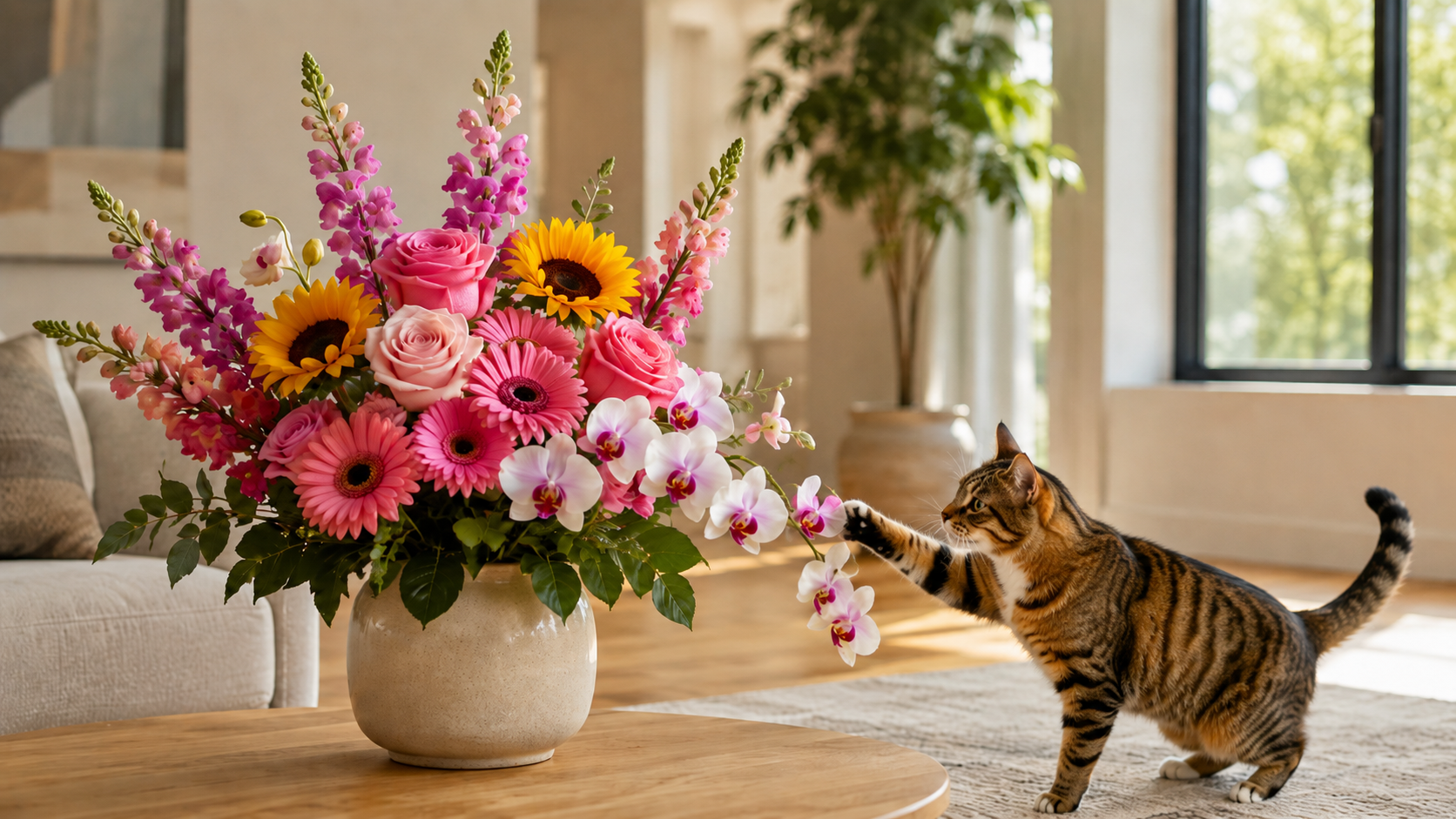
12 Cat Safe Flowers for Beautiful, Pet-Friendly Bouquets
Cat safe flowers include roses, Gerbera daisies, sunflowers, orchids, snapdragons, freesias, lisianthus, zinnias, asters, statice, stock, and waxflower. These blooms are considered non-toxic to cats when the exact species has been correctly identified.
That does not make them cat food. Eating any plant material may still cause vomiting or diarrhea, while thorns, pesticides, flower food, and unidentified greenery create separate risks. The safest approach is to check every stem in a bouquet, use botanical names when possible, and keep even non-toxic flowers away from cats that like to chew. Never bring true lilies or daylilies into a home with cats.
Quick Answer: Which Flowers Are Safe for Cats?
Five of the most common cat safe flowers are:
- Roses (Rosa species): Non-toxic, but thorns should be removed.
- Gerbera daisies (Gerbera jamesonii): Safe and available in many bright colors.
- Sunflowers (Helianthus species): Non-toxic and ideal for cheerful arrangements.
- Orchids: Many familiar varieties, including Phalaenopsis orchids, are non-toxic.
- Snapdragons (Antirrhinum majus): Safe blooms that add height to a bouquet.
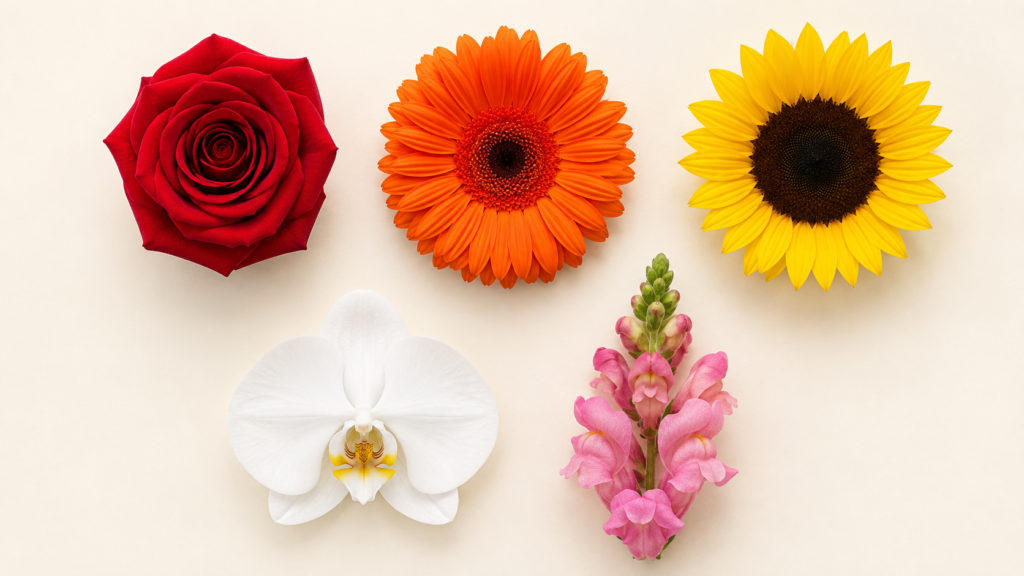
The ASPCA’s current flower-safety guidance also identifies roses, sunflowers, zinnias, Gerbera daisies, snapdragons, orchids, asters, statice, freesias, and waxflower as non-toxic options.
| Flower | Botanical name | Cat-safe status | Main caution |
|---|---|---|---|
| Rose | Rosa species | Non-toxic | Remove thorns |
| Gerbera daisy | Gerbera jamesonii | Non-toxic | Do not confuse it with chrysanthemums |
| Sunflower | Helianthus species | Non-toxic | Large amounts may upset the stomach |
| Orchid | Selected Orchidaceae species | Non-toxic | Verify the variety |
| Snapdragon | Antirrhinum majus | Non-toxic | Its bitter taste may cause drooling |
What Does “Cat Safe” Really Mean?
When veterinary sources describe cat safe flowers, they mean the plant is not known to contain toxins expected to cause serious poisoning in cats. They do not mean that a cat can safely eat unlimited petals, stems, or leaves.
Cats are meat-eaters, and their digestive systems are not designed to process large quantities of plant material. Even a non-toxic flower may cause:
- Vomiting
- Diarrhea
- Drooling
- Loss of appetite
- Stomach discomfort
- Choking or an intestinal blockage after a large ingestion
Flowers can also carry substances that are not naturally part of the plant. Pesticides, fertilizers, preservatives, decorative sprays, glitter, and flower food may make an otherwise safe arrangement risky.
Use the ASPCA’s toxic and non-toxic plant database for cats whenever you need to verify a flower. Search by its botanical name rather than relying only on a florist’s common name.
Why Common Flower Names Can Be Misleading
A true rose from the Rosa genus is non-toxic. Christmas rose, desert rose, moss rose, and primrose are different plants, and some are toxic to cats despite having “rose” in their names.
The same problem occurs with lilies. Easter lilies, Asiatic lilies, tiger lilies, peace lilies, lily of the valley, Peruvian lilies, and daylilies are different plants. Some cause mouth irritation, while true lilies and daylilies can cause fatal kidney injury.
For this reason, a useful list of cat safe flowers should include botanical names and not rely on appearance or marketing labels alone.
12 Cat Safe Flowers for Your Home or Bouquet
The following cat safe flowers are practical choices for gifts, home arrangements, and special occasions. Every option should still be kept away from a cat that regularly chews plants.
1. Roses
True roses from the Rosa genus are non-toxic to cats. They are easy to find and available in red, pink, white, yellow, peach, orange, and mixed colors.
The flower itself is not the main concern. Sharp thorns can injure a cat’s paws, skin, eyes, or mouth. Ask the florist to remove the thorns and avoid petals treated with glitter, dye, or decorative spray.
Roses are among the most useful cat safe flowers for romantic bouquets because they pair well with lisianthus, statice, snapdragons, and verified waxflower.
2. Gerbera Daisies
Gerbera daisies, scientifically known as Gerbera jamesonii, are non-toxic to cats. Their large blooms are available in red, yellow, orange, pink, white, and other bright shades.
Do not confuse Gerbera daisies with chrysanthemums or mums. Both can have a daisy-like shape, but chrysanthemums are toxic to cats. Ask for “Gerbera” by name rather than requesting any type of daisy.
3. Sunflowers
Verified Helianthus species are non-toxic to cats. Sunflowers work especially well in summer, fall, birthday, congratulations, and get-well arrangements.
Their large heads can make a vase top-heavy. Use a stable container with a wide base so your cat cannot easily knock it over. A small bite is not expected to cause serious poisoning, but eating a large amount may still upset the stomach.
4. Orchids
Many commonly sold orchids are non-toxic, including familiar varieties from the Phalaenopsis, Cymbidium, Dendrobium, and Oncidium groups.
Orchids work well for people who want elegant cat safe flowers or a potted plant that lasts longer than a cut arrangement. Since the orchid family contains thousands of species and hybrids, confirm the exact variety before buying an unfamiliar plant.
5. Snapdragons
Snapdragons, or Antirrhinum majus, are non-toxic to cats. Their upright stems add height to a bouquet, while their flowers come in white, yellow, peach, pink, red, and purple.
The flowers have a bitter taste. A cat that bites one may drool briefly, but the plant is not expected to cause serious toxicity. Keep it out of reach to prevent chewing and protect the arrangement.
6. Freesias
Freesias are fragrant, funnel-shaped flowers available in white, yellow, pink, purple, orange, and red. Verified freesia species are widely used in pet-friendly bouquets.
These blooms are useful when you want scented cat safe flowers without adding lilies. They work as supporting flowers beside roses, lisianthus, or snapdragons. Eating them may still cause mild digestive discomfort.
7. Lisianthus
Lisianthus, or Eustoma grandiflorum, has layered petals that resemble soft roses. It comes in white, pink, purple, blue, cream, and mixed shades.
It is a strong option for wedding arrangements, romantic gifts, and formal bouquets. Lisianthus provides a full, elegant appearance without thorny stems and pairs naturally with roses and statice.
8. Zinnias
Zinnias, particularly Zinnia elegans, are non-toxic flowers with rounded, layered blooms. Their bright colors make them suitable for cheerful home displays and informal gifts.
They look especially attractive with sunflowers and snapdragons. As with other cat safe flowers, remove fallen leaves and petals so your cat is not encouraged to play with or eat them.
9. Asters
Verified aster varieties, including suitable Aster and Symphyotrichum species, are considered non-toxic to cats. Their smaller, daisy-like flowers add texture around larger focal blooms.
Identification matters because several unrelated plants are sold under broad daisy-style names. Ask the florist to confirm the botanical name before adding asters to a mixed bouquet.
10. Statice and Limonium
Statice belongs to the Limonium genus and is commonly used as a filler flower. Its tiny purple, blue, pink, yellow, or white blooms help create a fuller arrangement.
Verified statice is one of the most practical cat safe flowers for replacing unidentified filler. It also dries well, although dried pieces should remain out of reach because sharp fragments can irritate the mouth.
11. Stock
Stock, or Matthiola incana, produces clusters of fragrant flowers along upright stems. It is commonly available in white, cream, pink, lavender, and purple.
Stock adds fragrance, height, and volume to a bouquet. It is considered non-toxic, but a cat that eats the leaves or stems may still develop a mild upset stomach.
12. Waxflower
Verified waxflower from the Chamelaucium genus produces small, star-shaped blooms. It is often available in white, pink, or purple and works well as a delicate bouquet filler.
Waxflower pairs nicely with roses, orchids, and lisianthus. Because the common name “waxflower” may be used loosely, confirm the botanical name before treating an unfamiliar plant as safe.
Cat Safe Flowers for Bouquets: Check Every Ingredient
A bouquet does not become safe just because its main flowers are non-toxic. Florists may add filler flowers, leaves, berries, and greenery that are not listed on the product page or bouquet label.
Before buying cat safe flowers, ask the florist to identify:
- Every focal flower
- Every supporting flower
- All filler flowers
- Every type of greenery
- Decorative berries or seed pods
- Dried plant material
- Floral sprays or preservatives
Avoid arrangements described only as “designer’s choice,” “seasonal mix,” or “assorted greenery.” If the florist cannot identify one of the stems, ask for it to be removed.
Is Eucalyptus Safe for Cats?
No. Eucalyptus is popular bouquet greenery, but the ASPCA classifies eucalyptus as toxic to cats. Ingestion may cause drooling, vomiting, diarrhea, weakness, or depression.
A bouquet containing safe roses and toxic eucalyptus should not be described as cat-safe. Request a flower-only arrangement when verified non-toxic greenery is unavailable.
Is Baby’s Breath Safe for Cats?
The answer depends on the exact species and how the term is being used. The ASPCA entry for Gypsophila elegans classifies it as non-toxic but notes that vomiting or diarrhea may still occur after ingestion.
Other sources treat baby’s breath more broadly as an unsafe or irritating filler. Since bouquet labels rarely provide the exact Gypsophila species, cautious cat owners may prefer verified statice, waxflower, freesia, or lisianthus instead.
Flowers Toxic to Cats That Should Stay Out of Your Home
Knowing which flowers to avoid is just as valuable as choosing cat safe flowers. Some toxic flowers cause temporary stomach irritation, while others can produce kidney, liver, heart, or nervous-system damage.
True Lilies and Daylilies
True lilies from the Lilium genus and daylilies from the Hemerocallis genus are medical emergencies for cats.
Dangerous varieties include:
- Easter lilies
- Asiatic lilies
- Stargazer lilies
- Oriental lilies
- Tiger lilies
- Japanese show lilies
- Daylilies
The leaves, petals, stems, pollen, and vase water can all be dangerous. A cat may brush against pollen and later swallow it while grooming.
The FDA’s guidance on lilies and cats warns that even a small exposure can cause fatal kidney failure in less than three days. Removing the pollen or placing the bouquet on a high shelf does not make a true lily safe.
Tulips, Daffodils and Hyacinths
Tulips, daffodils, and hyacinths are toxic to cats. Their bulbs usually contain the highest concentration of toxic compounds, but the leaves and flowers should not be treated as safe.
Possible signs include vomiting, diarrhea, drooling, abdominal discomfort, reduced appetite, and weakness. Potted bulbs create an extra risk for cats that enjoy digging in soil.
Chrysanthemums and Carnations
Chrysanthemums, commonly called mums, can cause vomiting, diarrhea, drooling, skin irritation, and poor coordination. Carnations generally cause milder reactions but are still classified as toxic to cats.
Gerbera daisies, roses, and lisianthus offer similar color and volume without using these toxic flowers.
Other Flowers and Greenery to Avoid
The ASPCA’s toxic plant guidance identifies several other plants that can harm cats and other pets. Common examples include:
- Azaleas
- Oleander
- Hydrangeas
- Foxglove
- Iris
- Gladiolus
- Bird of paradise
- Ivy
- Holly
- Mistletoe
Do not try to identify an unknown flower by color or petal shape alone. Keep it away from your cat until a florist, veterinarian, or reliable plant database confirms its identity.
How to Buy Cat Safe Flowers From a Florist
Tell the florist that the arrangement is going into a home with a cat. The phrase “pet-friendly” can be too broad because a plant may affect cats and dogs differently.
You can send this request when ordering:
“This bouquet is for a home with a cat. Please use only flowers, fillers, and greenery confirmed as non-toxic to cats. Do not include true lilies, daylilies, eucalyptus, chrysanthemums, carnations, or unidentified foliage. Please list every plant used and contact me before making substitutions.”
Ask the florist to:
- Remove rose thorns
- Exclude every true lily and daylily
- Identify all greenery and filler
- Avoid glitter, dye, scented oils, and decorative sprays
- Explain how to use the flower-food packet
- Confirm any substitution before changing the arrangement

This simple checklist makes buying cat safe flowers easier and reduces the chance of an unsafe filler being added at the last moment.
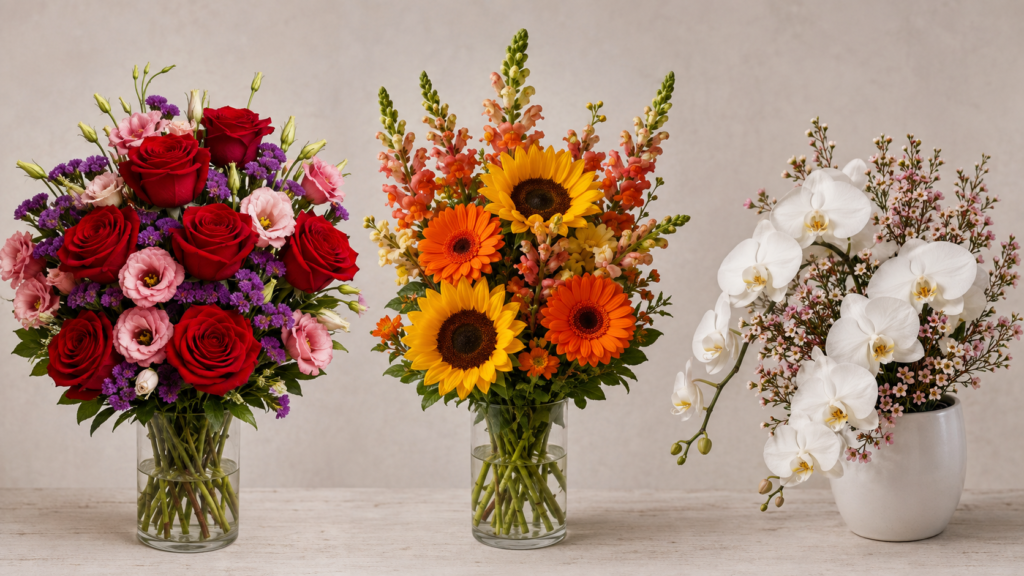
Three Cat Safe Bouquet Ideas
Romantic Rose Bouquet
Combine de-thorned roses with lisianthus and verified statice. This creates a layered romantic arrangement without eucalyptus, carnations, or unidentified baby’s breath.
Bright Sunflower Bouquet
Use sunflowers as the focal blooms, Gerbera daisies for extra color, and snapdragons for height. This combination works well for birthdays, congratulations, and get-well gifts.
Elegant Orchid Arrangement
Combine a verified Phalaenopsis orchid with lisianthus and waxflower. Keep the design simple so that each ingredient remains easy to identify.
These cat safe bouquet ideas are starting points rather than automatic guarantees. Confirm every plant’s botanical name before purchasing the finished arrangement.
How to Display Cat Safe Flowers at Home
Even cat safe flowers should be placed where your cat is unlikely to chew them. Choose a heavy vase with a wide bottom and avoid placing it beside furniture your cat uses for jumping.
Follow these precautions:
- Pick up fallen petals and leaves promptly.
- Replace dirty vase water regularly.
- Store unused flower food securely.
- Do not add essential oils to the water.
- Avoid loose ribbons and strings that could be swallowed.
- Keep the arrangement in a closed room when you are away.
- Offer cat grass if your cat regularly seeks out plants.
Vase water may contain bacteria, flower food, plant residue, or chemicals. Do not let your cat drink it, even when the flowers themselves are non-toxic.
What to Do If Your Cat Eats a Flower
Remove your cat from the area and prevent further exposure. Photograph the flower, bouquet, label, and packaging so a veterinary professional can help identify the plant.
Contact your veterinarian, an emergency veterinary hospital, or ASPCA Animal Poison Control at (888) 426-4435. The hotline is available 24 hours a day, although a consultation fee may apply.
Be ready to explain:
- What plant was involved
- Which part the cat touched or ate
- How much may have been eaten
- When the exposure happened
- What symptoms you have noticed
- Your cat’s age, weight, and medical history
Do not induce vomiting or give milk, oil, salt, or another home remedy unless a veterinary professional tells you to do so.
If a true lily or daylily may be involved, seek emergency veterinary care immediately. Do not wait for symptoms because kidney damage may begin before your cat appears seriously ill.
Final Takeaway
The best cat safe flowers are clearly identified, non-toxic blooms arranged without dangerous fillers or greenery. Roses, Gerbera daisies, sunflowers, verified orchids, snapdragons, freesias, lisianthus, zinnias, asters, statice, stock, and waxflower give you plenty of attractive choices.
Check every stem, remove thorns, keep the vase out of reach, and never allow true lilies or daylilies into your home. With those precautions, cat safe flowers can bring color into your space without creating an avoidable risk for your pet.
Frequently Asked Questions About Cat Safe Flowers
What flowers are safest for cats?
Roses, Gerbera daisies, sunflowers, snapdragons, freesias, lisianthus, zinnias, statice, and verified orchids are common non-toxic choices. Cats should still be prevented from eating them.
Are roses safe for cats?
True roses from the Rosa genus are non-toxic to cats. Remove the thorns and avoid chemical sprays, pesticides, and misleading plants such as Christmas rose or desert rose.
Are orchids safe for cats?
Many common orchids, including Phalaenopsis, Cymbidium, Dendrobium, and Oncidium varieties, are considered non-toxic. Confirm the exact variety before buying an unfamiliar orchid.
Is baby’s breath safe for cats?
The ASPCA lists Gypsophila elegans as non-toxic but notes that it may cause vomiting or diarrhea. If the exact species is unknown, choose a clearly identified alternative such as statice.
Can cats drink flower-vase water?
No. Vase water may contain bacteria, flower food, pesticides, plant residue, or toxins from unsafe flowers. Water that has held true lilies or daylilies is particularly dangerous.
Can removing lily pollen make lilies safe for cats?
No. The stems, leaves, petals, pollen, and vase water of true lilies and daylilies can all be dangerous. These plants should be kept completely out of cat households.
What should I tell a florist when ordering cat safe flowers?
Explain that the bouquet is for a home with a cat. Request a full ingredient list, no true lilies or daylilies, no eucalyptus, no unidentified greenery, and no substitutions without your approval.
You May Also Like: Erothtos Safety Review: Risks and Legal Alternatives
