


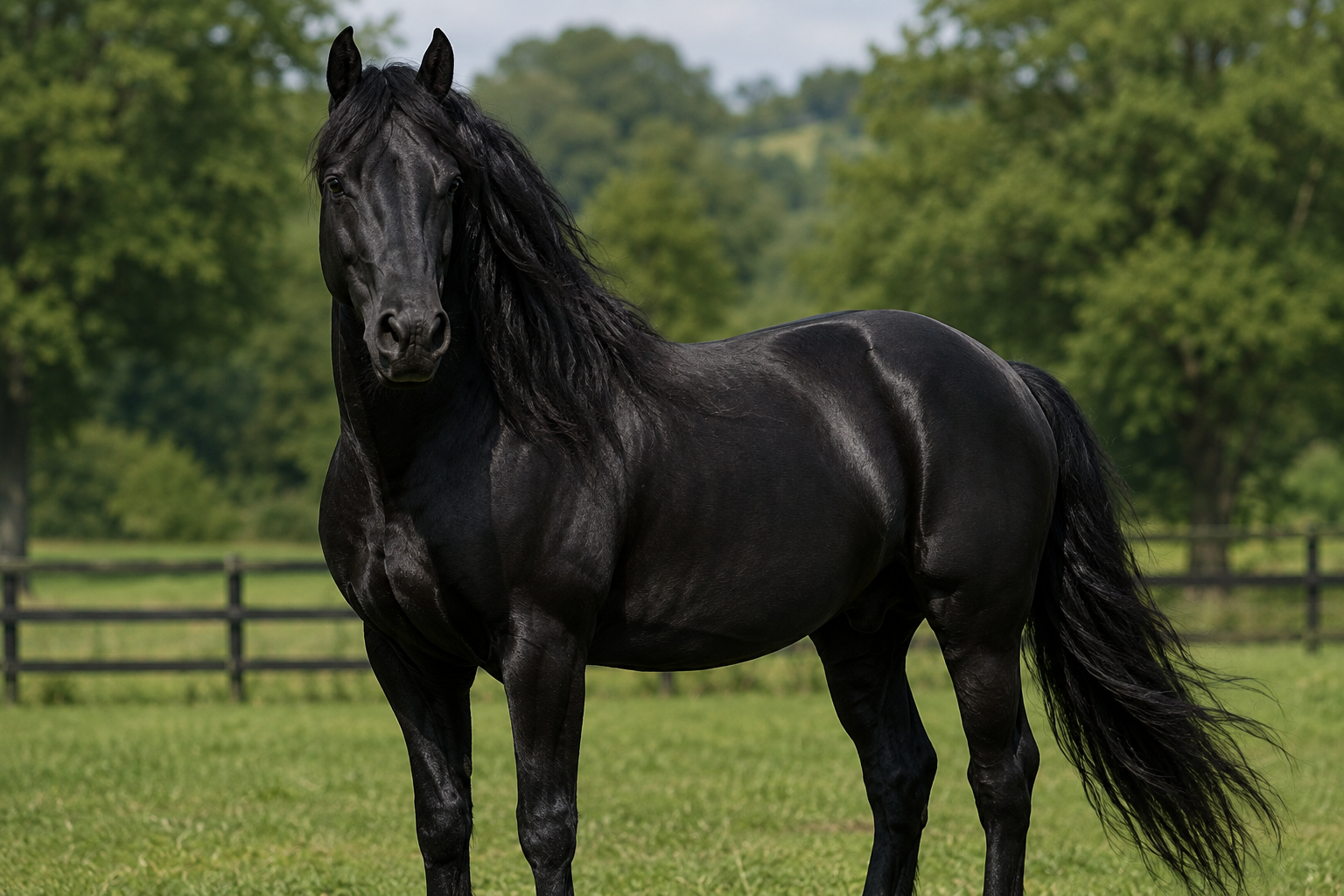
Black horses are defined by a true black base coat, not by breed. A genetically black horse has black pigment distributed across the body rather than restricted mainly to the mane, tail and lower legs.
The most famous example is the Friesian, but black horses occur in many breeds, including Murgese, Fell Pony, Dales Pony, Morgan, Thoroughbred and several draft breeds. If your horse looks black but develops brown or reddish hairs in the sun, that does not automatically mean it is a different color. Coat fading, lighting and genetics can all affect appearance. Understanding the difference between a true black, dark bay and other dark coats makes identification much easier.
What Is a Black Horse?
Black is one of the three basic horse coat colors, alongside bay and chestnut. At the genetic level, black coloring is associated with the production and distribution of eumelanin, the pigment responsible for black and brown coloration.
A true black horse generally has:
- A black body coat
- Black mane and tail
- Black lower legs
- Dark skin
- Dark eyes
- No naturally brown body areas caused by the bay pattern
White markings do not necessarily prevent a horse from being classified as black. A black horse can have a star, stripe, socks or other white markings depending on its genetic pattern.
The key distinction is where the black pigment is distributed. The Agouti gene controls whether black pigment remains concentrated at the horse’s points or spreads across the body. A horse with the recessive a/a Agouti genotype, assuming it has the genetic ability to produce black pigment, can have black pigment distributed uniformly over its body.
That is why “black” describes a coat color, not a breed.
How to Tell a Black Horse From a Dark Bay Horse
This is one of the most common sources of confusion.
A very dark bay horse can look almost completely black from a distance. The difference becomes easier to see when you examine areas where the horse has less dense hair or where the underlying color is more obvious.
Check the muzzle
Look closely around the muzzle and lips, particularly in good natural light.
A true black horse normally has black hair across the body, while a dark bay can show warmer reddish or brown tones around the muzzle.
Look at the flanks
Part the hair or inspect the coat in direct but natural light.
Dark bay horses may reveal reddish or brown hairs on the flank, around the elbows or underneath the belly. These warmer areas are a useful clue that the horse is bay rather than black.
Examine the mane and tail
Both black and bay horses can have black manes and tails, so these areas alone aren’t enough to identify the color.
Instead, compare the mane and tail with the body.
If the mane and tail are black but the body has obvious reddish-brown tones, bay is more likely.
Don’t rely on photographs alone
Lighting can dramatically change how a black horse looks.
A horse photographed:
- In bright sunlight may appear brown or bronze
- In shade may look almost blue-black
- With a dusty coat may look grayish
- With a wet coat may appear exceptionally dark
Camera settings can exaggerate these differences.
If the distinction matters for breeding, registration or record keeping, visual identification may not be enough. Genetic testing can establish important coat-color markers. UC Davis’s Veterinary Genetics Laboratory, for example, offers Agouti and Red Factor testing using hair roots.
Why Do Some Black Horses Turn Brown in the Sun?
A black horse can develop a brown, reddish or faded appearance without actually changing its genetic base color.
This is commonly described as sun fading or coat bleaching.
The exposed ends of dark hairs can become lighter, making the horse appear brown or chocolate-colored. The effect may be particularly noticeable during summer or in horses spending long periods outdoors.
This creates a common misconception:
“My black horse turned brown, so it must be bay.”
Not necessarily.
A horse’s underlying genetic color does not change simply because the hair becomes faded.
How to tell fading from a true color difference
Look at newly grown hair and less-exposed areas.
Compare:
- Hair close to the roots
- Hair underneath the mane
- Hair underneath the tail
- Areas protected from direct sunlight
- The winter coat compared with the summer coat
If the roots and protected areas remain distinctly black while the exposed ends look brownish, fading is a strong possibility.
There can also be individual variation in how strongly a black horse’s coat fades. Genetics, hair structure, environment and exposure all contribute to how the coat looks.
Popular Black Horse Breeds
There is no single “black horse breed.” Black individuals occur in many breeds, while a smaller group is particularly associated with the color.
Friesian
The Friesian is probably the horse most people picture when they hear “black horse.”
Originating in the Netherlands, Friesians are known for their black coats, long manes and tails, feathering and elegant, elevated movement. The breed is used in recreation, driving and sport, including dressage.
The breed’s black appearance is not merely a marketing feature. The KFPS breeding goal specifically describes the Friesian’s black color, abundant hair, characteristic appearance, reliable character and trainability as important breed characteristics.
For many people, a Friesian is the classic black horse with a long flowing mane and dramatic presence.
Murgese
The Murgese originated in southern Italy, particularly the Apulia region.
It is strongly associated with a glossy black coat. Historical and genetic resources describe the breed as black, with only rare variations in other dark coloring. Murgese horses have traditionally been used for riding and agricultural work and are also suitable for harness activities.
They are a good example of a breed where black is much more characteristic than it is in many mainstream riding breeds.
Fell Pony
The Fell Pony is a British native pony from northern England.
Black is one of its recognized colors, along with brown, bay and gray. The Fell Pony Society lists a maximum height of 14 hands and describes the breed as a versatile family pony.
Its compact build, feathering and dark coat can give it a distinctive appearance, particularly when the horse is well groomed.
Dales Pony
The Dales Pony is another British native breed commonly associated with black coats.
Black is the most common color in Dales Ponies, although dark brown and gray also occur. The breed is valued for its strength and versatility and can be used both under saddle and in harness.
Percheron
The Percheron is a French draft breed that can be found in black as well as gray.
Black Percherons have the classic powerful draft-horse build, with substantial bone, muscular bodies and a strong presence. They are very different in type from a Friesian even though both can have striking black coats.
Shire
Shires are another major draft breed in which black individuals are found.
Their enormous size, feathered lower legs and substantial build make a black Shire particularly imposing. However, coat color should not be used to identify the breed. A black draft horse could belong to several different breeds.
Morgan
Black is one of the colors found in Morgan horses.
The Morgan is a versatile American breed used for riding, driving and a range of disciplines. Unlike the Friesian or Murgese, black is not what defines the breed.
Thoroughbred
Black Thoroughbreds exist, although many horses described casually as “black” may actually be very dark bay.
When identifying a Thoroughbred’s color for registration or documentation, relying on a photograph alone can be risky. The distinction between black and dark bay matters more than the horse’s overall impression.
American Quarter Horse
Black is also possible in American Quarter Horses.
Because Quarter Horses occur in many colors, a black Quarter Horse is not unusual as a concept, but the color itself provides little information about the horse’s breed, temperament or intended use.
Are Black Horses Rare?
Black horses themselves are not a single rare breed or genetic curiosity.
The black base coat is one of the basic equine coat colors, and genetic testing for the variants involved is available across many breeds.
What can be rare is a particular black horse breed or bloodline.
For example, seeing a black Friesian is expected because the breed is strongly associated with black coloration. Seeing a black horse and assuming it must be a Friesian is a mistake.
The horse could instead be:
- A Murgese
- Fell Pony
- Dales Pony
- Morgan
- Thoroughbred
- Quarter Horse
- Percheron
- Shire
- Another breed or cross
Color can help describe a horse, but it cannot reliably identify its breed.
Black Horse Genetics Explained Simply
Horse coat-color genetics can become complicated quickly, but the basic black-versus-bay mechanism is easier to understand than it first appears.
Two major genes are especially important for the basic coat colors:
- MC1R, commonly called the Extension or Red Factor gene
- ASIP, commonly called the Agouti gene
MC1R influences whether a horse can produce black pigment. ASIP controls how that black pigment is distributed.
The Extension gene
The Extension locus is commonly represented by E and e.
A horse with two recessive e copies produces a chestnut base coat because it cannot produce the normal amount of black pigment through this pathway.
A horse that has at least one functional E allele can produce black pigment.
That is why the Extension gene needs to be considered before interpreting Agouti results.
The Agouti gene
Agouti determines where black pigment appears.
The simplified version is:
A/A— black pigment is restricted to the points when black pigment is presentA/a— black pigment is also restricted to the pointsa/a— black pigment can be distributed across the body
A horse capable of producing black pigment with a/a can therefore have a black base coat.
Why a/a matters
The a allele is recessive.
That means a horse can carry it without looking black.
For example, a bay horse can carry one a allele while still looking bay. If it passes that allele to a foal and the foal receives another a from the other parent, the foal can be a/a.
This is one reason breeding predictions cannot be based simply on what the parents look like.
Can two black horses produce a non-black foal?
Yes, depending on their other genetic variants.
Two black horses can carry recessive variants that affect the foal’s coat color. In particular, understanding the parents’ Extension status is necessary when predicting whether a chestnut foal is possible.
Coat-color inheritance is based on the combination of alleles inherited from both parents, not simply the visible color of each parent. UC Davis provides breeding examples showing how different combinations at the Extension and Agouti loci can produce black, bay or chestnut foals.
What is a smoky black horse?
A smoky black horse has a black base coat affected by a single-copy Cream dilution allele.
The Cream gene can produce several different appearances depending on the underlying base color and whether the horse has one or two copies of the dilution allele. UC Davis lists smoky black among the phenotypes associated with Cream dilution.
Smoky blacks can be particularly difficult to identify visually because they may look like ordinary black horses.
Problems People Face With Black Horses
Problem 1: The coat looks brown
Sun exposure is one possible explanation.
Compare the exposed coat with the roots and protected areas before deciding that the horse is a different genetic color.
Problem 2: The horse is called black but looks bay
This can happen because people use everyday color descriptions differently.
If accurate identification matters, don’t rely on a seller’s verbal description or a single photograph.
Problem 3: The coat changes dramatically with the seasons
Many horses look different as their summer and winter coats grow and shed.
Changes in hair length, lighting, grooming and sun exposure can all alter the visual impression.
Problem 4: Owners try supplements to make the coat darker
A dull or faded coat does not automatically mean a horse needs a supplement.
A horse’s diet should be based on its forage, workload, age, body condition and nutritional requirements. If a deficiency is suspected, work with an equine veterinarian or qualified equine nutrition professional rather than adding multiple products at random.
Penn State Extension notes that healthy horses consuming suitable forage and a properly formulated commercial feed will generally receive adequate vitamins, while nutritional problems should be addressed through appropriate diet evaluation.
Problem 5: A black horse is assumed to have a certain temperament
Coat color does not tell you whether a horse is calm, difficult, athletic, trainable or suitable for a beginner.
Temperament is influenced by many factors, including genetics, handling, training and individual personality.
Don’t choose a horse because it is black and then expect it to behave like a particular breed or stereotype.
How to Keep a Black Horse Looking Its Best
You don’t need an elaborate cosmetic routine to maintain a healthy black coat.
Groom regularly
Regular grooming removes dirt, loose hair and dried sweat while helping you notice changes in the skin and coat.
A practical routine includes:
- Curry combing where appropriate
- Brushing away dust and loose hair
- Cleaning the mane and tail carefully
- Washing when necessary rather than excessively
- Checking the skin underneath thick hair
A clean coat will usually look significantly darker and shinier than a dusty one.
Provide shade in hot weather
Shade is useful for all horses, not only black ones.
During hot weather, provide access to shade, clean water and good airflow. University of Minnesota Extension recommends shade and cooler turnout periods as part of heat-management strategies for horses.
A black coat can absorb substantial solar radiation, so sensible summer management matters even when the goal is simply keeping the horse comfortable.
Don’t chase a darker coat with unnecessary products
Coat sprays, shampoos and conditioners can improve appearance temporarily, but they don’t change the horse’s genetics.
Be especially cautious with supplements marketed as ways to “turn your horse black.” A healthy coat depends on overall health and adequate nutrition, not on a magic color-enhancing ingredient.
Watch for unexplained coat changes
A gradual seasonal change is usually very different from a sudden or unusual change accompanied by other signs.
If coat color changes occur alongside:
- Abnormal shedding
- Weight loss or gain
- Excessive drinking
- Changes in sweating
- Lethargy
- Skin problems
- Changes in body condition
talk to your veterinarian.
Coat-color fading can occasionally occur alongside health conditions, so it should not automatically be dismissed as a cosmetic issue when other symptoms are present.
Choosing a Black Horse: What Should You Look For?
If you’re buying a horse, color should be near the bottom of your decision-making list.
Start with the horse’s suitability for your actual needs.
Consider the intended use
Ask whether you want the horse for:
- Trail riding
- Dressage
- Jumping
- Western disciplines
- Driving
- Showing
- Breeding
- General pleasure riding
A spectacular black horse that is unsuitable for your experience level is still the wrong horse.
Evaluate temperament
Spend time handling the horse on the ground and, where appropriate, under saddle.
Ask:
- Is the horse manageable?
- How does it react to new situations?
- Does it stand quietly?
- How does it behave for the farrier?
- How does it load?
- Does its training match your ability?
Check soundness and health
Before purchasing, arrange an appropriate pre-purchase examination with an independent equine veterinarian.
A horse’s color cannot tell you whether it has soundness problems, dental issues, metabolic concerns or other health conditions.
Verify breed and registration
If the seller claims the horse is a particular breed, verify its documentation rather than relying on appearance.
A black horse with a flowing mane isn’t automatically a Friesian. A massive black horse isn’t automatically a Shire. Breed identification comes from pedigree, registration and physical characteristics—not color alone.
Common Questions About Black Horses
Are black horses rare?
No. Black is one of the basic equine coat colors and occurs across many breeds. Some individual breeds, however, are strongly associated with black coats and may be less common than mainstream horse breeds.
What breed of horse is naturally black?
Several breeds can be black. Friesians and Murgese are especially strongly associated with black coats, while breeds such as Fell Ponies and Dales Ponies also commonly include black horses.
Are Friesian horses always black?
The traditional Friesian appearance is black, and the KFPS breed standard emphasizes the breed’s black color. However, breed rules and registration details should be checked when evaluating unusual colors or markings.
Can a black horse turn brown?
A black horse can become visibly brownish or reddish from fading and environmental exposure. This does not necessarily mean its genetic base color has changed.
How can you tell a black horse from a dark bay?
Look for reddish or brown hair on the muzzle, flanks and other areas of the body. If the distinction matters for breeding or registration, genetic testing is more reliable than appearance alone.
Can two black horses have a chestnut foal?
Yes, depending on their genetic makeup. Visible coat color does not reveal every allele a horse carries. The Extension and Agouti genes both affect basic coat-color inheritance.
What is the best black horse breed?
There is no universally best black horse breed. A Friesian may suit someone interested in dressage or driving, while a Fell or Dales Pony may be a better fit for someone seeking a smaller, versatile pony. The right choice depends on your experience, intended use, budget and the individual horse.
Final Takeaway
Black horses are more interesting genetically than their simple appearance suggests. Black is a coat color, not a breed, and a horse that looks black in a photograph may actually be dark bay, smoky black or another closely related color.
If you’re identifying a horse, inspect the muzzle, flanks, body coat and hair roots in natural light rather than judging from a single photograph. If you’re breeding horses or need an exact genetic identification, DNA testing can remove much of the uncertainty. And if you’re considering buying a black horse, choose for temperament, health, training and suitability first—the color is the bonus, not the deciding factor.
You May Also Like: Cat Breeders Scotland: How to Find a Reputable Breeder
