


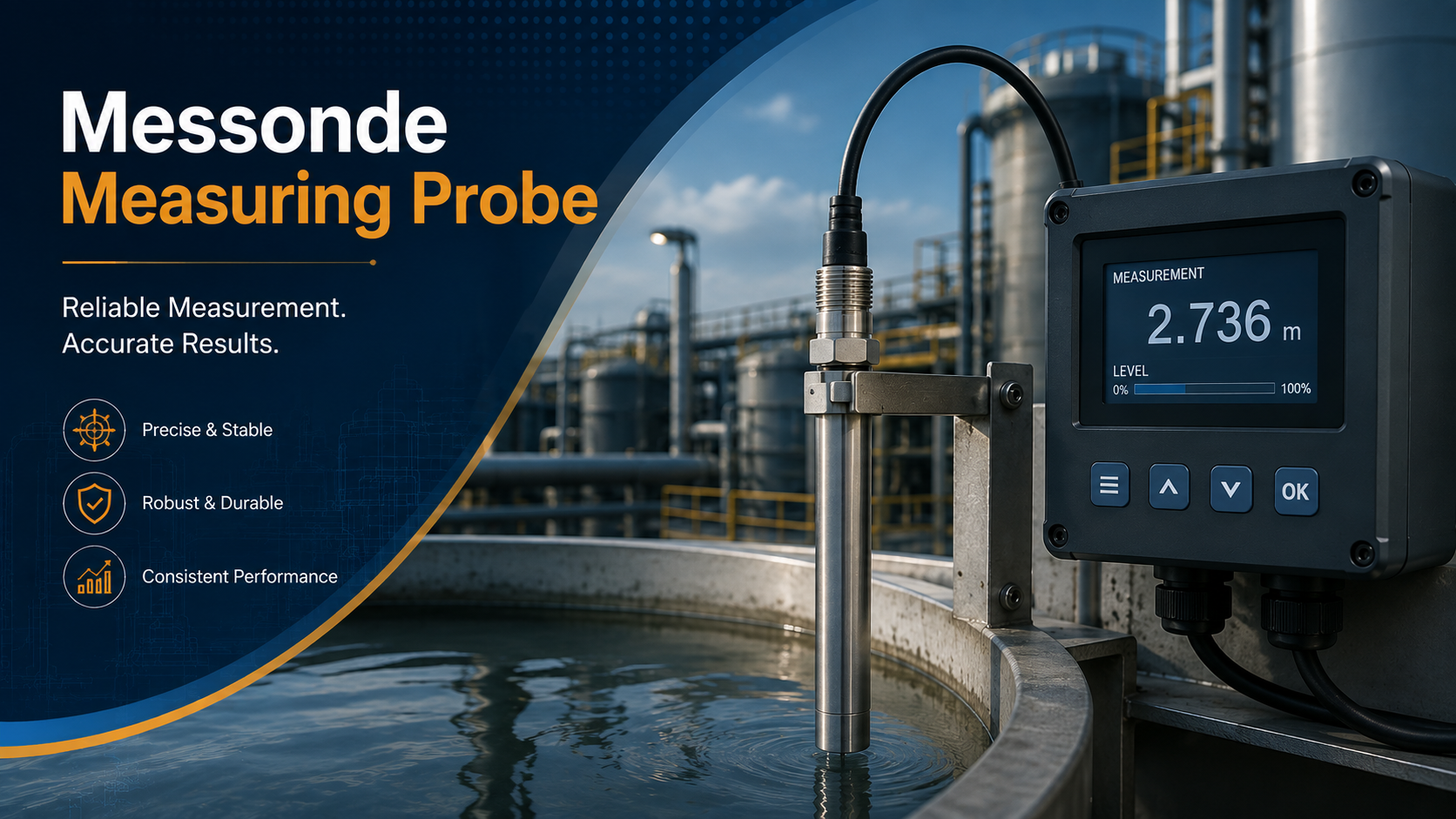
If you have come across the word Messonde, you may be wondering what it means, whether it is a German word, and whether it refers to a particular type of sensor or measuring device.
The answer depends on the context.
In technical and engineering contexts, Messonde is associated with Messsonde, the established German term for a measuring probe. A measuring probe is a device or probe assembly used to detect or measure a physical or chemical property such as temperature, pressure, airflow, liquid level, oxygen, conductivity, pH, thickness, or another measurable quantity.
However, Messonde is not the name of one specific measuring instrument. Different probes can perform completely different measurements.
This guide explains the meaning of Messonde, the difference between Messonde and Messsonde, how measuring probes work, where they are used, and how to identify the correct probe when you need a replacement.
What Does Messonde Mean?
Messonde generally refers to a measuring probe in technical usage.
The closely related German word Messsonde is the established technical term for a measuring probe. Depending on context, it can be translated into English as:
- measuring probe;
- measurement probe;
- test probe;
- measuring head;
- measuring sensor;
- probe.
The exact spelling Messonde can also appear in technical documents, product descriptions, patents, and other specialized contexts.
Therefore, it is not always appropriate to automatically assume that every occurrence of “Messonde” is simply a spelling mistake.
The most useful way to understand the term is to examine the language, source, equipment, and surrounding technical information.
Simple definition
Messonde refers to a measuring probe or measurement-probe assembly, while Messsonde is the established German technical form.
The term itself does not tell you what the probe measures.
A particular measuring probe may be designed for temperature, pressure, airflow, oxygen, conductivity, liquid level, thickness, or another physical or chemical property.
Messonde vs. Messsonde: What Is the Difference?
The difference between Messonde and Messsonde is one of the main reasons people searching for this term become confused.
Messsonde
Messsonde is the established German technical term associated with a measuring probe.
It is formed from:
- Mess- — relating to measurement;
- Sonde — probe.
In technical English, the most natural translation is generally measuring probe.
Messonde
Messonde is a shorter spelling that is also found in technical usage.
Depending on where you encounter it, it may be:
- a shortened technical spelling;
- a product designation;
- a term used in a particular technical source;
- a variation appearing in translated material;
- or simply an unconventional spelling.
Consequently, the context matters.
| Term | Typical meaning |
| Messsonde | Established German technical term for a measuring probe |
| Messonde | Attested shorter/variant technical usage; meaning depends on context |
| Measuring probe | Common English equivalent |
| Probe | General English technical term |
| Sensor | Related term, but not always an exact equivalent |
If you found Messonde printed on a piece of equipment, do not identify the device from the word alone. The model number, manufacturer, part number, and measurement specifications are much more useful.
What Is a Measuring Probe?
A measuring probe is the part of a measurement system that interacts with the object, material, surface, fluid, gas, or environment being measured.
A simplified measurement process looks like this:
Measured quantity → sensing element → signal → measuring instrument → displayed or recorded result
For example, a temperature probe may contain a sensing element whose electrical characteristics change with temperature.
A conductivity probe responds to the electrical properties of a liquid.
An oxygen probe detects oxygen concentration using an appropriate sensing technology.
The resulting signal is processed by the connected measuring instrument, controller, computer, or other system.
This means a probe is not necessarily the entire measurement system.
A complete system may contain:
- sensing element;
- probe housing;
- cable or wireless connection;
- signal-conditioning electronics;
- measuring instrument;
- software or display;
- calibration information.
The exact design depends on the application.
How Does a Messonde Measuring Probe Work?
There is no single operating principle for a Messonde because measuring probes are designed for different quantities.
The basic concept is nevertheless similar.
First, the probe interacts with whatever is being measured. Its sensing element responds to a physical or chemical property.
That response is converted into a usable signal.
The measuring instrument then interprets the signal and presents a result.
For example, a temperature measurement might involve a sensor whose electrical resistance changes as temperature changes. The instrument interprets that change and converts it into a temperature reading.
Other probes may use electrical, optical, chemical, magnetic, mechanical, or other measurement principles.
Therefore:
The word “probe” describes the role of the device, not one particular measurement technology.
This is why two devices that are both called measuring probes may look similar but be completely incompatible.
Types of Messonde and Measuring Probes
There is no single universal type of Messonde.
Measuring probes are better classified according to what they measure and where they operate.
1. Temperature Probes
Temperature probes measure temperature in gases, liquids, solids, surfaces, machines, processes, or equipment.
Common sensing technologies include:
- thermocouples;
- RTDs;
- thermistors;
- other electronic temperature sensors.
A temperature probe may be designed specifically for:
- air measurement;
- surface measurement;
- immersion measurement;
- penetration measurement;
- industrial processes;
- laboratory applications.
Important specifications include measurement range, accuracy, response time, probe dimensions, sensor type, cable length, connector, and environmental limitations.
A probe intended for surface measurements should not automatically be replaced with an immersion probe simply because both measure temperature.
2. Pressure Probes
Pressure probes and pressure-sensing assemblies are used to determine the pressure of gases or liquids.
They can be used in:
- industrial equipment;
- hydraulic systems;
- pneumatic systems;
- laboratory equipment;
- process-control systems;
- environmental measurement.
The appropriate probe depends on the pressure range, fluid or gas, temperature, connection, accuracy requirements, and mechanical design.
3. Airflow and Environmental Probes
Environmental measuring probes can measure variables such as airflow, air temperature, humidity, and other environmental conditions.
Some airflow probes use technologies designed to determine air velocity while simultaneously measuring temperature or other parameters.
They are commonly used in:
- ventilation systems;
- air-conditioning systems;
- building inspections;
- industrial environments;
- environmental measurements.
Important specifications can include airflow range, temperature range, probe diameter, response characteristics, accuracy, and compatibility with the measuring instrument.
4. Liquid-Level Probes
Level probes are used to determine whether a liquid or material has reached a particular level.
They can be used for:
- tank monitoring;
- overfill protection;
- pump protection;
- process control;
- storage systems.
Different level probes use different technologies.
For example, conductive probes can detect the presence of electrically conductive liquids at a specified point.
A level probe should therefore be selected according to the liquid characteristics, tank design, temperature, pressure, mounting arrangement, and required switching or measurement function.
5. Conductivity Probes
Conductivity probes measure the ability of a material, particularly a liquid, to conduct electrical current.
They are commonly relevant to:
- water testing;
- laboratory measurements;
- industrial processes;
- environmental monitoring;
- water-treatment applications.
Probe selection can depend on conductivity range, temperature, chemical compatibility, electrode construction, and the measuring instrument.
6. Oxygen and Gas Probes
Specialized probes can measure oxygen or other gases.
Applications can include:
- laboratory analysis;
- environmental monitoring;
- industrial processes;
- combustion systems;
- water-quality measurements.
The sensing principle varies according to the gas and application.
7. pH Probes
pH probes are used to determine the acidity or alkalinity of a solution.
They are common in:
- laboratories;
- water treatment;
- environmental testing;
- industrial processing;
- food and beverage applications.
Because pH sensors can be sensitive to contamination, storage conditions, temperature, calibration, and chemical exposure, proper maintenance is important.
8. Thickness and Inspection Probes
Specialized measurement probes can also be used for inspection tasks such as determining material or coating thickness.
These devices can use measurement principles very different from those used by temperature or conductivity probes.
This is another reason why the generic word Messonde is insufficient for identifying a particular device.
Where Are Measuring Probes Used?
Measuring probes are used almost anywhere reliable physical or chemical measurements are required.
Industrial Engineering
Factories use probes to monitor:
- temperature;
- pressure;
- flow;
- level;
- gas concentration;
- conductivity;
- other process variables.
The measurements may be displayed to operators or sent to an automated control system.
For example, a temperature measurement can help a control system maintain a process within a specified range.
A level probe can indicate when a tank is full or when a pump should stop.
Laboratories
Laboratories use specialized probes for controlled measurements in chemistry, biology, materials testing, environmental science, and other fields.
Laboratory probes may measure:
- temperature;
- pH;
- oxygen;
- conductivity;
- pressure;
- concentration;
- other properties.
Reliable laboratory measurements depend not only on the probe but also on calibration, sample handling, positioning, cleanliness, and the measurement procedure.
Environmental Monitoring
Environmental monitoring can involve probes for:
- water temperature;
- dissolved oxygen;
- conductivity;
- pH;
- humidity;
- air conditions;
- soil properties;
- other environmental variables.
Field instruments may use probes connected to portable meters, data loggers, or monitoring systems.
Food and Beverage Processing
Food-processing systems often require accurate measurements of temperature, level, pressure, conductivity, and other process variables.
In these applications, probe materials and hygienic design can be particularly important.
A probe that works correctly in a general industrial environment may not be suitable for food-processing equipment.
Messonde and Radiosonde: Are They the Same?
No.
This is an important terminology distinction.
A radiosonde is a specific meteorological instrument package used to collect measurements in the atmosphere, typically while carried upward by a weather balloon.
Radiosondes commonly collect information such as:
- temperature;
- atmospheric pressure;
- relative humidity.
The instrument’s movement can also be tracked to help determine wind information at different heights.
A radiosonde is therefore a specific atmospheric measurement system.
A Messonde or Messsonde, by contrast, is associated with the much broader concept of a measuring probe.
So you should not automatically use “Messonde” and “radiosonde” as synonyms.
Is Messonde a Sensor?
Not necessarily.
The terms sensor and probe overlap, but they are not always interchangeable.
A sensor is generally the element that detects a physical or chemical quantity.
A probe can refer to the physical assembly that positions the sensing element within the measurement environment.
For example:
Probe → sensing element → cable/electronics → measuring instrument
In some products, the probe and sensor may effectively be integrated into one component.
In other systems, the probe is a larger assembly containing one or more sensing elements.
Therefore, whether “sensor” is an appropriate translation depends on the specific product.
How to Identify a Messonde
If you have an unknown probe and want to identify it, do not search only for “Messonde.”
The word is too broad.
Instead, collect as much information as possible.
1. Identify the Manufacturer
Look for the manufacturer name on:
- the probe;
- cable;
- connector;
- equipment housing;
- label;
- packaging.
The manufacturer is often the fastest way to narrow down possible products.
2. Find the Model or Part Number
The original part number is usually the most valuable identification detail.
Check for:
- model number;
- type number;
- order number;
- serial number;
- catalog number;
- replacement-part number.
Search the exact number together with the manufacturer’s name.
For example:
[manufacturer] + [part number] + probe
or:
[manufacturer] + [model] + Messsonde
This is generally much more effective than searching for “Messonde” alone.
3. Determine What It Measures
Ask what the probe was designed to detect.
Possibilities include:
- temperature;
- pressure;
- airflow;
- humidity;
- liquid level;
- conductivity;
- oxygen;
- pH;
- thickness;
- another physical or chemical property.
This immediately eliminates many incompatible products.
4. Determine the Measurement Principle
Knowing what a probe measures is not always enough.
Two probes may measure the same quantity using completely different technologies.
For temperature, for example, a thermocouple and an RTD are different technologies.
Therefore identify both:
What does it measure?
and
How does it measure it?
5. Check the Measurement Range
A replacement probe must operate within the required range.
Check specifications such as:
- minimum and maximum temperature;
- pressure range;
- airflow range;
- conductivity range;
- measurement distance;
- level range;
- accuracy;
- resolution.
A probe may measure the correct quantity but still be unsuitable because its operating range does not match the application.
6. Check the Connector
Look carefully at the connection.
Important details include:
- connector type;
- number of contacts;
- cable configuration;
- plug shape;
- electrical interface;
- communication protocol where applicable.
Two probes may have similar physical dimensions but different electrical connections.
7. Check Physical Dimensions
Measure or record:
- probe length;
- diameter;
- cable length;
- thread size;
- insertion depth;
- mounting arrangement;
- connector dimensions;
- housing dimensions.
Physical compatibility is important, but it should never be the only compatibility check.
8. Check the Operating Environment
The environment can determine whether a probe is suitable.
Consider:
- temperature;
- pressure;
- moisture;
- chemicals;
- corrosive substances;
- vibration;
- dust;
- outdoor exposure;
- food-processing requirements;
- electrical requirements;
- hazardous-area requirements where applicable.
A visually identical probe can still be unsuitable if it is made for a different environment.
How to Find a Replacement Messonde
If your goal is to replace an existing measuring probe, follow this order:
Step 1: Identify the equipment
Record the manufacturer and equipment model.
Step 2: Find the original probe number
Look for the number printed or engraved on the probe, cable, connector, or packaging.
Step 3: Identify the measurement
Determine whether it measures temperature, pressure, airflow, level, conductivity, oxygen, pH, thickness, or another quantity.
Step 4: Confirm the technology
Determine the sensing principle or sensor type.
Step 5: Compare specifications
Check:
- measurement range;
- accuracy;
- response time;
- materials;
- dimensions;
- connector;
- cable;
- environmental limits.
Step 6: Confirm manufacturer compatibility
Where possible, use the original manufacturer’s documentation or approved replacement information.
Do not buy a replacement simply because it looks similar or is described as a “Messonde.”
Common Mistakes When Searching for Messonde
Searching Only for “Messonde”
This produces broad and sometimes unrelated results.
A better search combines the word with specific information.
For example:
manufacturer + model + Messonde
or:
part number + Messsonde
or:
equipment model + measuring probe
Assuming Messonde Is Always a Typo
Because Messsonde is the established German technical form, it may be tempting to assume that Messonde is always incorrect.
That conclusion is too simple.
The shorter spelling is also found in technical contexts.
Therefore, the source should be checked before deciding that the term is merely a mistake.
Assuming Every Messsonde Is the Same
A measuring probe is a broad category.
Different probes can measure:
- temperature;
- pressure;
- airflow;
- liquid level;
- oxygen;
- conductivity;
- pH;
- thickness;
- and many other quantities.
The word does not identify a specific sensor technology.
Choosing a Probe by Appearance
Two probes may look almost identical but have:
- different sensing elements;
- different electrical characteristics;
- different connectors;
- different ranges;
- different materials;
- different calibration requirements.
Appearance can help identify a probe, but it should not be the final compatibility test.
Ignoring the Original Equipment
A probe is often designed to work with a particular instrument or control system.
The manufacturer’s documentation may specify:
- compatible probes;
- supported sensor types;
- calibration procedures;
- electrical characteristics;
- replacement part numbers.
That information is usually more reliable than a generic marketplace description.
Accuracy, Precision, and Calibration
A measuring probe is useful only when the measurement it provides is sufficiently reliable for the application.
Accuracy
Accuracy describes how close a measurement is to the accepted or reference value.
Precision
Precision describes how consistently repeated measurements agree with one another.
A system can be precise but inaccurate if it repeatedly produces similar readings that are offset from the correct value.
Calibration
Calibration compares the measuring system with an appropriate reference.
The exact calibration procedure depends on the measurement technology.
Temperature, pH, conductivity, pressure, oxygen, and other probes can require very different calibration methods.
Probe performance can also change because of:
- contamination;
- aging;
- chemical exposure;
- damaged cables;
- worn sensing elements;
- incorrect installation;
- unsuitable environmental conditions.
Following the manufacturer’s calibration and maintenance requirements is therefore important.
Installation and Maintenance of Measuring Probes
Correct installation can be just as important as choosing the right probe.
The sensing element must be positioned appropriately for the measurement.
For example, a temperature probe placed too close to a local heat source may not represent the actual temperature of the wider process.
Maintenance requirements depend on the probe type.
Some probes may require:
- cleaning;
- calibration;
- inspection;
- protective storage;
- replacement of consumable components.
Cables and connectors should also be inspected for:
- mechanical damage;
- corrosion;
- moisture;
- loose connections;
- damaged insulation.
Cleaning should always follow the manufacturer’s instructions because aggressive cleaning methods can damage sensitive sensing surfaces.
Why Context Matters When You See the Word Messonde
The surrounding text usually provides the strongest clue about what Messonde means.
In a German engineering document
The intended meaning may be a measuring probe, particularly where the standard term Messsonde is involved.
In a product catalogue
Messonde may be part of a specific product or accessory name.
In this case, the manufacturer, model, and part number are more important than the generic translation.
In a patent
The term may appear as part of a technical invention or description involving a particular measurement method.
In a translated manual
You may encounter several related terms, including:
- Messsonde;
- Messonde;
- Messfühler;
- sensor;
- probe.
The exact English translation should follow the technical context rather than a word-for-word dictionary substitution.
In weather-related content
If the text describes a balloon-borne atmospheric instrument, radiosonde is normally the more specific term.
Frequently Asked Questions About Messonde
Is Messonde a German word?
Messonde is found in German technical usage, but Messsonde is the established German technical term for a measuring probe.
The exact spelling Messonde can appear in technical and commercial contexts, so it should not automatically be dismissed as a typo.
What is Messsonde in English?
The most direct technical translation is measuring probe.
Depending on context, it may also be translated as:
- probe;
- test probe;
- measuring head;
- measuring sensor.
Is Messonde the same as Messsonde?
They can refer to the same general concept, but the spellings should not automatically be treated as identical in every context.
Messsonde is the established German technical form, while Messonde is also attested in technical usage.
The source and surrounding information should determine the intended meaning.
Is a Messonde a sensor?
Not necessarily.
A probe may contain a sensor or sensing element, while the probe itself can refer to the larger physical assembly used to place that sensing element in the measurement environment.
In some products the distinction is small, but technically the terms are not always exact synonyms.
What can a Messsonde measure?
There is no single measurement associated with Messsonde.
Depending on the design, a measuring probe may be used for:
- temperature;
- pressure;
- airflow;
- liquid level;
- conductivity;
- oxygen;
- pH;
- thickness;
- humidity;
- other physical or chemical properties.
Is Messonde the same as a radiosonde?
No.
A radiosonde is a specific atmospheric measurement instrument normally used with weather balloons.
A Messsonde is a broader term associated with measuring probes.
They should not be treated as synonyms.
How do I identify a Messonde?
Start with the manufacturer, equipment model, and original part number.
Then determine:
- what it measures;
- how it measures it;
- its measurement range;
- connector type;
- physical dimensions;
- environmental requirements;
- compatibility with the measuring instrument.
This information is much more useful than the word “Messonde” alone.
What is the difference between a probe and a sensor?
A sensor is generally the element that detects a physical or chemical quantity.
A probe can refer to the physical assembly that positions or protects the sensor and allows it to interact with the measurement environment.
The terms can overlap depending on the product.
Read About: Tech Giants Envision a Future Beyond Smartphones in 2026
Final Answer: What Does Messonde Actually Mean?
Messonde is a term associated with a measuring probe, while Messsonde is the established German technical term for a measuring probe.
A measuring probe is not one particular device. It can be designed to measure temperature, pressure, airflow, liquid level, conductivity, oxygen, pH, thickness, humidity, or many other physical or chemical properties.
The exact spelling Messonde can appear in technical and commercial contexts, so it should not automatically be treated as a spelling mistake. At the same time, the word alone is not enough to identify a particular instrument.
If you are trying to understand or replace a Messonde, focus on the manufacturer, model, part number, measurement type, sensing principle, measurement range, connector, dimensions, and operating environment.
That information will tell you far more about the actual device than the word Messonde itself.
