


What Is Ark Augmented Reality and How Does It Work?
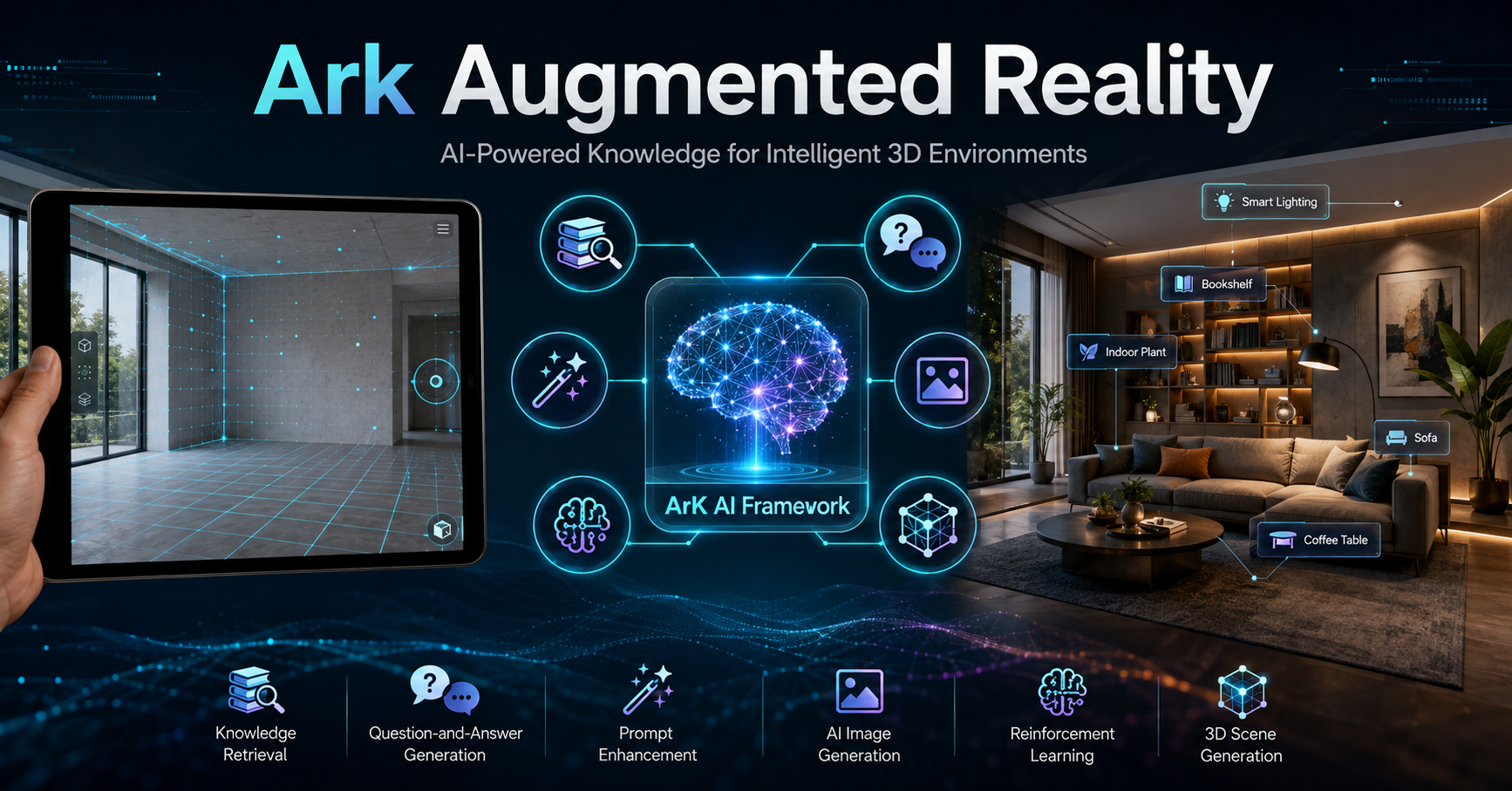
Ark Augmented Reality is an artificial intelligence research framework designed to generate and edit 2D and 3D scenes in environments an AI system has not encountered before. Its full research name is ArK: Augmented Reality with Knowledge Interactive Emergent Ability.
ArK is not a headset, mobile app, video game, or alternative name for Apple ARKit. It is an experimental approach that connects knowledge retrieval, foundation models, image generation, reinforcement learning, and 3D scene-building tools. Its purpose is to help AI systems apply existing knowledge when understanding or creating unfamiliar physical and virtual environments.
What Is Ark Augmented Reality?
Ark Augmented Reality is a research project introduced in a May 2023 preprint by researchers affiliated with Microsoft Research, the University of Washington, MILA, and UCLA.
The researchers developed ArK to address a difficult problem in augmented and mixed reality: AI systems may perform well in environments represented in their training data but struggle when they encounter a new room, virtual world, game level, or scenario.
A conventional system may need additional images, object models, labels, and training data before it can handle each new environment. ArK explores whether knowledge already stored in large foundation models can reduce that repeated work.
You can read the original methodology in the official ArK research paper or view its diagrams and demonstrations on the official ArK project page.
What Does ArK Stand For?
The project title expands to:
Augmented Reality with Knowledge Interactive Emergent Ability
The mechanism at the center of the research is called:
Augmented Reality with Knowledge Inference Interaction
Both phrases describe the same broad idea: an intelligent agent retrieves and applies relevant knowledge while interacting with or generating a scene.
The capitalized K represents knowledge. It is not a reference to Apple ARKit.
What Problem Does ArK Try to Solve?
Modern augmented-reality systems can track device movement, detect surfaces, estimate lighting, and place virtual objects in physical space. However, detecting a flat surface does not necessarily mean the system understands what that surface represents or how it should be used.
For example, a standard AR application might recognize a horizontal surface and place a digital object on it. A more knowledgeable system could reason that:
- A dining table usually has chairs around it.
- A desk may contain a monitor, keyboard, and lamp.
- A bedroom usually includes a bed and storage furniture.
- A kitchen should contain different objects from an office.
- A game dungeon may need pathways, obstacles, walls, and suitable lighting.
- Objects should be placed according to their purpose and relationships.
ArK attempts to introduce this kind of contextual knowledge into scene generation.
What Is an Unseen Environment?
An unseen environment is a physical or virtual setting that was not directly represented during a model’s task-specific training.
It could be:
- A newly scanned room
- An unfamiliar office
- A new game map
- A virtual classroom
- A simulated factory
- A mixed-reality training space
- A scene described through text and reference images
The challenge is not limited to recognizing individual objects. The system must decide which objects belong in the environment, how they relate to one another, and where they should be placed.
The original ArK research specifically focuses on transferring knowledge to novel domains and scenarios rather than collecting a large new training dataset for every task.
Is Ark Augmented Reality an App or Product?
ArK should currently be understood as a research framework, not a finished consumer product.
There is no verified official ArK mobile app, commercial headset, subscription service, or publicly released software development kit on the research project’s website.
As of August 1, 2026, the official project page still lists the project’s code as “coming soon.”
Can You Download Ark Augmented Reality?
There is no confirmed official consumer download for the ArK research framework.
Search results may show unrelated applications, games, companies, or augmented-reality services using the words “Ark” or “ARK.” Those products should not automatically be treated as implementations of the 2023 research.
Before downloading anything with a similar name, check:
- The developer’s identity
- The official website
- The app-store listing
- The project description
- The privacy policy
- Whether it references the original research team
Does ArK Require a Special Headset?
The research introduces a scene-understanding and generation method rather than a dedicated hardware platform. It does not introduce an official ArK headset.
A future implementation could theoretically work alongside:
- Smartphones
- Tablets
- Mixed-reality headsets
- Virtual-reality systems
- Game engines
- Spatial-computing devices
- Desktop 3D design tools
Actual device support would depend on how developers implemented the research ideas.
Is ArK Open Source?
The official project page provides the paper and research demonstrations, but it does not currently provide a complete public code repository.
This makes independent reproduction more difficult. Developers can study the described workflow, but they cannot simply download and install an official ArK package.
How Does Ark Augmented Reality Work?
ArK combines several AI processes instead of relying on one model.
At a high level, the framework:
- Receives image and text information.
- Retrieves knowledge related to the requested scene.
- Generates questions and answers about the scene.
- Uses a language model to improve the visual prompt.
- Sends that prompt to an image-generation model.
- evaluates the generated result.
- Uses feedback to improve knowledge retrieval.
- Converts the 2D concept into a structured 3D scene.
The official design describes the use of large foundation models, including GPT-4 and DALL-E, together with knowledge memory and reinforcement-learning techniques.
Step 1: Understanding Image and Text Inputs
The process begins with information describing the requested environment.
The input might include:
- A written prompt
- A reference image
- A user question
- A scene-editing instruction
- A combination of image and text information
A user could describe a room, game environment, object arrangement, or visual style. The system then determines what additional knowledge is needed to produce a useful scene.
Step 2: Retrieving Relevant Knowledge
ArK uses a knowledge-memory component to retrieve information related to the image-text pair.
That information can help answer questions such as:
- Which objects normally appear in this scene?
- What purpose does each object serve?
- How should the objects be arranged?
- Which items should be positioned near one another?
- What visual details define the requested environment?
- What would make the scene appear realistic or useful?
The official project describes pretraining an agent to retrieve relevant knowledge for a given image-text pair.
Step 3: Generating Questions and Answers
The system generates questions about the requested scene and answers them using the retrieved knowledge.
For a home-office scene, it might reason through questions such as:
- What furniture belongs in a home office?
- Where should the desk be positioned?
- Which objects normally sit on the desk?
- How much space should remain around the chair?
- What lighting would suit the room?
- Where should electrical equipment be placed?
This question-and-answer process creates a richer description than a short user prompt may provide on its own.
Step 4: Creating an Improved Visual Prompt
The generated questions and answers are passed to a language model, which creates a more detailed prompt for an image generator.
A basic request such as “create a medieval workshop” could be expanded to include:
- Heavy wooden workbenches
- Hand tools
- Timber supports
- Storage shelves
- Stone walls
- Warm firelight
- Metalworking equipment
- Period-appropriate materials
- Clear spatial relationships
The more detailed prompt gives the image model stronger context for creating the scene.
Step 5: Generating a 2D Scene
An image-generation model produces a 2D visual representation from the improved prompt.
The generated image is not necessarily the final AR experience. It can act as a reference for identifying:
- Which objects should appear
- How the room should look
- Where objects should be positioned
- Which visual style should be used
- How different objects relate to one another
Step 6: Using Reinforcement-Learning Feedback
The project describes a reinforcement-learning process based on similarities between generated results and reference information.
The feedback encourages the agent to retrieve knowledge and ask questions that improve the generated scene.
In simpler terms, the system learns which pieces of information produce a more suitable output.
Step 7: Turning the Concept Into a 3D Scene
The final stages use the generated visual information to support 3D or gaming-scene generation.
A language model can help produce:
- Object lists
- Position instructions
- Spatial arrangements
- Scene structures
- Program-synthesis code
- Commands for a 3D engine
The official ArK project describes using knowledge from web entities and the 2D world to support 3D scene generation.
| Stage | Main Input | Main Task | Expected Output |
|---|---|---|---|
| Scene request | Image and text | Interpret the requested environment | Initial context |
| Knowledge retrieval | Scene context | Find relevant information | Knowledge memory |
| Question generation | Retrieved knowledge | Identify missing details | Questions and answers |
| Prompt creation | Questions and answers | Expand the scene description | Detailed visual prompt |
| Image generation | Improved prompt | Create a visual reference | 2D scene |
| Feedback | Generated and reference data | Evaluate similarity and relevance | Learning reward |
| 3D generation | Image and knowledge | Arrange objects and generate instructions | Structured 3D scene |
What Is Knowledge Memory in Ark AR?
Knowledge memory refers to information the system retrieves and applies to a new interaction, environment, or scene-generation task.
It should not necessarily be understood as one conventional database containing every possible room or object. It is better viewed as a method for accessing knowledge represented in foundation models, datasets, image-text relationships, and external sources.
Why Knowledge Memory Matters
A system that only detects geometry may identify a table as a flat surface.
A knowledge-supported system may also understand that:
- Chairs are usually placed around a dining table.
- Plates belong on top of the table rather than underneath it.
- A hanging light may be centered above the dining area.
- Walking space should remain between furniture.
- A formal dining room differs from a workshop.
- Objects must be scaled appropriately for the room.
This contextual reasoning can help generated scenes appear more coherent and useful.
How Knowledge May Reduce Repeated Training
Without transferable knowledge, developers may need to collect, label, and process new data for every scenario.
Knowledge transfer could reduce that burden by allowing an agent to apply general concepts to unfamiliar tasks.
For example, a system that understands desks, chairs, monitors, and office layouts may adapt that knowledge to different office environments instead of learning every room from the beginning.
The original ArK research paper explains how the framework attempts to transfer knowledge memory from foundation models to new domains and scene-generation tasks.
A Practical Example
Imagine asking an AI system to turn an empty room into a virtual science classroom.
A basic generator might place random educational objects throughout the room. An ArK-style system could retrieve knowledge about classroom design and reason that the environment may need:
- Student workstations
- A teacher presentation area
- Laboratory surfaces
- Safe walking routes
- Equipment storage
- Display screens
- Suitable lighting
- Clearly separated practical areas
It could then use that knowledge to create a more organized visual concept and generate instructions for constructing the scene in 3D.
What Does Cross-Modality Mean?
Cross-modality means moving and combining information across different forms of data.
ArK works with several modalities, including:
- Written language
- Questions and answers
- Images
- Scene descriptions
- Spatial information
- 3D objects
- Program instructions
A language model can interpret a written description, while an image model turns that description into a visual concept. The image can then inform a system that arranges objects in three-dimensional space.
Why One Data Type Is Not Enough
Text is useful for describing purpose and relationships, but it may not define every visual detail.
An image shows appearance and composition, but it may not explain why objects are arranged in a particular way.
A 3D scene represents position and depth, but it still needs instructions about which objects to include and how they should interact.
Combining these forms of information allows the system to use the strengths of each modality.
What Is Reality-Agnostic Behavior?
Reality-agnostic behavior means applying relevant knowledge across different types of environments instead of limiting it to one physical or virtual setting.
The same general knowledge could potentially support:
- A real room viewed through a camera
- A fully digital game world
- A mixed-reality simulation
- A virtual training environment
- An interactive spatial-design tool
This does not mean every environment should be treated identically. The system must adapt the knowledge to the user’s goal, role, task, and surroundings.
Ark Augmented Reality vs. Standard AR
Standard augmented reality typically focuses on sensing the physical environment and placing digital elements within it.
ArK focuses more strongly on retrieving knowledge and using generative AI to understand, create, and edit scenes.
| Area | Standard Augmented Reality | ArK Research Approach |
|---|---|---|
| Main purpose | Place and track digital content | Generate knowledge-informed scenes |
| Device tracking | Core feature | Would rely on supporting AR tools |
| Surface detection | Common capability | Not the central contribution |
| Knowledge retrieval | Usually application-specific | Central to the framework |
| Generative AI | Optional | Fundamental to the approach |
| Scene creation | Often manually designed | Partly generated through AI |
| Unseen environments | May require custom logic | A primary research focus |
| Current availability | Used in commercial tools | Experimental research framework |
ArK would not remove the need for cameras, sensors, tracking, rendering, anchors, or user-interface tools. It addresses another layer of the problem: deciding what a scene should contain and how knowledge can guide its generation.
Ark Augmented Reality vs. Apple ARKit
The similar names create confusion, but ArK and ARKit are different technologies.
What Is Apple ARKit?
ARKit is Apple’s official framework for creating augmented-reality apps and games.
According to Apple’s official ARKit documentation, the framework combines device motion tracking, world tracking, scene understanding, camera information, and display features to simplify the development of AR experiences.
ARKit helps developers:
- Track device movement
- Analyze camera images
- Detect and understand parts of an environment
- Create spatial anchors
- Position digital content
- Build AR experiences for supported Apple platforms
What Is the ArK Research Framework?
ArK is a knowledge-driven AI research approach for scene understanding and generation.
It does not provide the complete hardware sensing, motion tracking, application management, or rendering tools offered by Apple ARKit.
Could ArK and ARKit Work Together?
Conceptually, they could complement each other.
ARKit could handle:
- Device tracking
- Camera access
- Surface understanding
- Spatial anchors
- Object positioning
- Sensor information
A knowledge-driven system inspired by ArK could handle:
- Interpreting the user’s request
- Retrieving contextual knowledge
- Generating suitable visual concepts
- Recommending object arrangements
- Producing 3D content or instructions
This is a possible implementation model, not an officially released integration between Apple and the ArK research team.
Ark Augmented Reality vs. ARCore
ARCore is Google’s platform for developing augmented-reality experiences.
According to Google’s official ARCore documentation, ARCore uses motion tracking, environmental understanding, and light estimation to integrate virtual content with the physical world. It supports development through Android, Unity, Unreal Engine, iOS-related tools, and WebXR workflows.
ARCore focuses on practical AR capabilities such as:
- Tracking a mobile device’s position
- Detecting surfaces
- Estimating environmental lighting
- Placing virtual objects
- Maintaining spatial anchors
- Supporting AR application development
ArK focuses on knowledge retrieval, generative AI, and scene creation. An ArK-inspired system would still need ARCore or another supporting platform to handle device tracking and real-world placement.
Ark Augmented Reality vs. VR and Mixed Reality
Augmented reality, virtual reality, and mixed reality describe related but different experiences.
Augmented Reality
Augmented reality adds digital content to a view of the physical world.
A phone app that displays a virtual chair inside a real room is an AR experience.
Virtual Reality
Virtual reality replaces the user’s visible surroundings with a computer-generated environment.
A VR headset may place the user inside a virtual training center, game world, classroom, or simulation.
Mixed Reality
Mixed reality allows digital and physical elements to coexist and interact more deeply.
Virtual content may respond to:
- Room geometry
- Real surfaces
- Physical objects
- User movement
- Hand gestures
- Spatial boundaries
ArK is relevant to this broader spatial-computing field because the researchers designed it to work with scene generation in physical and virtual environments.
What Did the ArK Research Demonstrate?
The researchers evaluated ArK on 2D and 3D scene-generation and editing tasks.
They reported that the knowledge-enhanced approach improved the quality of generated scenes compared with the baseline workflows used in their experiments. The official project page also presents visual demonstrations and human-evaluation results.
You can review the results on the official ArK project page and in the complete research preprint.
What the Results Suggest
The findings suggest that retrieved knowledge can help generative models create scenes that people consider more appropriate, detailed, or visually coherent.
They also support the concept of using a generated 2D image to help guide 3D scene construction.
What the Results Do Not Prove
The research does not establish that ArK:
- Works reliably in every physical environment
- Replaces commercial AR-development platforms
- Creates error-free 3D scenes
- Understands environments exactly like a human
- Runs smoothly on ordinary consumer devices
- Is ready for safety-critical applications
- Has been independently reproduced at a broad scale
- Is available as a finished commercial product
The project should be treated as promising research rather than a complete industry standard.
Potential Uses of Ark Augmented Reality
The original paper mentions possible relevance to metaverse environments and gaming simulation. Other applications are reasonable possibilities based on the framework’s design, but they should not be mistaken for confirmed ArK products.
Gaming and Level Generation
A game designer could potentially describe an environment and use knowledge-supported generation to create:
- Object layouts
- Background concepts
- Themed rooms
- Interactive locations
- Early level prototypes
- Alternative versions of a scene
Human designers would still need to review gameplay quality, technical performance, visual consistency, and accessibility.
Education
A knowledge-driven system could potentially generate subject-specific learning environments, such as:
- A historical settlement
- A virtual laboratory
- A model of the solar system
- An interactive anatomy room
- A language-learning environment
- A reconstructed archaeological site
Relevant knowledge could help the system include objects and relationships that match the educational topic.
Workplace Training
Organizations could explore AI-generated simulations for:
- Equipment instruction
- Emergency preparation
- Factory procedures
- Maintenance training
- Warehouse operations
- Customer-service scenarios
- Staff onboarding
Any environment used for safety or professional instruction would need expert validation.
Retail and Interior Visualization
A knowledge-driven design tool could suggest furniture arrangements, store layouts, product displays, or room styles based on the purpose of a space.
This could make AR visualization more adaptive than placing one fixed 3D object at a time.
Architecture and Spatial Design
Designers could use AI-generated images and 3D arrangements during early concept development.
The results would not replace:
- Accurate architectural plans
- Structural calculations
- Accessibility requirements
- Building-code reviews
- Engineering analysis
- Professional approval
Collaborative Virtual Environments
Users could describe their roles, goals, and spatial needs. A system could then generate a shared environment suited to those requirements.
Possible applications might include:
- Virtual meetings
- Creative workshops
- Multiplayer environments
- Training sessions
- Remote design reviews
- Collaborative classrooms
Problems Ark Augmented Reality Could Help Solve
Repeated Data Collection
Training a separate system for every room or scenario can be expensive and time-consuming.
Knowledge transfer may reduce the amount of task-specific data required for each new environment.
Weak Semantic Understanding
Some AR systems can recognize geometry without understanding the meaning or purpose of the environment.
Knowledge retrieval may provide additional context about objects, roles, and spatial relationships.
Disconnected Virtual Objects
Digital objects may look out of place when their scale, location, style, or purpose does not match the physical environment.
Contextual knowledge could help improve placement decisions.
Manual Scene-Creation Costs
Building a detailed 3D environment requires modeling, layout planning, programming, testing, and design work.
Generating an initial object list or layout could speed up early prototyping.
Limited Adaptation
A fixed AR experience may present the same content to every user.
A knowledge-driven system could potentially adapt scenes according to different tasks, roles, locations, or user goals.
Limitations of Ark Augmented Reality
Dependence on Foundation Models
ArK depends on knowledge generated or retrieved through other AI models.
If those models contain inaccurate, incomplete, outdated, or biased information, the generated scene may reflect those weaknesses.
AI Hallucinations
Language and image models can generate details that appear convincing but are incorrect.
In a game prototype, an invented detail may be easy to fix. In medical, industrial, or emergency training, an incorrect object or instruction could create serious problems.
The NIST AI Risk Management Framework provides voluntary guidance for organizations managing risks connected with the design, development, use, and evaluation of AI systems.
Computational Requirements
The proposed ArK workflow may involve:
- Knowledge retrieval
- Question answering
- Language generation
- Image generation
- Reinforcement learning
- Program synthesis
- 3D rendering
Running all these stages quickly enough for responsive interaction could require significant computing resources and optimization.
No Public Official Code
The absence of official public code makes the project less accessible to ordinary developers and limits independent reproduction.
Limited Evaluation Scope
The research evaluates specific scene-generation and editing tasks.
Those results do not automatically prove that the framework will perform equally well across every:
- Device
- Industry
- Environment
- Language
- AR application
- Safety requirement
- User group
Privacy and Spatial Data
An AR system may process images and maps of private homes, workplaces, documents, people, and personal belongings.
Immersive technologies can also collect spatial, behavioral, physical, and biometric information. NIST research notes that the scale and nature of data processing in immersive systems can create distinct cybersecurity and privacy risks.
The NIST research on privacy and immersive technologies provides additional information about these concerns.
Developers would need clear rules for:
- Camera and microphone access
- Spatial mapping
- Image and video storage
- Cloud processing
- User consent
- Bystander consent
- Data-retention periods
- Model training
- Third-party data sharing
- Account and data deletion
Bias and Cultural Assumptions
AI models may associate rooms, professions, cultures, or locations with stereotypical objects and layouts.
A generated classroom, home, office, or religious space may reflect assumptions that do not match the actual user’s needs.
Human review and diverse evaluation data would be necessary to reduce these problems.
Can Developers Use Ark Augmented Reality Today?
Developers can read the paper, study the project diagrams, and experiment with similar components. However, there is no complete official ArK toolkit available from the project page.
A developer attempting to build an ArK-inspired system would likely need:
- Python knowledge
- Machine-learning experience
- Vision-language models
- Knowledge-retrieval systems
- Image-generation tools
- Prompt-development skills
- Reinforcement-learning methods
- 3D modeling knowledge
- A game engine such as Unity or Unreal Engine
- AR tracking through ARKit or ARCore
- Privacy and security controls
Apple ARKit and Google ARCore are established platforms for tracking devices and connecting digital content with physical environments.
ArK would not replace these platforms. It could act as an additional knowledge, reasoning, and content-generation layer.
What Ark Augmented Reality Means for the Future of AR
ArK represents a shift from manually preparing every digital scene toward systems that can reason about what an unfamiliar environment may require.
Its value is not that it provides a finished AR application today. Its value lies in the research direction:
- Connecting language and vision models
- Retrieving contextual knowledge
- Improving scene prompts
- Generating visual concepts
- Converting concepts into 3D arrangements
- Adapting content to unfamiliar scenarios
The project also highlights unresolved challenges. AI-generated environments must become more reliable, efficient, controllable, reproducible, privacy-aware, and accessible before they can support high-stakes real-world tasks.
For now, Ark Augmented Reality is best understood as an experimental knowledge-driven framework with possible relevance to gaming, simulation, mixed reality, education, training, and spatial design.
Frequently Asked Questions
What is Ark Augmented Reality?
Ark Augmented Reality is an AI research framework that uses knowledge from foundation models to improve the generation and editing of 2D and 3D scenes.
What does ArK stand for?
ArK stands for Augmented Reality with Knowledge Interactive Emergent Ability. Its main mechanism is called Augmented Reality with Knowledge Inference Interaction.
Is Ark Augmented Reality an app?
No official consumer ArK app has been released by the research project. ArK is currently presented as a research framework and demonstration.
Is ArK the same as Apple ARKit?
No. ARKit is Apple’s development framework for augmented-reality apps. ArK is a research approach involving knowledge retrieval and generative AI.
Can developers download the ArK code?
The official project page currently lists the code as “coming soon,” so a complete official implementation is not publicly provided there.
Does ArK use GPT and DALL-E?
Yes. The research describes using foundation models such as GPT-4 and DALL-E within its knowledge, prompt, image, and scene-generation workflow.
What industries could use ArK technology?
Potential future applications include gaming, education, workplace training, retail visualization, architecture, simulation, and collaborative mixed-reality environments.
You May Also Like: Auztron Bot: What It Was and Risks to Check
