Sodiceram is a term associated online with both a historical French ceramics company and a newer claimed advanced-ceramic concept. Recent articles describe Sodiceram as a sodium-enhanced material with properties such as low porosity, durability, and thermal stability, but no clearly identified manufacturer or standardized technical definition currently establishes those claims as universal. The context therefore matters before evaluating its uses or benefits.
What Is Sodiceram?
Sodiceram does not currently have one universally accepted definition.
The name appears in two major contexts.
The first is historical and business-related. S O D I C E R A M was a ceramics-related company based in Reims, France. Business records associate it with ceramic and sanitary products, while corporate records show liquidation proceedings and radiation from the register in 2023.
The second is much newer. Numerous websites now use Sodiceram to describe an alleged advanced ceramic material associated with sodium-based compounds, high durability, low porosity, thermal stability, and chemical resistance.
These meanings should not automatically be treated as one entity.
The simplest definition
If you searched “Sodiceram” because you encountered the term online, first determine whether the source is discussing:
- A historical French ceramics company
- A ceramic/tile-related product
- A supposed advanced ceramic technology
- Or a general concept built around sodium-containing ceramic formulations
That distinction is the foundation for understanding the entire topic.
Why Is Sodiceram Suddenly Getting Attention?
The current search landscape contains a large number of recently published Sodiceram explainers.
Many use almost the same narrative: Sodiceram is supposedly a next-generation ceramic with improved density, lower porosity, higher strength, thermal stability, chemical resistance, and sustainability advantages.
The problem is not that these properties are impossible for engineered ceramics.
The problem is evidence and identity.
A recent Sodiceram article itself notes that the available online descriptions do not establish a clear scientific definition, while another current article points out that the claims lack published laboratory data, third-party certifications, and a clearly identified manufacturer.
That makes verification a more valuable topic than another generic benefits list.
Is Sodiceram a Ceramic Material, Brand, or Company?
Historically, it is supported as a company name.
A French business listing identifies Sodiceram at 9 Route de Witry, 51100 Reims, with activities associated with sanitary equipment and related products.
Corporate records identify the company as S O D I C E R A M and document liquidation proceedings, followed by closure for insufficient assets and radiation in October 2023.
Current websites, however, use “Sodiceram” as a material or technology name.
That distinction matters for anyone searching for a manufacturer or trying to purchase a product.
An old business listing should not be interpreted as proof that the company is still operating today.
Likewise, a modern blog post should not be interpreted as proof that a standardized material category exists.
Is Sodiceram Really a Sodium-Based Ceramic?
Sodium-based chemistry is one of the most frequently repeated explanations for Sodiceram, but the specific connection remains insufficiently verified.
Several current pages say Sodiceram contains sodium oxide, sodium silicates, silica, alumina, clay, or related mineral components.
The underlying science is plausible in a general ceramic-processing context.
Sodium-containing materials can act as fluxes. Fluxes influence the melting and vitrification behavior of ceramic and glass formulations.
But this produces an important scientific distinction:
“Sodium can influence ceramic processing” does not mean “every product called Sodiceram is a sodium-enhanced ceramic with superior performance.”
The latter requires product-specific evidence.
How Is Sodiceram Supposed to Work?
The manufacturing description found across current articles generally involves:
Raw materials → mixing → sodium-based additive → shaping → firing → controlled cooling → testing
The proposed mechanism is that sodium-containing compounds influence vitrification and help create a denser ceramic structure.
But ceramic performance is controlled by many variables:
- Chemical composition
- Particle size
- Forming pressure
- Firing temperature
- Firing atmosphere
- Cooling rate
- Porosity
- Microstructure
- Surface treatment
Therefore, the presence of a sodium compound alone cannot predict the final strength, water absorption, thermal resistance, or durability.
What Properties Are Associated With Sodiceram?
The following characteristics appear repeatedly in current online descriptions:
| Property | Claimed relevance | Evidence a buyer should request |
|---|---|---|
| Low porosity | Reduced absorption | Water-absorption measurement |
| Durability | Longer service life | Strength and abrasion tests |
| Thermal stability | Temperature changes | Thermal-performance data |
| Chemical resistance | Harsh environments | Chemical-resistance test |
| Surface hardness | Wear resistance | Appropriate hardness/abrasion test |
| Weather resistance | Outdoor applications | Frost/weather testing |
| Low maintenance | Easier ownership | Cleaning and care documentation |
The key point is that a claimed property and a measured property are not the same thing.
For established ceramic products, professionals normally work with measurable specifications. Current Sodiceram articles often do not provide equivalent numerical evidence.
Where Is Sodiceram Used?
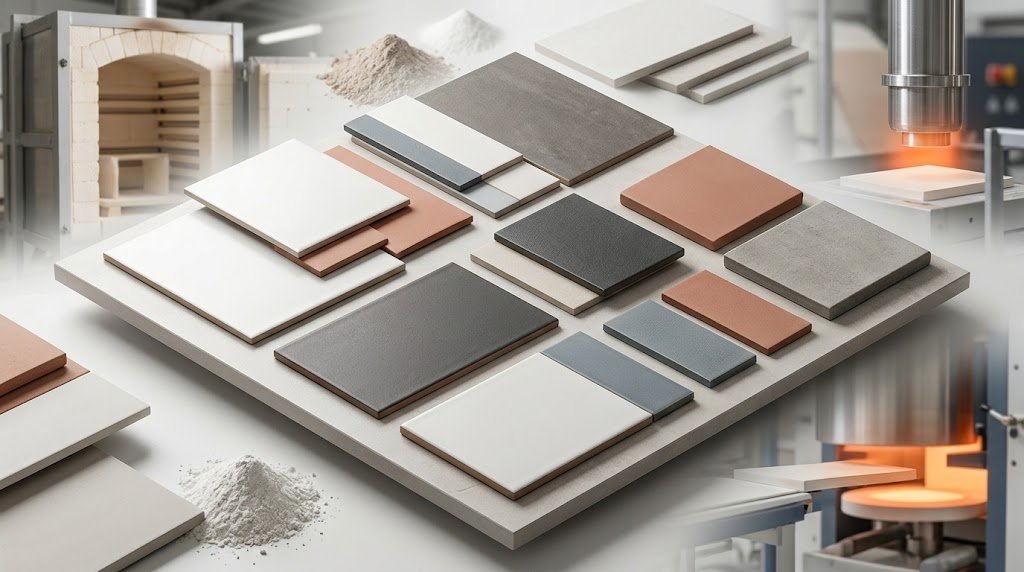
Sodiceram Tiles and Interior Surfaces
Several current sources position Sodiceram around floors, walls, kitchens, bathrooms, decorative tiles, and architectural interiors.
For these applications, evaluate:
- Water absorption
- Slip resistance
- Abrasion resistance
- Thickness
- Surface finish
- Installation requirements
Construction and Architecture
Some websites describe Sodiceram as suitable for architectural surfaces, building materials, and exterior applications.
For construction, however, application-specific testing matters more than a general statement that the material is “durable.”
Industrial and Technical Uses
The online material narrative extends further into industrial machinery, chemical environments, high-temperature applications, electronics, laboratories, and engineering components.
These applications require substantially stronger evidence.
A decorative wall tile and a furnace component do not have the same performance requirements.
What Happens to Sodiceram Under Real-World Conditions?
Performance depends on the environment in which the ceramic operates.
For a bathroom, moisture, cleaning chemicals, slip resistance, and installation quality may dominate.
For outdoor paving, water absorption, frost, thermal cycling, and surface traction become more important.
For industrial equipment, the relevant variables can include thermal shock, chemical attack, mechanical loads, abrasion, and dimensional stability.
In practical use, this leads to a simple professional rule:
Define the failure conditions first, then choose the material.
A common mistake professionals see with unfamiliar materials is evaluating the marketing claim before identifying the actual operating conditions.
Sodiceram vs Traditional Ceramic
| Factor | Traditional ceramic | Sodiceram |
|---|---|---|
| Definition | Established category | Varies by source |
| Composition | Product-specific | Claimed formulations vary |
| Testing | Established testing practices | Verify exact product |
| Applications | Well documented | Application claims vary |
| Performance | Measurable | Require supporting data |
| Procurement | Comparatively straightforward | Greater verification needed |
The important advantage of traditional ceramic is predictability of specification, not automatic superiority.
Sodiceram vs Porcelain: Which Is Better?
Neither is automatically better.
Porcelain is a well-established ceramic category with extensive technical and commercial documentation.
If a Sodiceram product is offered as an alternative, compare:
- Water absorption
- Slip resistance
- Abrasion resistance
- Strength
- Thickness
- Frost resistance
- Chemical resistance
- Thermal behavior
- Installation requirements
- Price and lifecycle cost
For a bathroom, moisture and slip performance may dominate.
For commercial flooring, wear and traffic performance may matter most.
For industrial use, the comparison must be much more technical.
How Can You Verify Sodiceram Before Buying?
Use this eight-point verification process:
1. Identify the entity.
Is it a company, product, technology, or simply an online description?
2. Identify the manufacturer.
Do not rely solely on the product name.
3. Find the product number.
A genuine commercial product should normally be identifiable.
4. Request technical documentation.
Look for a technical data sheet and installation instructions.
5. Check standards and certification.
Determine which standards apply to the intended use.
6. Request test results.
Especially for unusual performance claims.
7. Compare alternatives.
Use the same performance criteria for porcelain and established ceramic products.
8. Calculate lifecycle value.
Consider installation, maintenance, replacement, and expected service life.
Common Sodiceram Misunderstandings
“Sodiceram is definitely a new scientific ceramic category.”
Current evidence does not establish that as a universal definition.
“The name proves it contains sodium.”
The sodium connection is frequently claimed online, but the exact composition of a verified commercial Sodiceram product needs documentation.
“Sodiceram is automatically stronger than porcelain.”
No reliable universal comparison can be made without product-specific test data.
“Sodiceram is definitely the same company everywhere online.”
No. Historical company records and current material descriptions represent different evidence contexts.
“Lots of websites confirm it.”
Many current articles repeat similar claims, but independent corroboration is limited.
Is Sodiceram Worth It?
That depends entirely on which Sodiceram you mean and what you need it to do.
For a ceramic surface, compare the specific product against established ceramic and porcelain alternatives.
For an engineering application, demand technical documentation and independent testing before accepting claims about exceptional performance.
A useful decision formula is:
Verified identity + measurable specifications + appropriate testing + application fit + lifecycle cost
If one of those elements is missing, confidence in the purchase should decrease.
What Could Change for Sodiceram in the Future?
The wider advanced-ceramics industry continues to develop new formulations, manufacturing methods, surface treatments, and energy-efficient processing.
That broader innovation provides a plausible context for why Sodiceram is increasingly described online as a modern ceramic concept.
But future industry developments should not be presented as proof of a specific Sodiceram product.
The most meaningful change would be clearer documentation: an identifiable manufacturer, defined formulation, standardized product specifications, independent testing, and transparent certification.
Final Verdict
Sodiceram is a confusing but increasingly searched term because two different stories have become attached to the same name.
The historical story is relatively concrete: S O D I C E R A M was a ceramics-related company in Reims, France, and corporate records show that its liquidation ultimately closed in 2023.
The modern material story is less certain. Current websites describe Sodiceram as an advanced or sodium-enhanced ceramic with numerous performance benefits, but the available online evidence does not establish one standardized composition, manufacturer, or independent performance dataset.
So the best answer to “What is Sodiceram?” is:
It depends on the context. Verify the entity before accepting the material claims.
That distinction is the most important fact for anyone researching, buying, specifying, or writing about Sodiceram in 2026.
Read About: Simbramento: Meaning, Origins, and What’s Verified
Frequently Asked Questions About Sodiceram
What is Sodiceram?
Sodiceram is a term used online for more than one ceramics-related subject. It is associated with a historical French ceramics company in Reims and, more recently, with an alleged advanced or sodium-enhanced ceramic material whose exact composition and certification remain unclear.
Is Sodiceram a real ceramic material?
A standardized material called Sodiceram is not clearly established by the evidence currently available online. Numerous websites describe it as an advanced ceramic, but a clearly identified manufacturer, standardized formulation, and independent technical dataset have not been established.
Is Sodiceram the same as the Sodiceram company in France?
Not necessarily. Historical records document S O D I C E R A M as a ceramics-related company in Reims, while modern websites use Sodiceram as a material or technology name; these references should not be assumed to represent the same entity.
Is Sodiceram better than porcelain?
There is not enough verified product-specific evidence to make that claim. Porcelain is an established ceramic category, so any Sodiceram product should be compared using measurable specifications such as water absorption, abrasion, slip resistance, strength, thermal behavior, and chemical resistance.
How can I verify a Sodiceram product?
Ask for the manufacturer, product number, technical data sheet, applicable standards, and independent test results. If a seller cannot provide evidence for major claims such as exceptional heat resistance, low porosity, or industrial chemical resistance, those claims should be treated cautiously.
